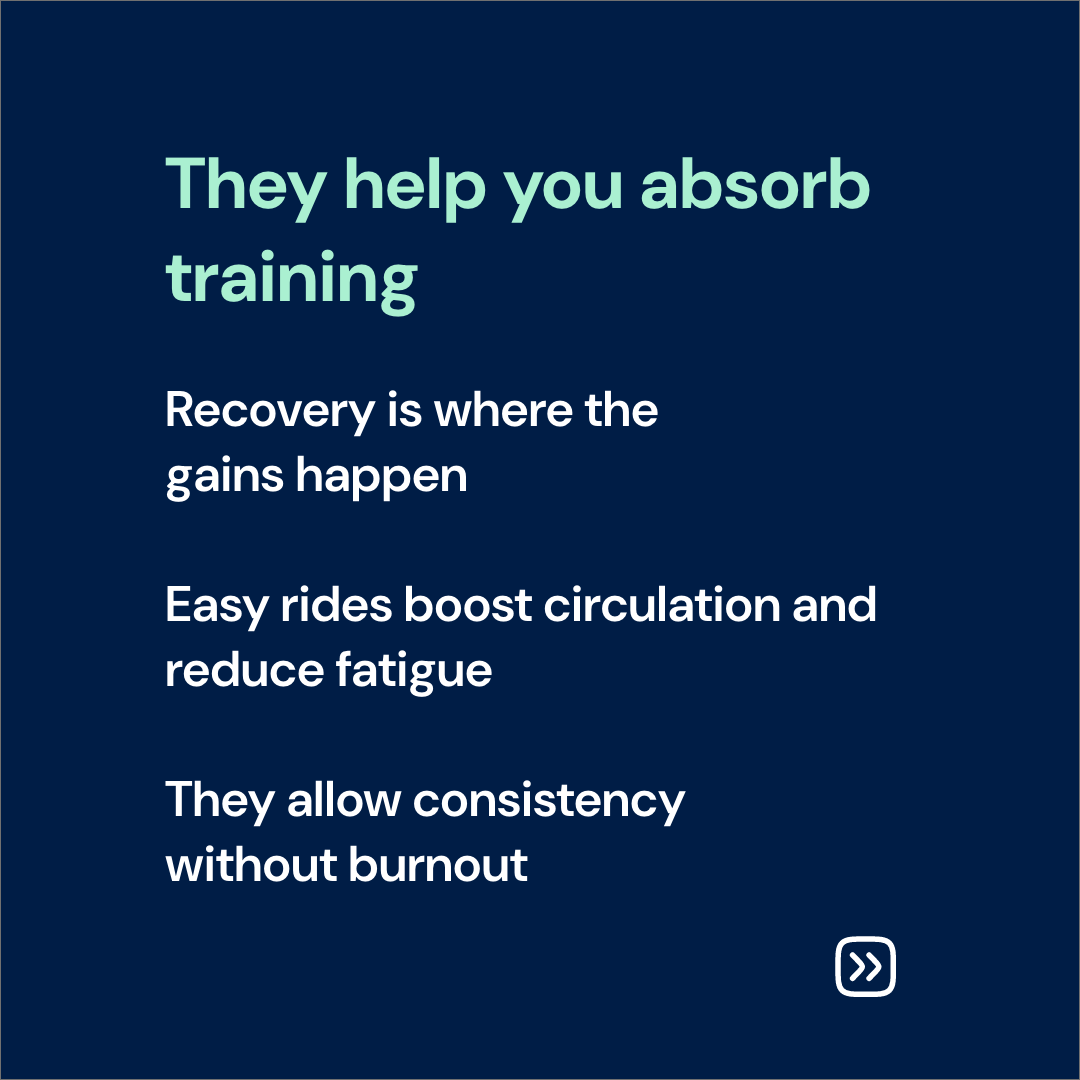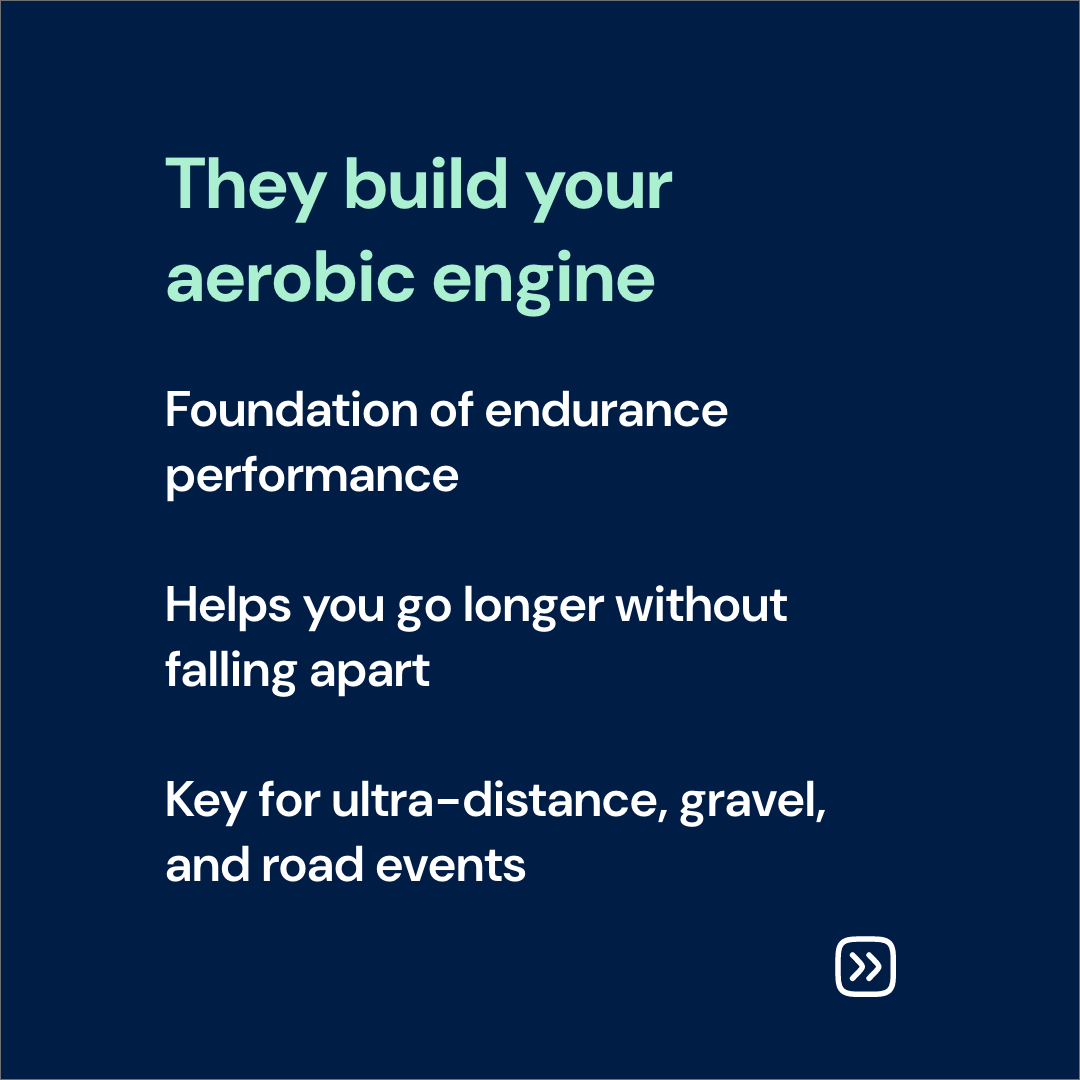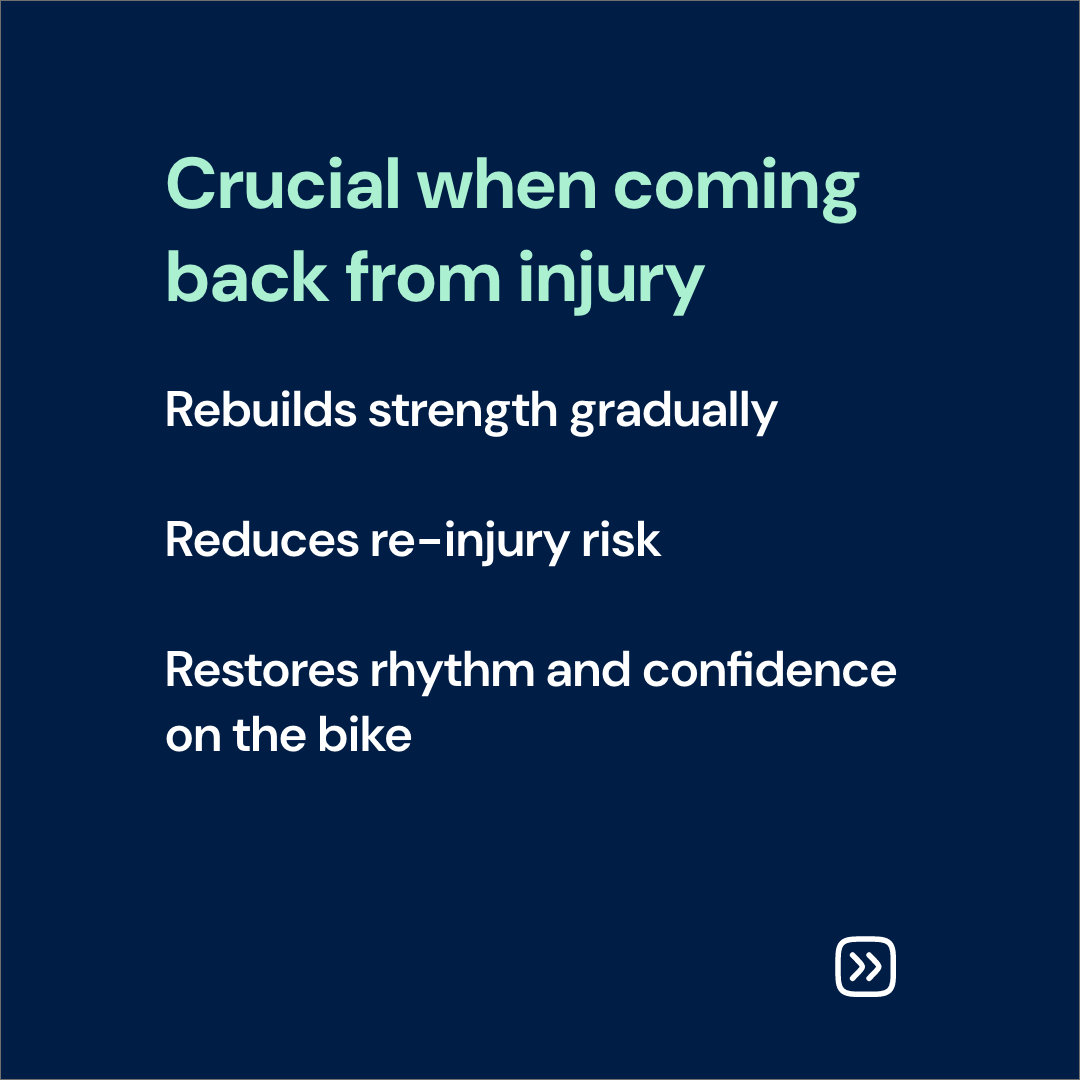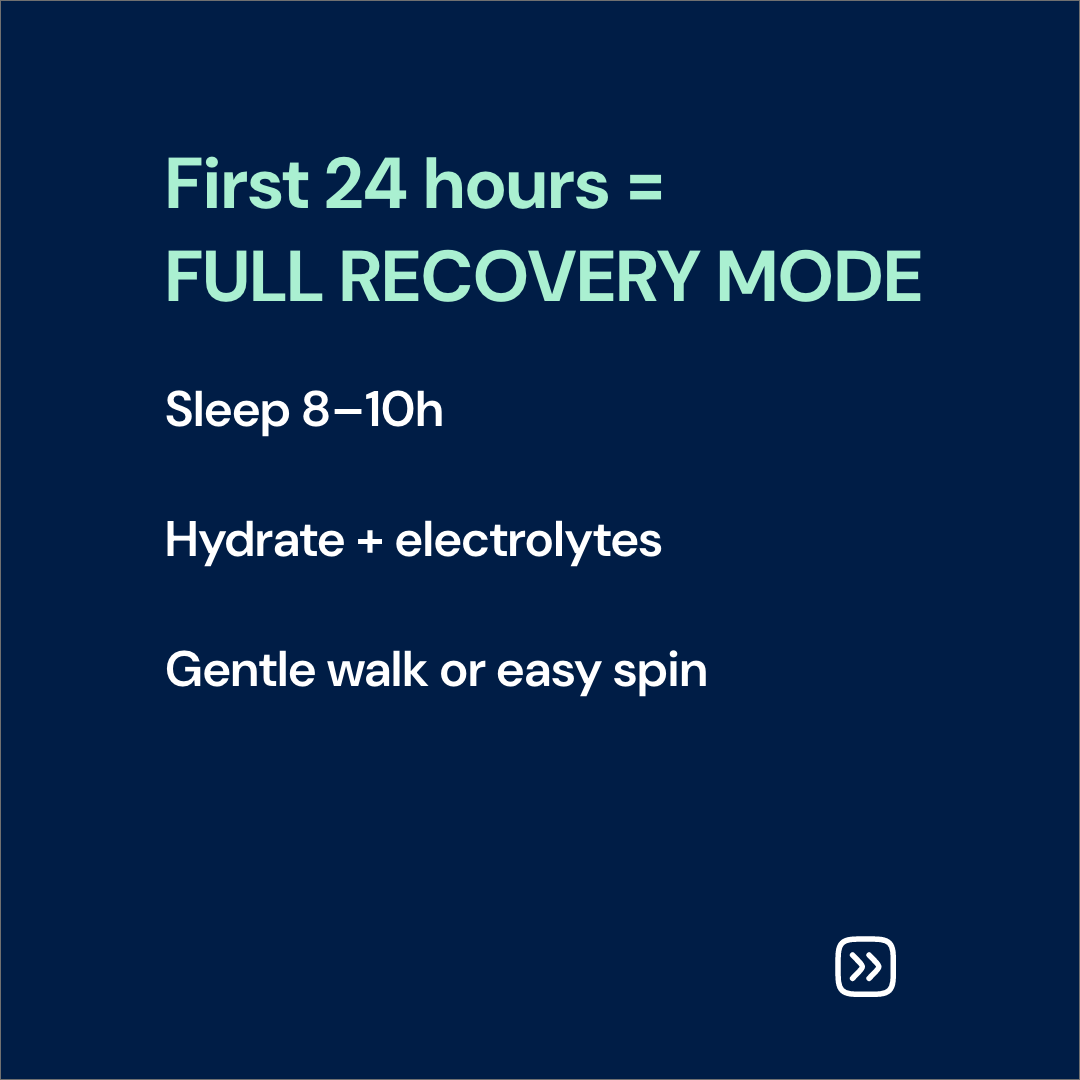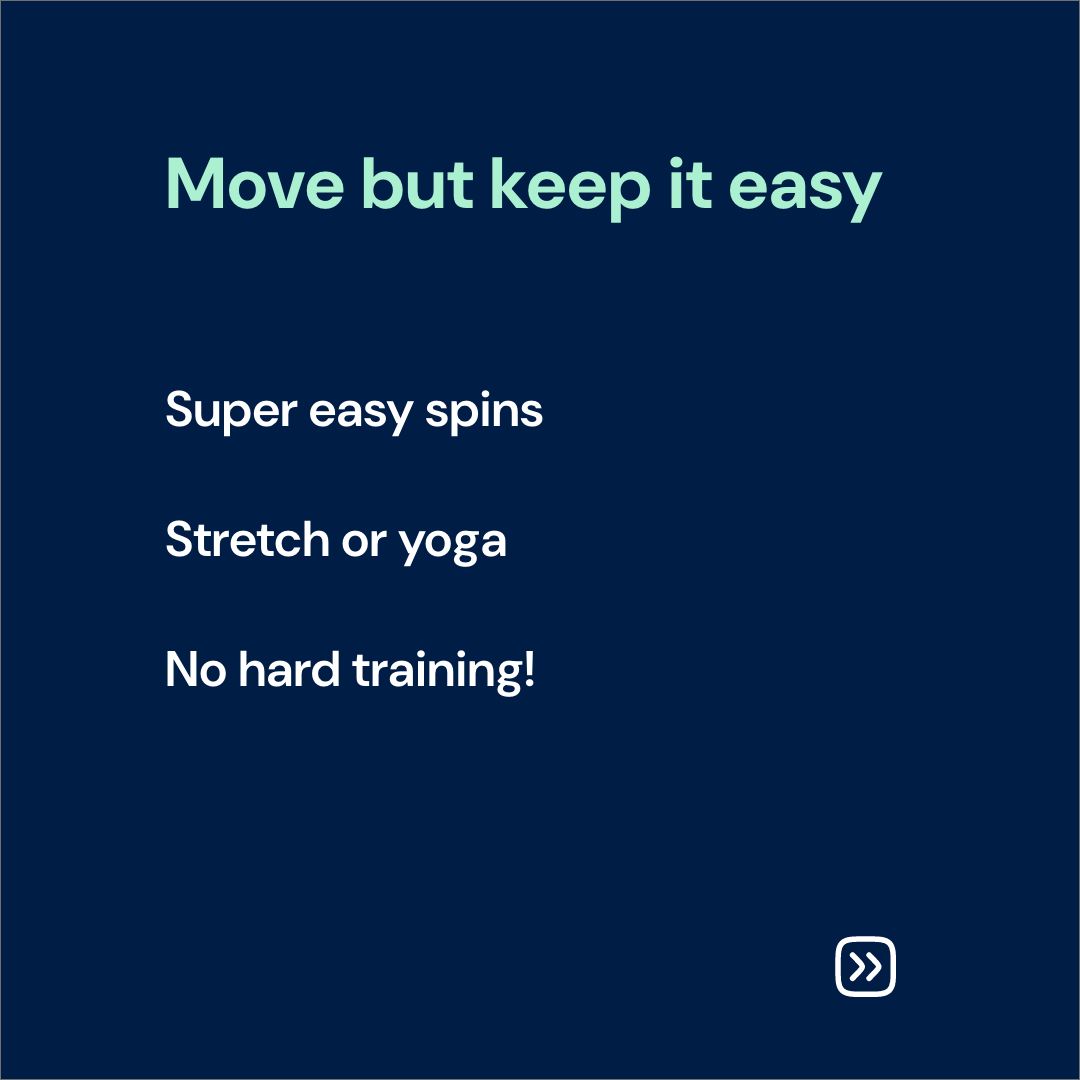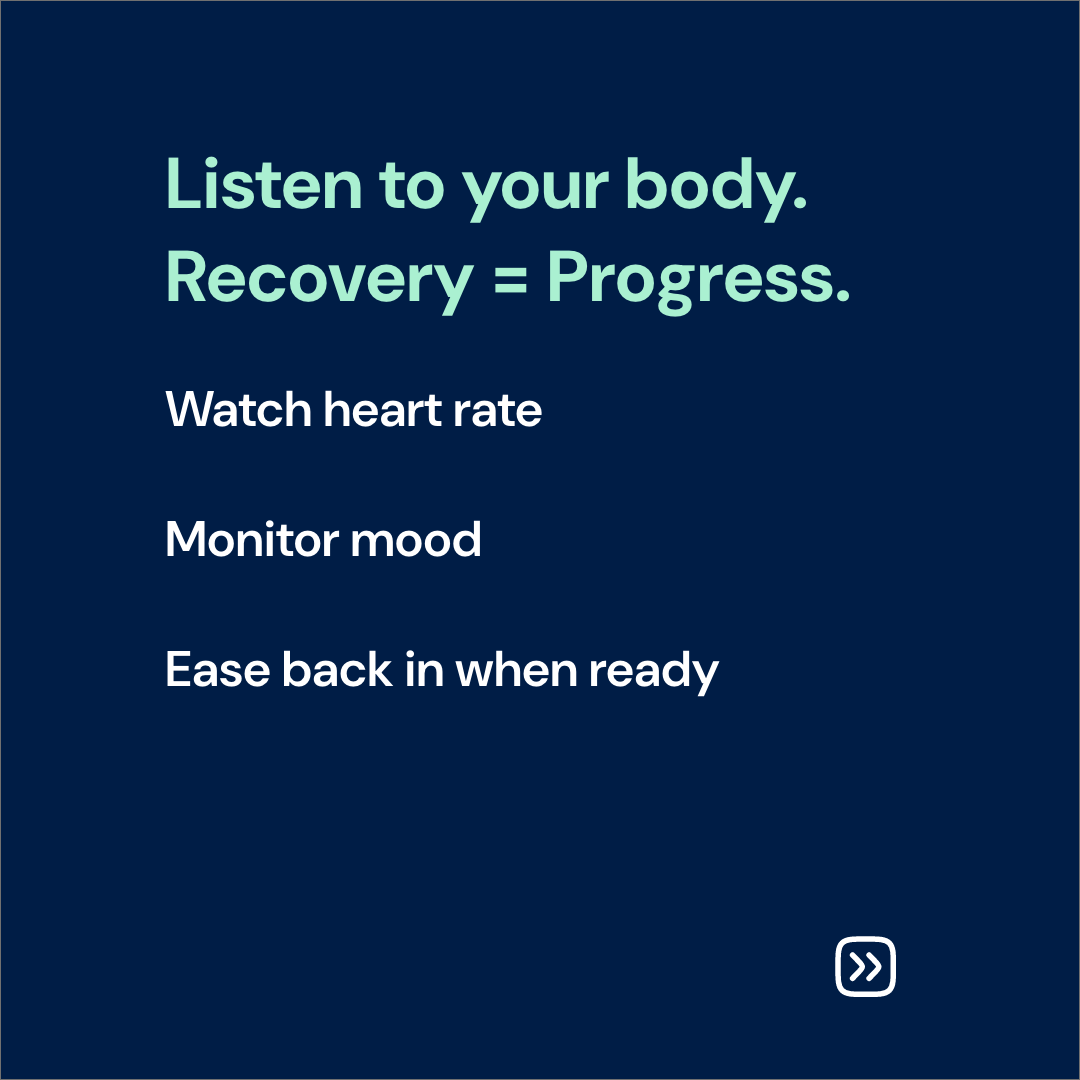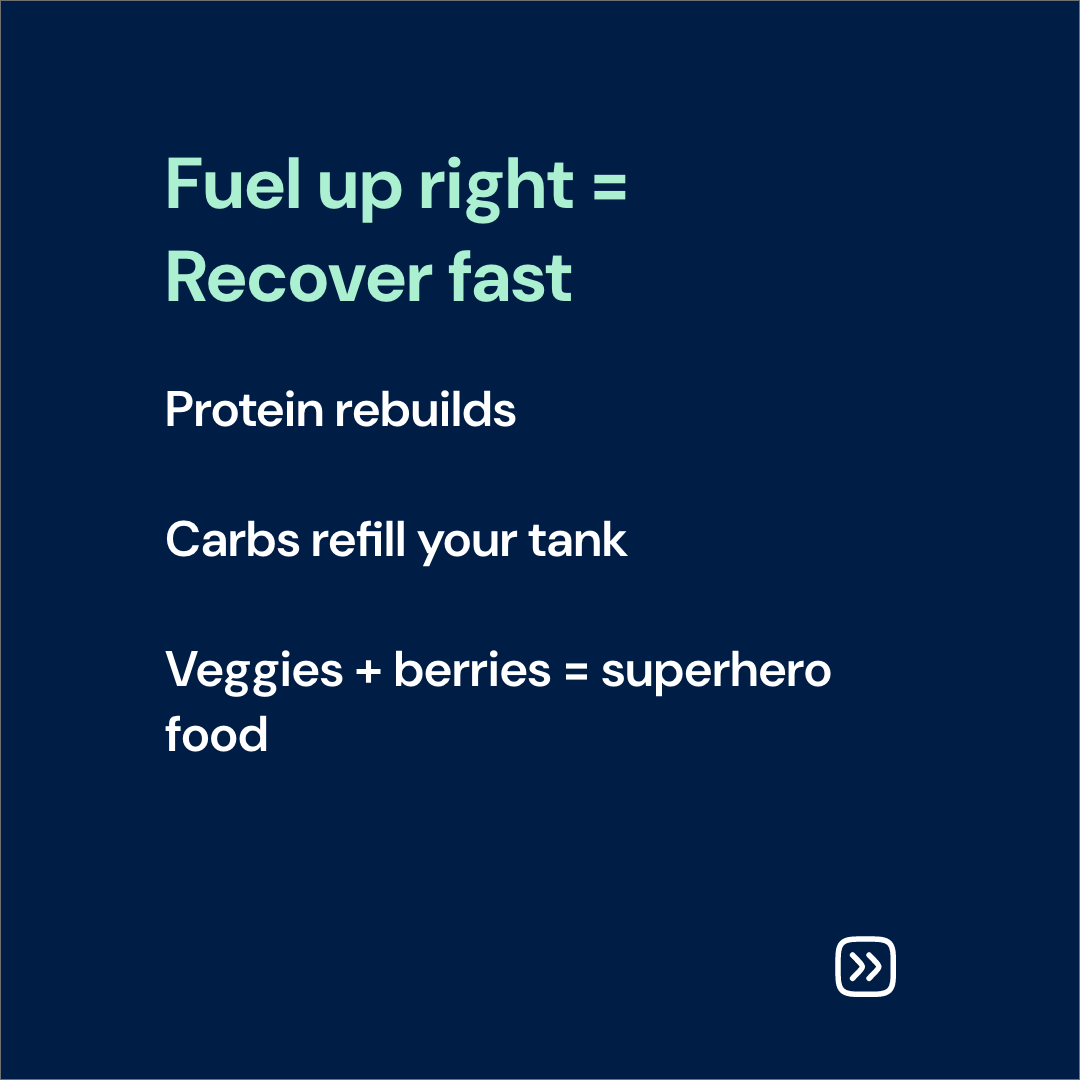

The evidence-based guide to getting faster when it's cold
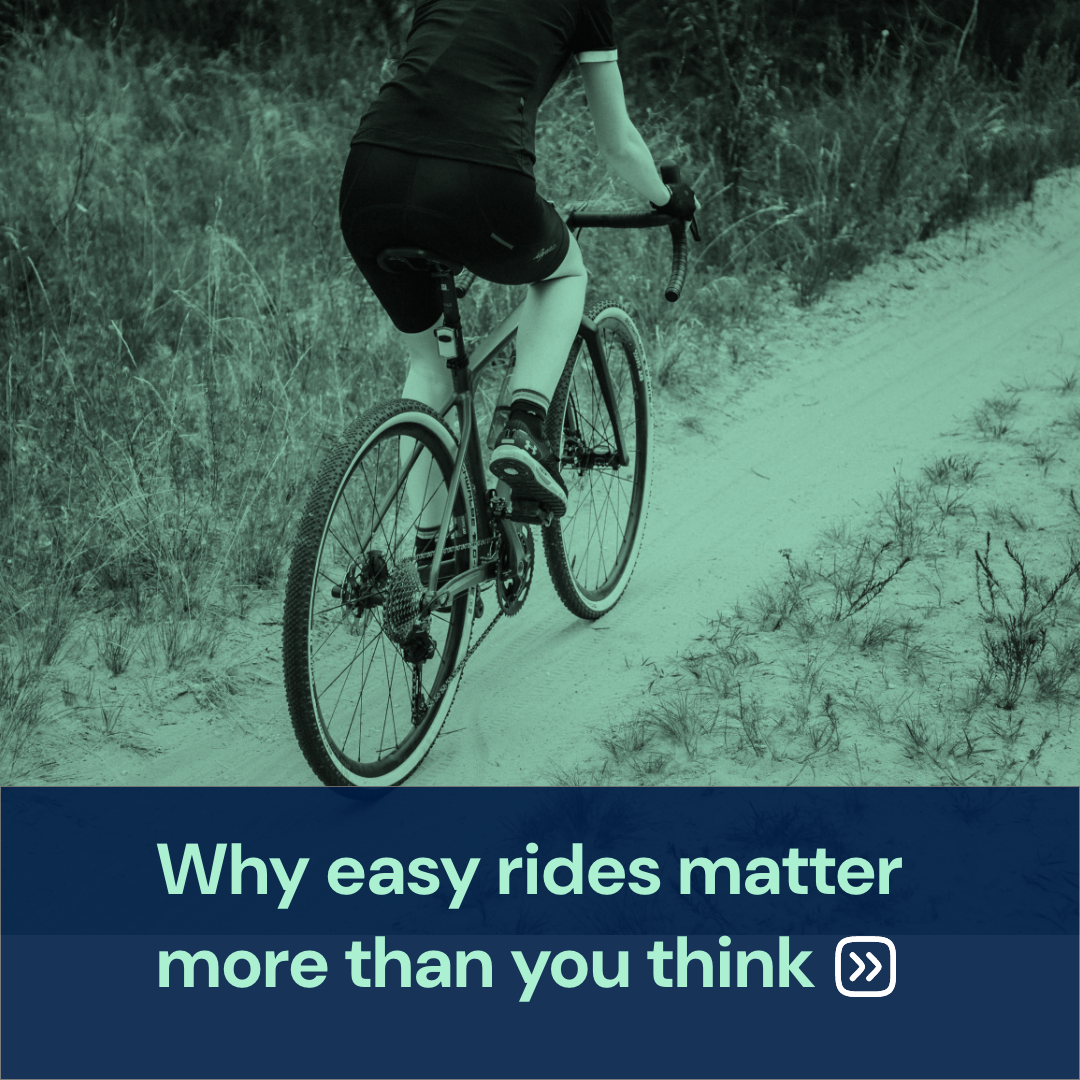
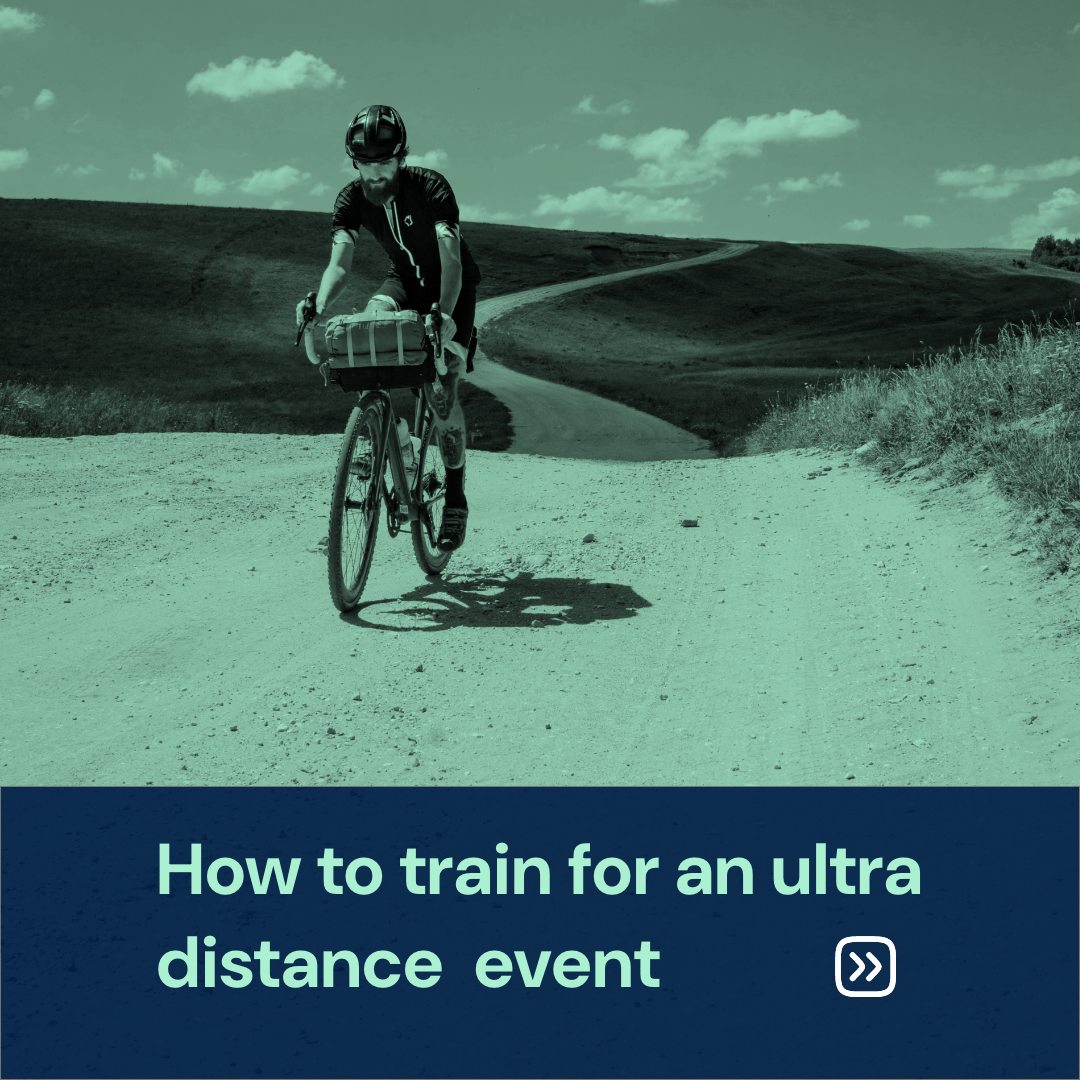
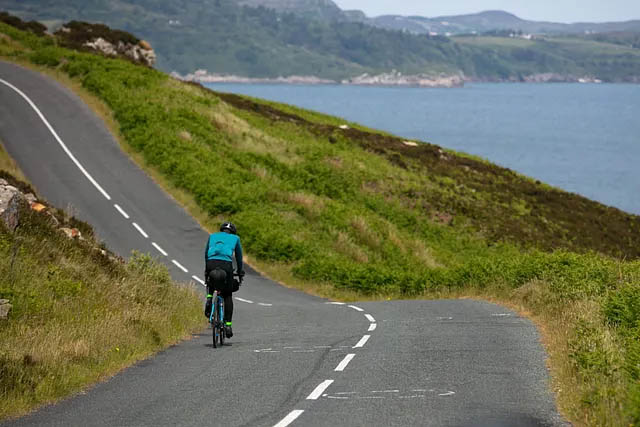
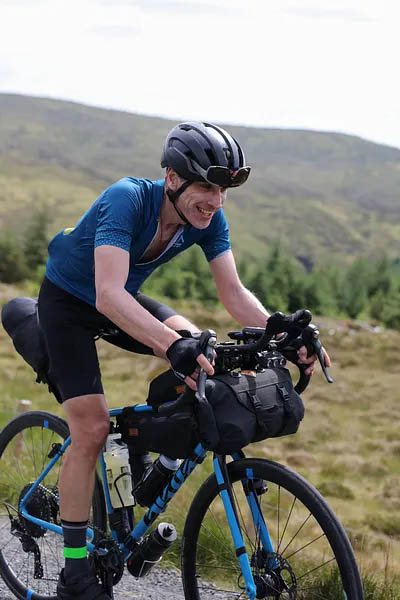
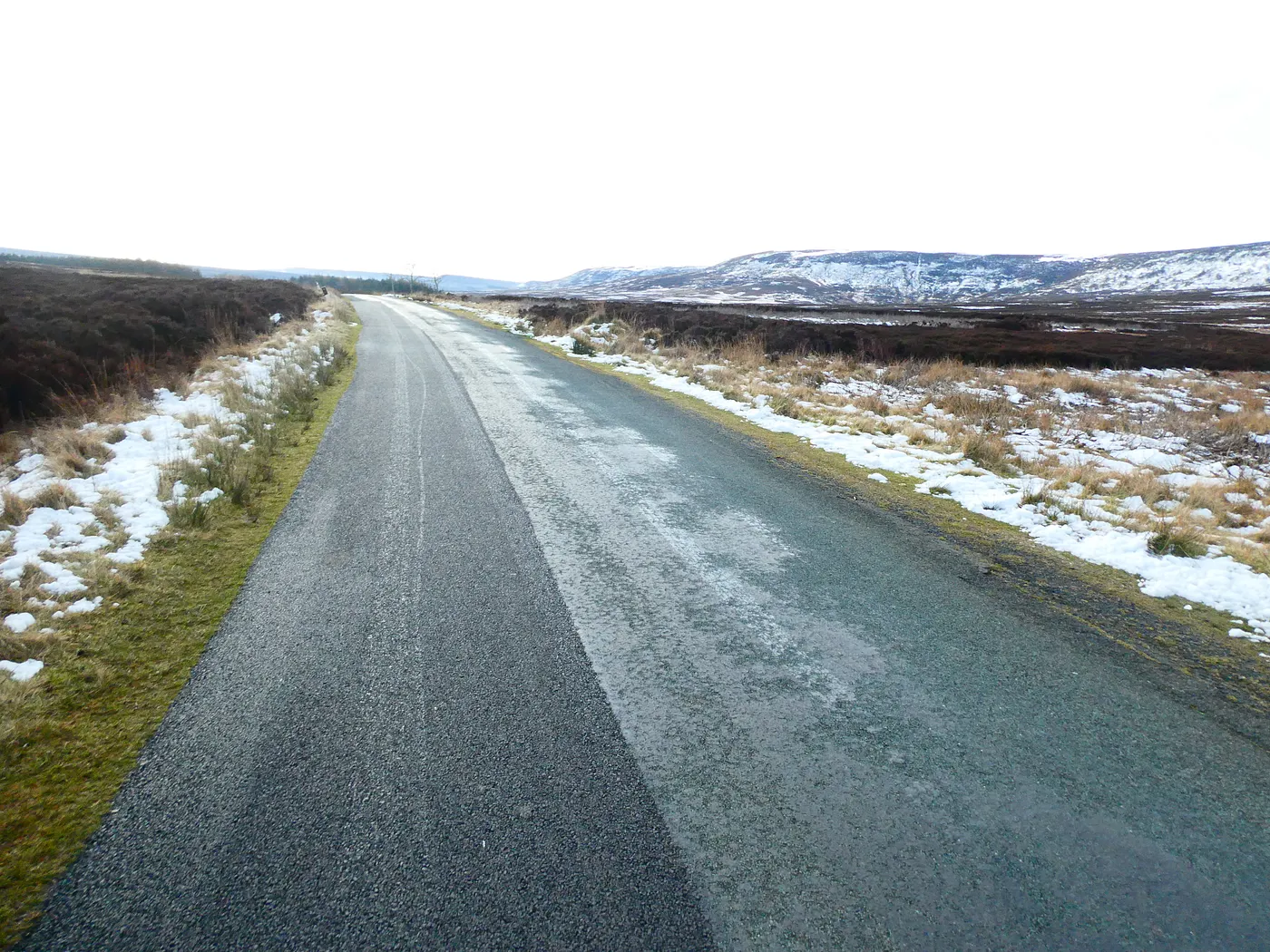
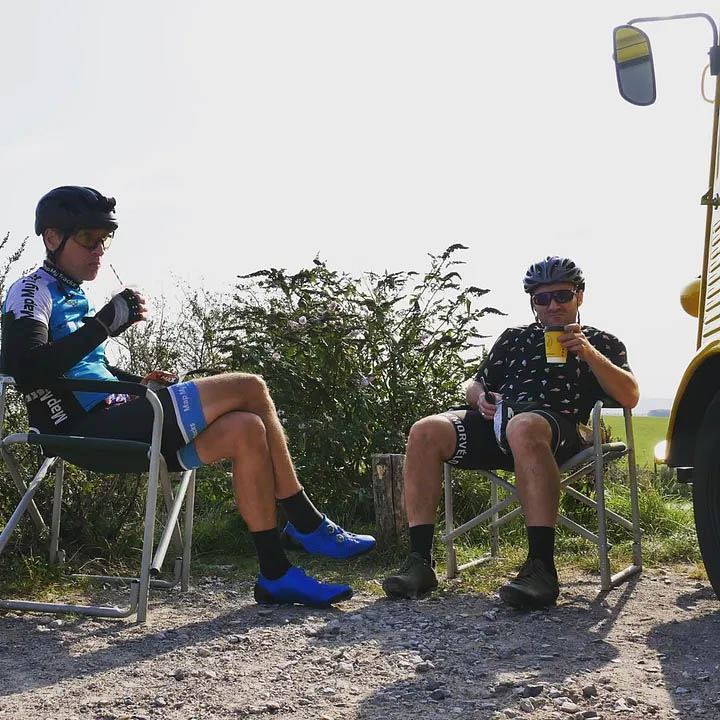
Cyclist wearing thermal cycling bibs and winter kit riding in cold weather conditions
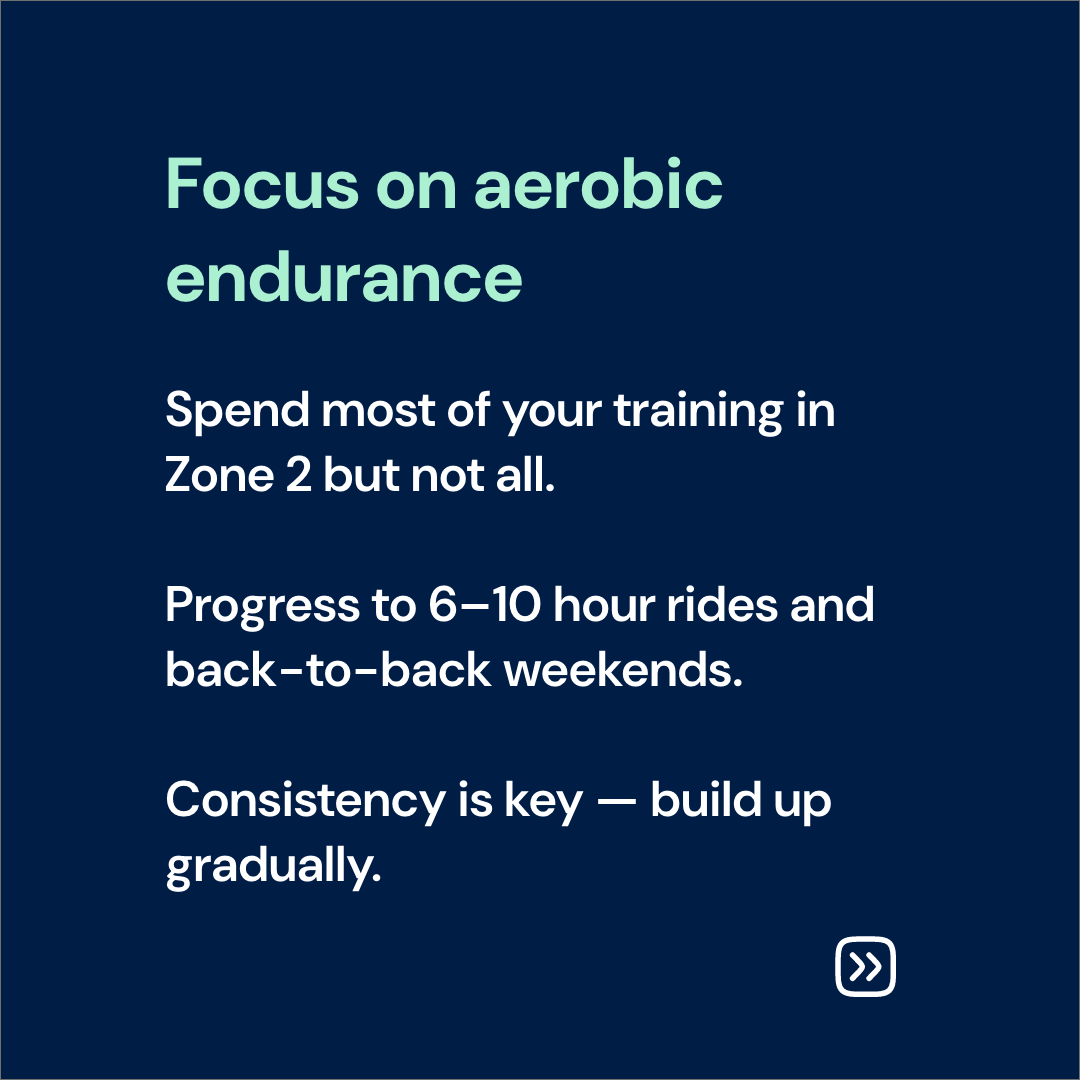
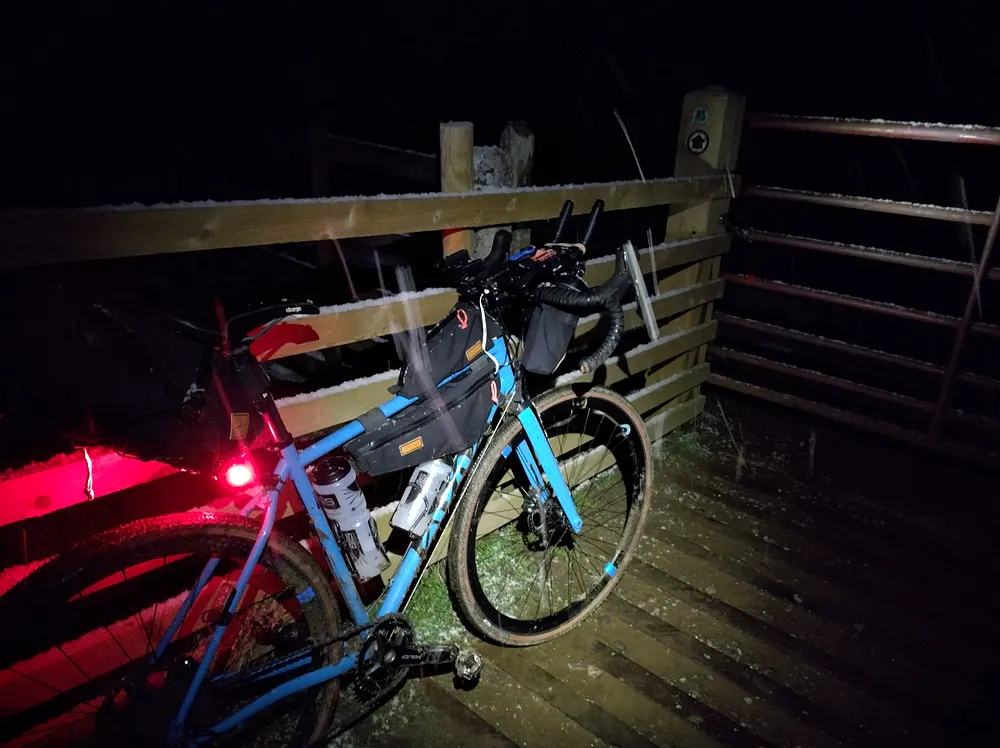
Cyclist performing high-intensity interval training on winter road
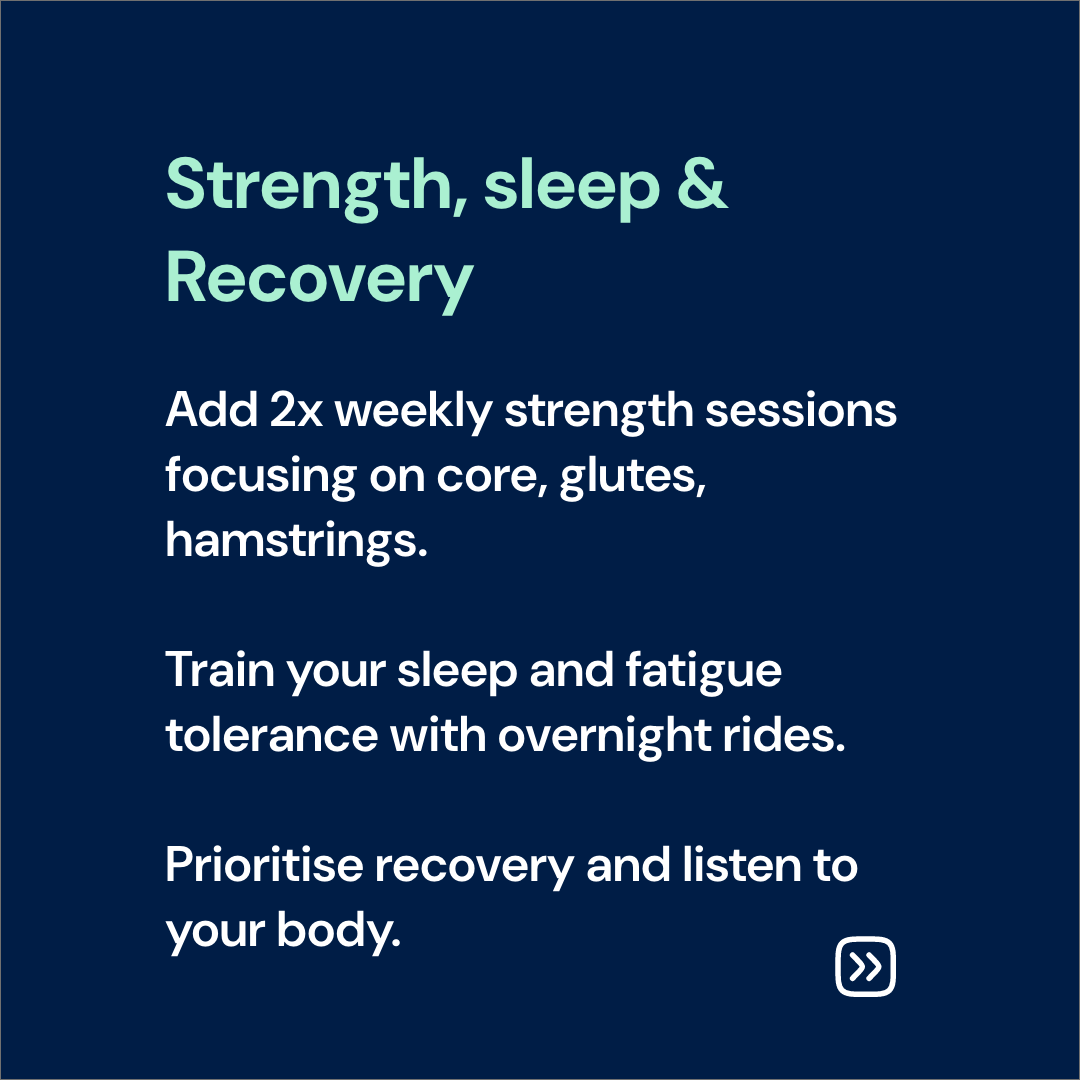
Cyclist stopping ride due to cold conditions, checking temperature or adding layer
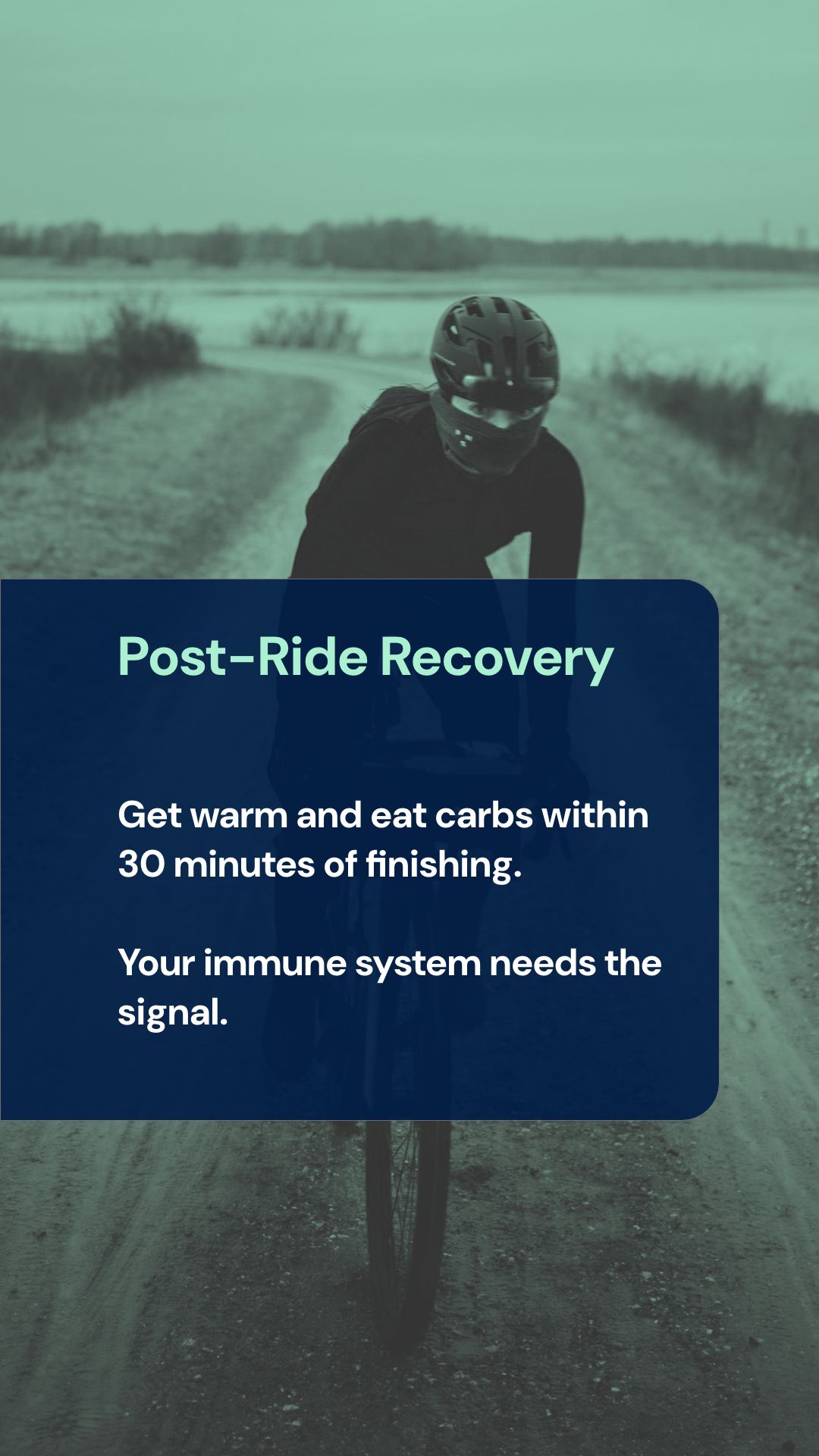
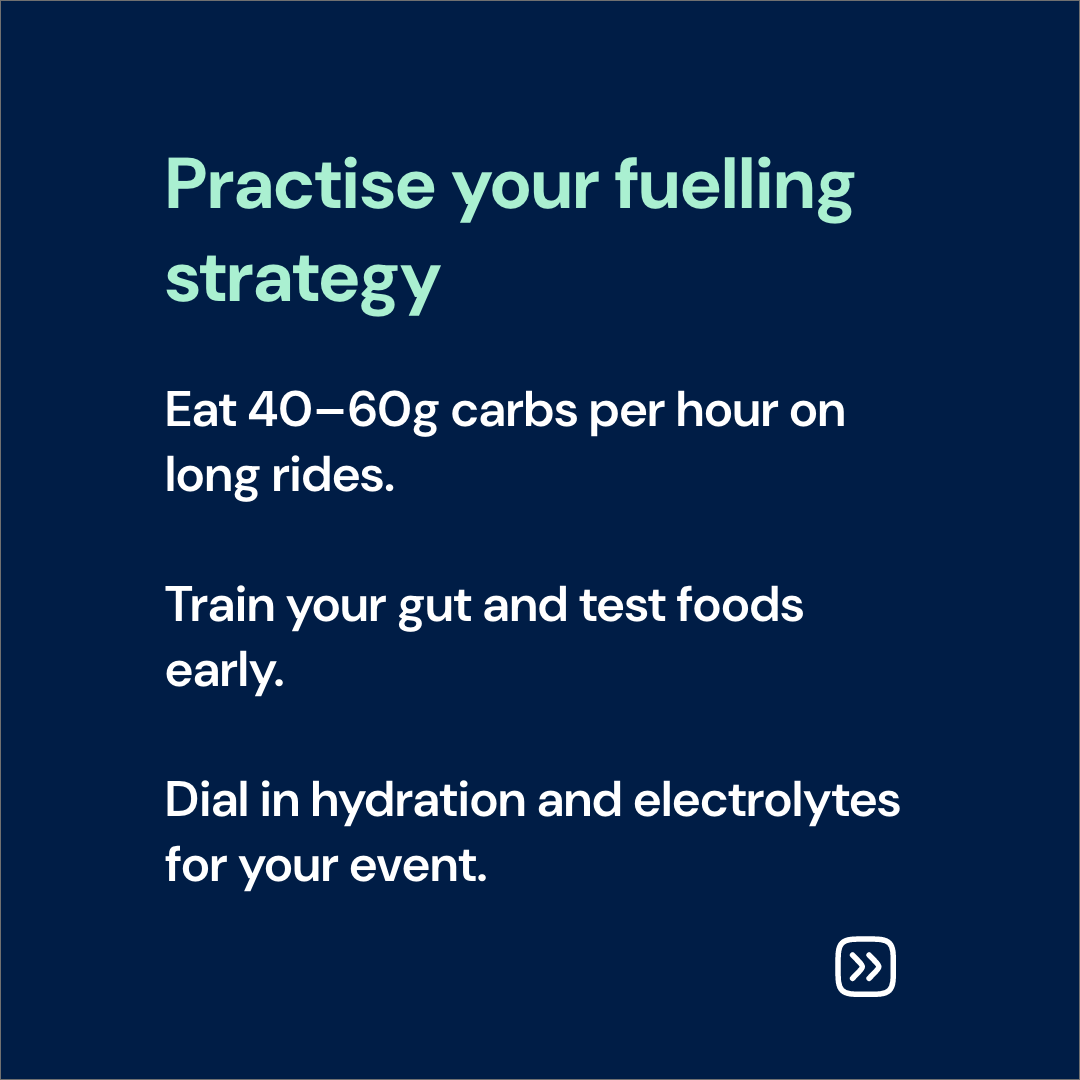
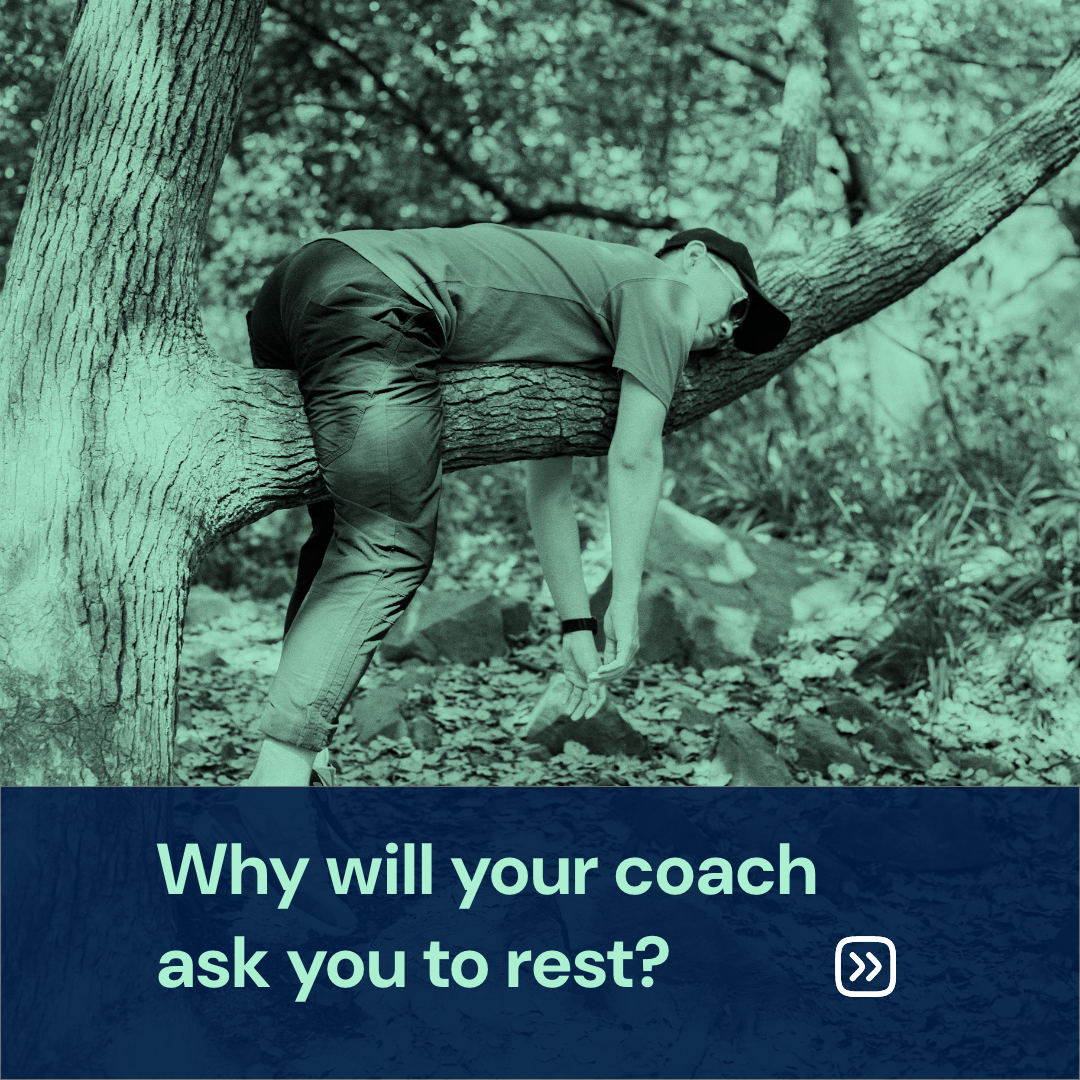
Cyclist warming up indoors after winter ride with recovery drink and food
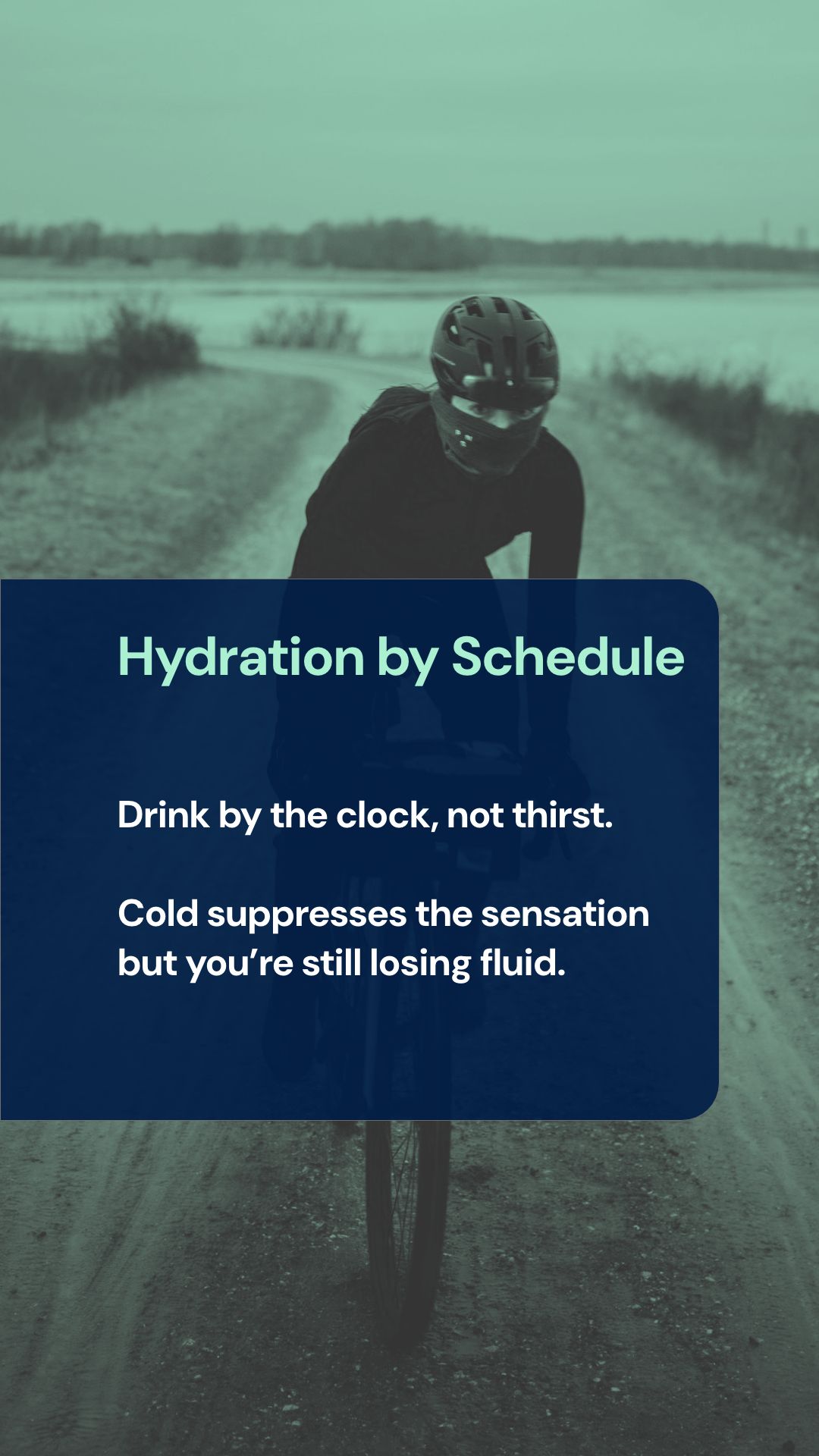
Cyclist drinking from water bottle during cold weather training ride
Boundary working with time crunched cyclists

Winter Cycling Training: The Evidence-Based Guide to Getting Faster When It’s Cold

Stop grinding through winter base miles. Research shows you can maintain and even improve fitness with less volume using block periodisation, proper thermal kit, and strategic recovery protocols.
Coaching & training plans
Personalised coaching and training plans available from £60/month

Why Winter Training Actually Matters

Most cyclists treat winter as something to survive. Get through December to February without losing too much fitness, then rebuild in spring. I used to think the same way, grinding through endless base miles in the Kent rain. That's backwards.

This is especially true if you're training for ultra-distance events. Riders planning a 300km audax in July or a multi-day tour in August often panic about winter volume. They think they need those long base miles now or they'll never be ready. The research suggests otherwise.

Winter isn't a holding pattern. It's an opportunity to train in ways that simply don't work in summer. The cold acts as a physiological stimulus. Shorter days force you into time-efficient training blocks. And while other riders are doing slow miles in poor conditions, you can be doing the work that actually maintains your top-end fitness.

The research backs this up. More importantly, it works in practice for riders targeting everything from century rides, L'Etape du Tour or  Paris-Brest-Paris. Here's what you need to know.

Keep Your Muscles Warm (This Isn't About Comfort)

What to wear

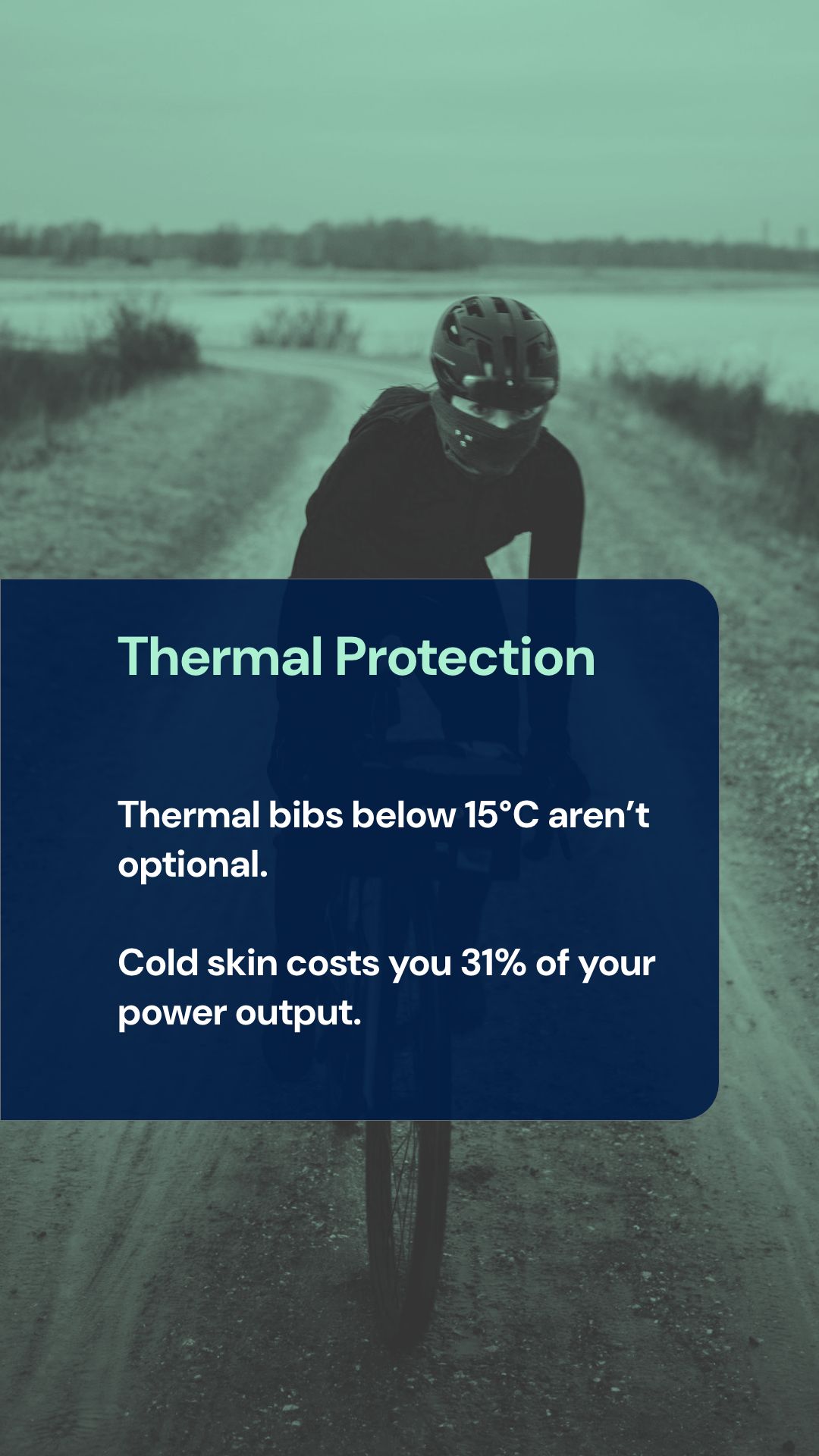
Below 15°C, you need thermal bibs. Not summer bibs with leg warmers. Proper thermal bibs with a fleece lining. Below 10°C, add knee warmers over the top. Yes, over thermal bibs. The knee joint haemorrhages heat. Below 5°C, you want overshoes as well. Numb toes aren't just uncomfortable, they're a sign you've lost power output.

One more thing. Overdress your legs, underdress your torso. Your core generates heat. Your legs don't, not enough anyway. This took me a while to learn properly. In British winter, where the damp cold finds every gap in your kit, getting the layering right makes the difference between a quality session and just suffering.

Why this matters

Stephen Cheung's lab at Brock University found something remarkable. When your skin gets cold, even if your core temperature stays normal, your time to exhaustion drops by 31%. Not a few per cent. Thirty-one. The mechanism is straightforward. Cold skin slows nerve conduction velocity. Your brain limits how many muscle fibres it recruits because it's trying to conserve heat. You're not weak. You're mechanically limited.

Keep your muscles at operating temperature and you keep your power output. It's that simple.

Common mistakes

The biggest one? Comparing your winter watts to summer numbers. Riders panic when they see lower power numbers in January and assume they're losing fitness. Stop it. You're fighting increased air density in cold weather, which creates more aerodynamic drag. Add road resistance and usually a headwind, and your normalised power tells you nothing about fitness in January.

A better measure? Look at your power-to-heart-rate ratio. If that's stable across the season, your fitness is fine. The lower absolute numbers are environmental, not physiological.

Second mistake: thinking you'll warm up once you're going. You won't. Not properly. If you leave the house underdressed, you'll be underdressed for the entire ride. Third: numb extremities. If you can't feel your toes or fingers, you've already gone too far. Turn around.

Train in Blocks, Not Lines

The protocol

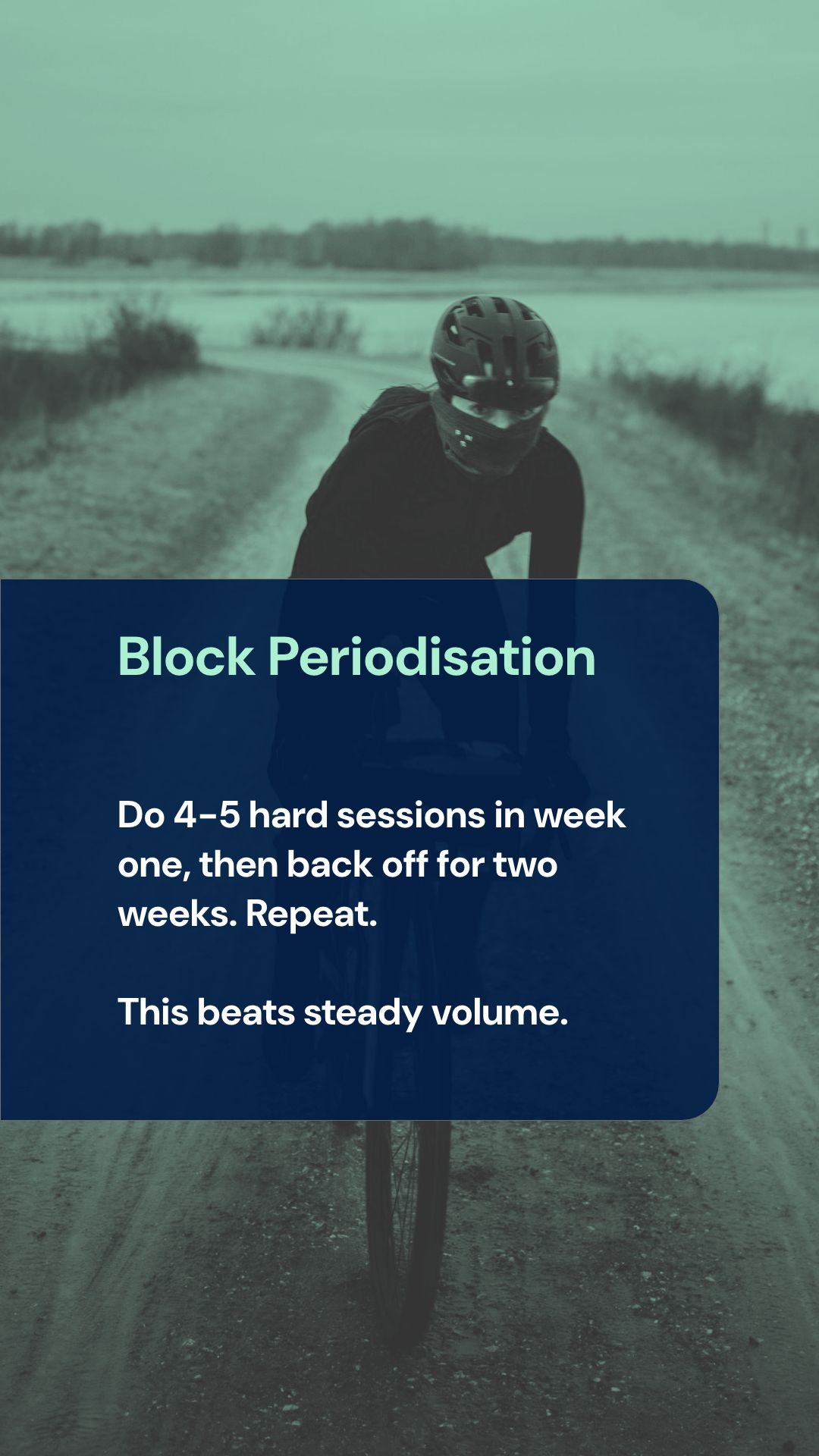
Here's what actually works when you've only got six to eight hours a week. Week one: four or five hard sessions. Intervals, tempo, threshold work. Doesn't matter hugely which, as long as it's quality. Weeks two and three: one hard session per week. The rest is easy or recovery. Properly easy, not "I'm just going to push this climb" easy. Then repeat the three-week cycle.

That's it. No complicated periodisation charts. No spreadsheets. Just three weeks of very different training stress.

Why this works

Bent Rønnestad's research group in Norway tested this exact protocol against traditional training. Same total volume. Same total intensity. Just organised differently. The block periodisation group improved VO₂max by 4.6%. Power output at lactate threshold went up 10%. The traditional group, spreading their intensity evenly across the month, saw no significant changes at all.

The theory is something called cumulative fatigue and delayed adaptation. You hammer yourself for one week, which creates a significant training stress. Then you back right off, which allows the adaptation to express itself. The traditional approach never creates enough stress to force adaptation, but also never allows enough recovery to realise it.

Winter makes this practical. You can do your hard week when conditions are good. Then when the weather turns awful, you're in your recovery weeks anyway.

What this means for ultra-distance training

This is where riders planning long summer events often get it wrong. If you're targeting a 300km audax in July, a LEL in August, or any multi-day tour, you're probably panicking about winter volume right now. You think you need to be doing 15-20 hour weeks in December to build the base for summer.

You don't. What you need in winter is to maintain your ability to produce steady power. That's intensity work, not volume. If you're only riding six hours a week through winter using block periodisation, you'll produce superior adaptations compared to grinding out twice that volume in poor conditions. The fitness you're building now is the foundation for the volume you'll add in spring.

Quality beats quantity. Always has, but especially when conditions limit your training time. For ultra-distance events, winter is about maintaining your ceiling and your steady-state power. The long rides come later, when you've got daylight and better conditions. Riders doing 15 hours of slow winter miles are getting some fitness benefit, but far less return per hour invested. More importantly, they're often arriving at spring tired rather than ready to build.

The volume will come. But it comes more productively when you've maintained your ability to ride at a decent intensity. That's what block periodisation preserves through winter.

Never Train Through Shivering

The hard rule

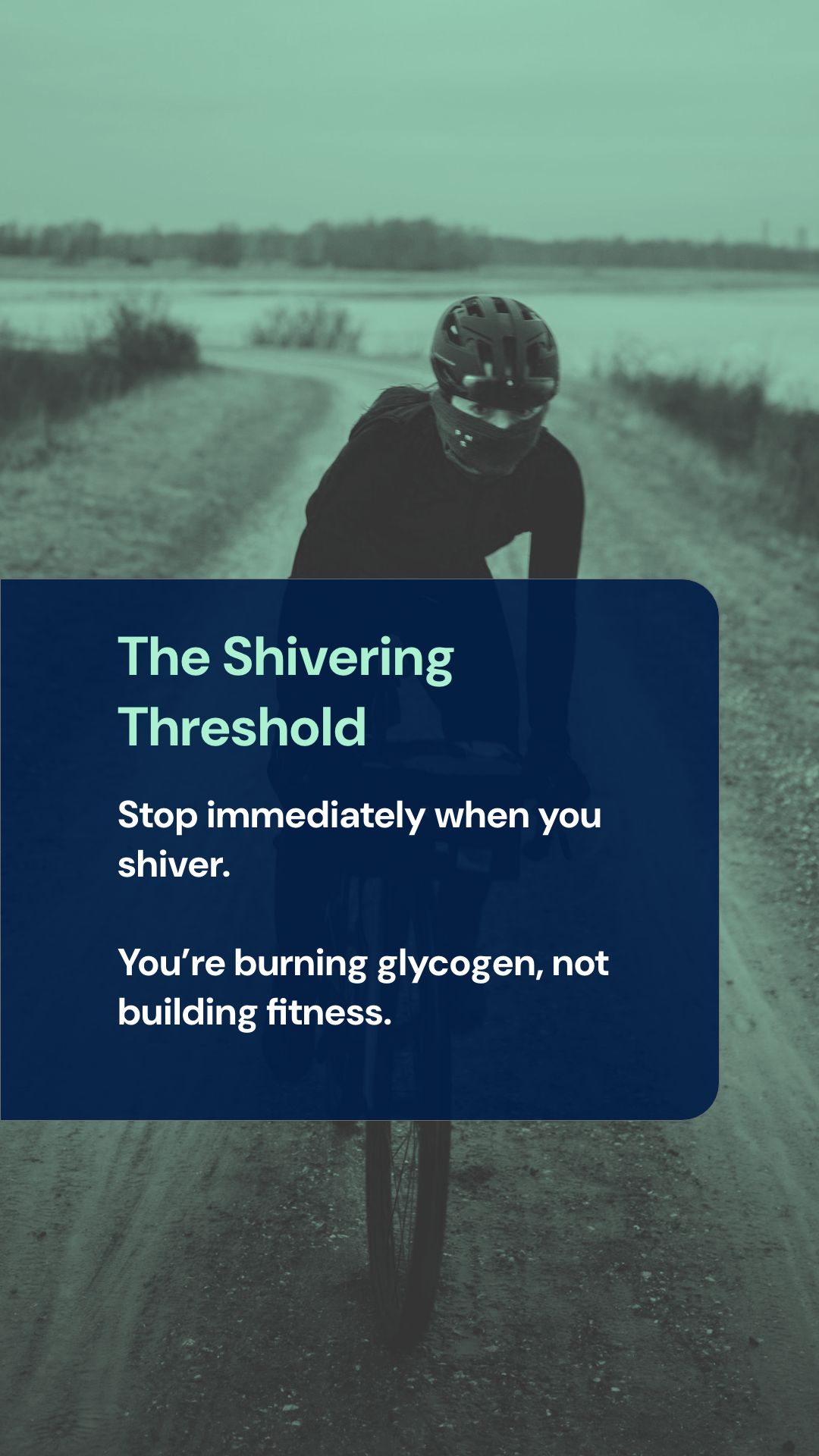
When you start shivering, the session is over. Add a layer if you've got one. Otherwise, go home. Not in five minutes. Now. If you get indoors and you're still shivering after five minutes, you stayed out too long. Learn from that.

I used to ignore this. Thought pushing through made me tougher, especially on long training rides. Then I started looking at the power files from those sessions. The last hour was always rubbish. I wasn't being tough, I was wasting time and depleting glycogen.

Why shivering changes everything

Shivering can double your metabolic rate. Sounds good, right? More energy expenditure? No. Because shivering burns glycogen, fast. It's your body's emergency heating system, and it runs on your sprint fuel. Once you're shivering, you're not building fitness. You're depleting your carbohydrate stores and sabotaging tomorrow's session.

There's another consideration. When you're not shivering but you're in cool conditions, brown adipose tissue activates. This increases your resting metabolic rate slightly and shifts fuel oxidation towards fat. But that benefit disappears completely once shivering starts. The difference between beneficial cold exposure and destructive cold exposure is whether you're shivering. That's your line.

What shivering tells you

Usually, it means you underdressed. Sometimes it means you went too long. Occasionally it means you didn't eat enough during the ride. Whatever the cause, the solution is the same. Stop. There's no toughness points for finishing an interval set while shivering. You're just making yourself slower.

For ultra-distance riders, this is particularly important. The temptation is to push through on long winter rides because you think you need the time in the saddle. You don't. Not if you're shivering. That's junk miles, and they're counterproductive.

When to Train Outside (And When Not To)

The approach

Get outside once or twice a week when conditions allow. Dry roads, daylight, temperature above freezing. Keep these rides to 60 or 90 minutes. Make them quality, not epic. Use the turbo for your longer sessions, your harder sessions, or when the weather's genuinely dangerous.

I use indoor training for structured work. No shame in that. But I also make sure to get outside when conditions are reasonable. Partly for mental health, partly because riding outdoors maintains the skills and confidence you need for longer events. There's also a physiological reason.

The cellular signal

Research from Dustin Slivka's group shows that exercising in cold temperatures, around 7°C, increases expression of something called PGC-1α. This is the master regulator of mitochondrial biogenesis. It's the genetic signal that tells your cells to build more aerobic machinery. You get this signal training indoors as well, just from the exercise itself. But the cold appears to amplify it. Think of outdoor cold training as an additional stimulus, not a replacement for structured indoor work.

The catch? This is an acute molecular response. To turn that signal into actual fitness requires consistency over weeks and months. It's not a shortcut. It's just another tool.

Be realistic about this

Don't ride in dangerous conditions chasing "cold benefits". Ice, severe cold, no visibility? Stay inside. The marginal gain from cold exposure isn't worth the injury risk or the rubbish training session. Indoor training works perfectly well. But if conditions are reasonable, getting outside adds something. Exactly how much is hard to quantify, but the research suggests it's not nothing.

In British winter, we rarely deal with extreme cold. More often it's damp, grey, and windy. Pick your days. When the roads are dry and you've got daylight, get out. When it's bucketing down and blowing a gale, that's what the turbo is for.

Get Warm Fast After Hard Efforts

The 30-minute window

As soon as you finish, get this done. Strip off immediately. Not after you've put the bike away. Not after you've checked Strava. Now. Hot shower or at least a warm room. Your core temperature needs to come back up. Eat 30 to 50 grams of carbohydrate plus 20 grams of protein. A recovery shake works. So does toast and peanut butter, or a bowl of porridge. Drink 500 to 750ml of fluid. Warm is better than cold, purely because you'll drink more of it.

Why the rush matters

Hard training temporarily suppresses immune function. Research by David Nieman and others has shown this "open window" effect clearly. Your body's first line of defence drops for several hours after intense exercise. Add cold stress on top and you've likely created a bigger immunological challenge. The faster you rewarm and get carbohydrate in, the faster cortisol drops back to baseline. That helps close the vulnerability window.

This isn't theoretical. You probably know this already if you've ever finished a hard winter ride, cooled down slowly, then been ill three days later. The connection is real. For riders training for summer events, getting ill in January or February doesn't just cost you a week. It costs you the cumulative training you'd have done across that week and the recovery period after.

The hydration trap

Here's something most cyclists don't realise. Cold air suppresses your thirst response. The hormone that makes you feel thirsty, arginine vasopressin, doesn't trigger properly in the cold. Meanwhile, you're losing fluid through respiration. Every breath out in cold air is visible moisture leaving your body. Plus cold-induced diuresis means you're losing more fluid through urination. Net result: significant dehydration without feeling thirsty.

Drink by the clock. 500ml per hour, whether you feel like it or not. If your urine isn't pale by evening, you underdrank.

What Winter Training Actually Looks Like

Forget suffering through it. Forget "just getting through to spring". Here's what working with physiology instead of against it means. You ride less than summer, but harder when you do. You dress warmer than feels necessary. You stop before you shiver, not after. You get warm and eat fast. You drink whether you're thirsty or not.

Your power numbers look lower because physics doesn't care about your feelings. That's fine. You're not racing in January. But when March arrives and everyone else is rebuilding base fitness, you've still got your top end. You can go straight into proper training, not spend six weeks remembering how to ride a bike hard.

The research shows block periodisation produces superior adaptations with the same training time. Proper thermal protection prevents a 31% power loss. Cold exposure provides an additional training stimulus for mitochondrial development. The principles work. Apply them consistently and you'll arrive at spring with your fitness intact, possibly improved.

For ultra-distance riders, this approach means you can add volume productively in spring. You haven't spent winter grinding yourself down with long, slow, cold miles. You've maintained your intensity, your steady-state power, and your ability to respond to training stress. When conditions improve and you start building towards your summer event, you're adding volume to a solid foundation, not trying to rebuild everything from scratch.

The Mistakes Everyone Makes

Chasing summer volume in winter conditions. You can't. The conditions don't allow it and your body doesn't need it. Switch to blocks. For ultra-distance riders especially, winter volume is counterproductive. Save it for spring when you can actually complete quality long rides.

Underdressing legs because your core feels warm. Your torso generates heat. Your legs don't. Thermal bibs aren't a luxury item.

Continuing when you're shivering. This is ego, not training. You're depleting glycogen, not building fitness.

Slow cool-down after hard winter efforts. Get warm within 30 minutes. Your immune system notices the difference.

Drinking only when thirsty. Cold suppresses thirst. Drink by the clock instead.

Final Thoughts

Winter training isn't complicated. It's just different. Keep your muscles at operating temperature. Concentrate your intensity into focused blocks. Stop before you shiver. Recover aggressively. Drink by schedule.

Do that and you'll arrive at spring with your fitness intact, possibly improved. The riders who ground out endless slow winter miles will be starting from scratch. Whether you're targeting a local sportive, gran fondo or an Audax, the principle is the same. Winter is about maintaining quality, not chasing quantity. The volume comes later. The choice is obvious really.

References

Nieman DC. Exercise, infection, and immunity. International Journal of Sports Medicine 1994; 15(S3):S131-S141.

Ouellet V, Labbé SM, Blondin DP, et al. Brown adipose tissue oxidative metabolism contributes to energy expenditure during acute cold exposure in humans. Journal of Clinical Investigation 2012; 122(2):545-552.

Rønnestad BR, Hansen J, Ellefsen S. Block periodisation of high-intensity aerobic intervals provides superior training effects in trained cyclists. Scandinavian Journal of Medicine & Science in Sports 2014; 24(1):34-42.

Slivka DR, Tucker TJ, Dumke C, Cuddy JS, Ruby B. Human mRNA response to exercise and temperature. International Journal of Sports Medicine 2012; 33(2):94-100.

Wallace PJ, McKinlay BJ, Coletta NA, et al. Effects of core and shell cooling on cycling time to exhaustion in the cold. Journal of Applied Physiology 2024; 136(1):66-77.

Reach out if you've hit a plateau in your training or want some help to improve your cycling performance. 💪 🚴🏼‍♂️

Coaching & training plans
Personalised coaching and training plans available from £60/month

North Cape 4000 Training: Preparing for Multi-Week Self-Supported Riding

You're registered for North Cape 4000. You're about to ride 4,000km from Rovereto to North Cape across some of Europe's finest cycling terrain. For riders stepping up from events like Paris-Brest-Paris or London-Edinburgh-London, multi-week self-supported riding offers something fundamentally different. Here's what that means for preparation.
North Cape 4000 coaching & training plans
Personalised coaching and training plans available from £60/month

You're registered for North Cape 4000. You're in good company with over 600 other riders also preparing this year. You're about to experience one of the great cycling adventures across Europe.

For riders with previous multi-week experience from events like Transcontinental Race or Trans America, you know what's coming. For riders stepping up from Paris-Brest-Paris or London-Edinburgh-London, you're entering different territory. Multi-week self-supported riding creates demands that standard ultra-distance training doesn't fully address.

That's not a problem. It's an opportunity to develop new capabilities.

What Makes Multi-Week Different

At London-Edinburgh-London, day three brings cumulative fatigue. You're exhausted, decision-making is impaired, everything hurts. The finish is 12-15 hours away. You can see the end. You push through and it's done.

At NC4000 and other multi-week events, day ten might bring that same fatigue level. You've still got a week ahead. The finish isn't 12 hours away. It's 1,000km and 6-7 days distant. The psychological demand differs fundamentally. When the finish is visible, you can push through almost anything. When it's days away and you're already deep into the effort, you need different mental capabilities.

This isn't about being tougher. It's about developing capabilities matched to sustained multi-week effort. The voice saying "why am I doing this" arrives earlier and stays longer. You're not pushing through to recovery. You're managing ongoing deficit with days still ahead. Having completed LEL doesn't automatically prepare you for this. The mental approach that works on day three of a 1,500km event requires adaptation for day ten of 4,000km when North Cape is still a week away.

That's what makes it interesting.

Training for Multi-Week Physical Capacity

Fitness matters enormously. You need genuine physical capacity to ride 4,000km in two to three weeks. But multi-week self-supported riding demands more than fitness alone.

Physical resilience over extended duration becomes important. Day three saddle discomfort is manageable. Day ten saddle discomfort after a week of cumulative irritation requires different management. Over three days, you push through knowing recovery is coming. Over two weeks, you're managing issues that may develop throughout the duration. Bike fit, nutrition strategies, equipment reliability, sleep management all take on different characteristics over extended periods. Minor irritations can become significant over two weeks.

Many riders experience their most challenging moments around day 8-10. The psychological demand differs from shorter ultras. You're deep into the effort. You're still several days from the finish. In previous ultras, the end was visible by this point. Here, you're managing the middle section of a much longer adventure.

Self-supported logistics adds another dimension. On day one, booking accommodation is straightforward. On day twelve, when you're deep into cumulative fatigue and struggling to think clearly, those same tasks require more effort. Navigation decisions, equipment maintenance, nutrition management, pacing strategy all happen whilst cognitively affected by sustained effort.

Pacing over multi-week duration requires different understanding. Week one can feel deceptively comfortable for well-trained riders. 300km days feel achievable. Individual capacity varies significantly. Elite riders from events like Transcontinental Race sustain aggressive pacing throughout. Others discover their optimal approach involves more conservative week one pacing, building reserve for later stages. Understanding your own capacity requirements for multi-week efforts differs from understanding what works over 3-4 days.

These capabilities are trainable. That's the point.

How Training Differs for Multi-Week Events

Standard ultra-distance training builds capacity for 3-4 day efforts followed by recovery. It works brilliantly for PBP, LEL, and similar events. Multi-week events (NC4000, Transcontinental Race, Trans America, Indian Pacific Wheel Race) demand sustained output for 14-20+ days with only sleep-based recovery. That requires different physiological adaptation.

Training to sustain output over extended periods with incomplete recovery requires different periodisation than training for a single multi-day effort where you push through to full recovery. The psychological preparation that works when the finish is approaching doesn't work the same way when it's still days distant. Managing logistics when fresh is straightforward. Making good decisions about navigation, accommodation, pacing, and equipment when cognitively affected by cumulative fatigue requires practised systems developed during preparation.

Equipment testing needs realistic conditions. Not "can I ride 300km on this saddle" but "what happens over 14 consecutive days with cumulative loading." Not "do my lights work" but "is my charging system reliable for two weeks." What works for four days might develop issues by day ten. Testing protocols for multi-week reliability differ from testing for shorter events.

Learning when to hold back even though you feel strong requires experience. Understanding how much capacity you actually need in reserve for later stages is counterintuitive. These are learnable skills that develop through preparation matched to the demands.

Starting preparation now (if you're registered for an upcoming edition) gives time to develop these capabilities. Waiting until a few months out and training primarily for fitness leaves gaps. Riders without multi-week experience often discover these gaps in Scandinavia, around day 8-10, when they're managing demands their training didn't fully address.

What You're About To Experience

For registered riders, you know the structure from the official website. Self-supported ride from Rovereto, Italy to North Cape, Norway. Mandatory gates at München, Berlin, Gränna, and Rovaniemi. GPS tracking throughout. Time windows for Finisher and Extra Time Finisher titles.

You've read the regulations. You understand it's an adventure structured with proper organisation. If this is your first multi-week event, what might not be immediately clear is how the experience unfolds over extended duration. How the challenges and rewards of week two differ from week one. How the mental and physical experience at day ten with days still ahead creates something different from anything shorter ultras offer.

The event organisers describe it as an experience that can "open your mind and truly change your life." They've created something well-organised with proper infrastructure and real adventure character across Europe. The route is scouted, gates are partially staffed, tracking systems work, the experience is legitimate.

Your preparation determines how you experience it. Not whether you can complete it (many riders with varied fitness levels finish), but how you navigate the challenges and appreciate the rewards.

Coaching for North Cape 4000

Coaching for multi-week self-supported events exists because riders benefit from preparation matched to what sustained multi-week riding actually entails. Fitness is essential. But the complete preparation picture includes capabilities that standard ultra-distance training doesn't fully develop.

Standard coaching for PBP, LEL, and similar events builds capacity for efforts where the finish becomes visible, where you push through to recovery. Multi-week events require additional capabilities.

Training to sustain output over 14-20+ days with incomplete recovery requires different periodisation. The psychological tools that work when the finish is 12 hours away require adaptation when it's 1,000km and 6 days away. Managing daily logistics when cognitively affected by cumulative exhaustion is trainable. Understanding when to hold back even though you feel strong requires specific knowledge about how fatigue accumulates over weeks and what capacity you need in reserve. Equipment selection and testing protocols for multi-week reliability differ from shorter events.

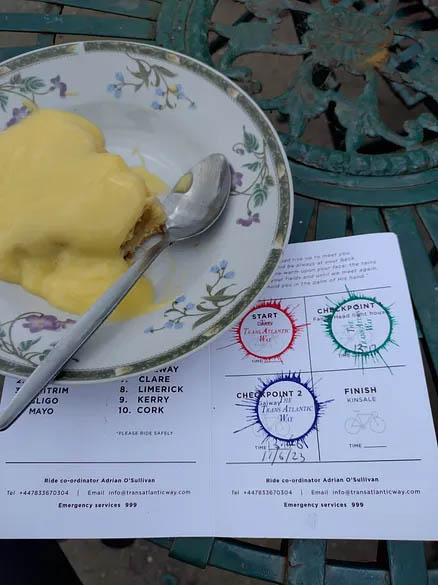
Having completed 14 ultra-distance events including 5th place at Trans Atlantic Way (1,600km self-supported across Ireland), I've experienced what multi-week self-supported events demand. The mental challenges when the finish is still days away, the logistics management under fatigue, the pacing decisions that shape how the adventure unfolds.

Preparation that addresses these elements changes the experience. Not just whether you finish (though that matters), but how you experience the adventure. Whether you're managing crises throughout or navigating challenges you've prepared for. Whether week two becomes survival mode or the continuation of an extraordinary journey.

For riders without multi-week experience preparing for NC4000, examining whether your training plan addresses fitness plus these additional capabilities is worth doing now. The difference isn't usually finishing versus DNF (though preparation affects that). The difference is often experiencing the adventure you're hoping for versus spending week two managing problems you weren't prepared for.

Contact Boundary Cycle Coach for multi-week ultra preparation. Initial consultations assess current training plans and identify where preparation for sustained multi-week efforts differs from standard ultra-distance training, specifically for riders without previous multi-week experience.

What Riders Say

Riders who complete NC4000 consistently describe it as transformative. Not despite the challenges, but partly because of them. The experience of sustained effort over two to three weeks across Europe creates something different from shorter ultras.

The physical achievement matters. Riding 4,000km self-supported is substantial. But riders often talk about the mental journey, the problem-solving under fatigue, the daily decisions about pacing and logistics, the experience of keeping moving when tired with days still ahead. The capability development that happens throughout the event.

Some bring high fitness levels. Others bring appropriate preparation for what multi-week self-supported riding entails. Often, it's the second group who describe the experience in the most positive terms. They experience the challenges they prepared for rather than discovering gaps during the event.

The organisation has created something well-structured with proper infrastructure. The adventure itself is extraordinary. Your preparation determines how you experience it.

The Adventure Ahead

Over 600 riders are confirmed for the next edition. Some have completed multi-week events before. Others are stepping up from 3-4 day ultras. All are training hard, building fitness, preparing physically.

For riders without multi-week experience, the question is whether preparation addresses what happens throughout sustained multi-week effort. Not just physical capacity (which is essential), but the mental capabilities for when the finish is still days away. The practised systems for managing logistics under cognitive fatigue. The understanding of pacing over extended duration. The equipment testing for multi-week reliability.

Standard ultra-distance training prepares you well for 3-4 day events. Multi-week self-supported events add dimensions that PBP or LEL training addresses partially. The event organisers have created something well-organised with proper infrastructure and real adventure character. Your preparation shapes your experience. Not just whether you complete it, but how you experience one of cycling's great adventures across Europe.

You're about to ride from Rovereto to North Cape. That's extraordinary. Preparation matched to what that actually entails makes it more extraordinary, not less.

Reach out if you've hit a plateau in your training or want some help to improve your cycling performance. 💪 🚴🏼‍♂️

North Cape 4000 coaching & training plans
Personalised coaching and training plans available from £60/month
Science of digestive resilience in ultra-distance riding
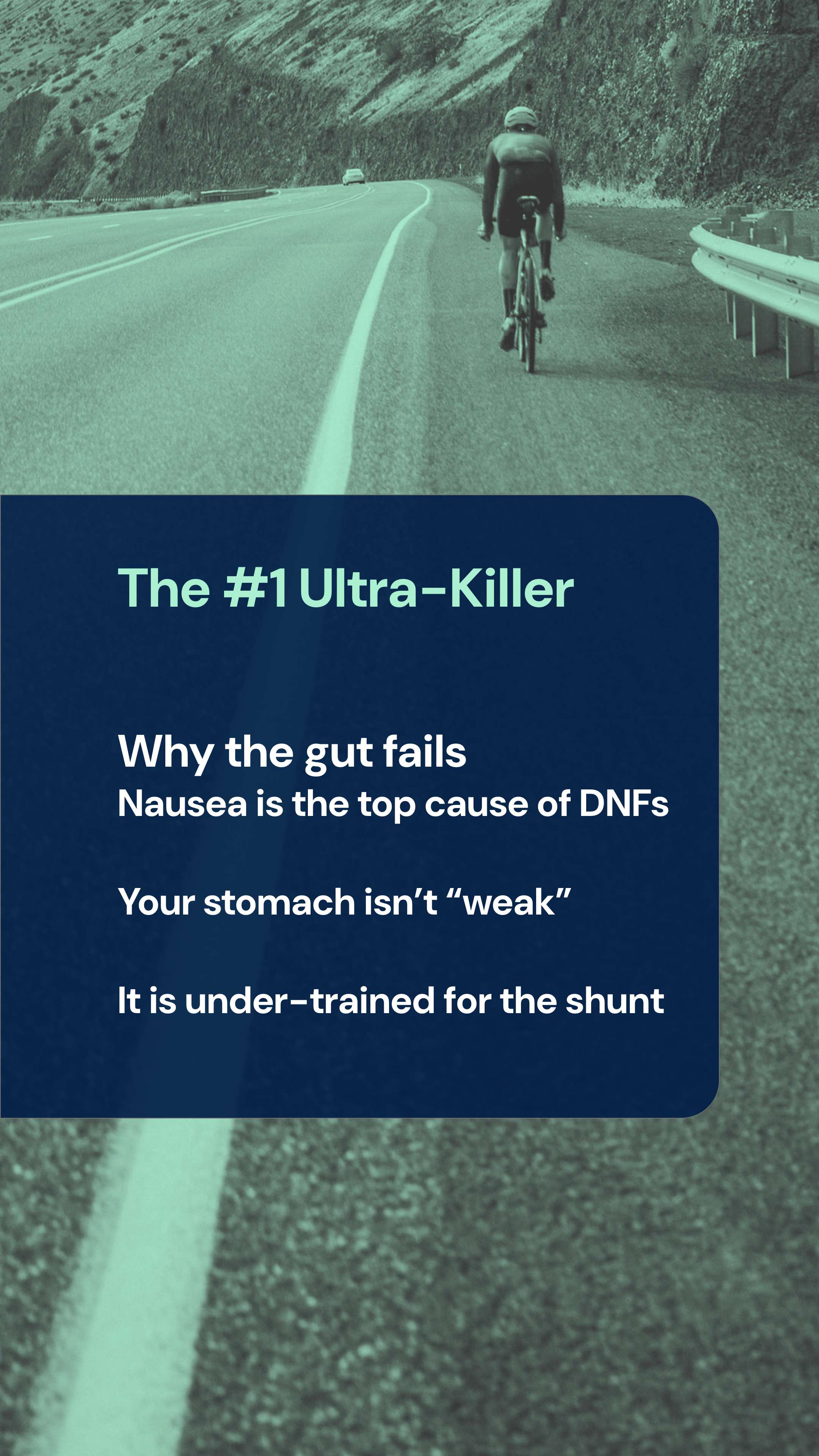
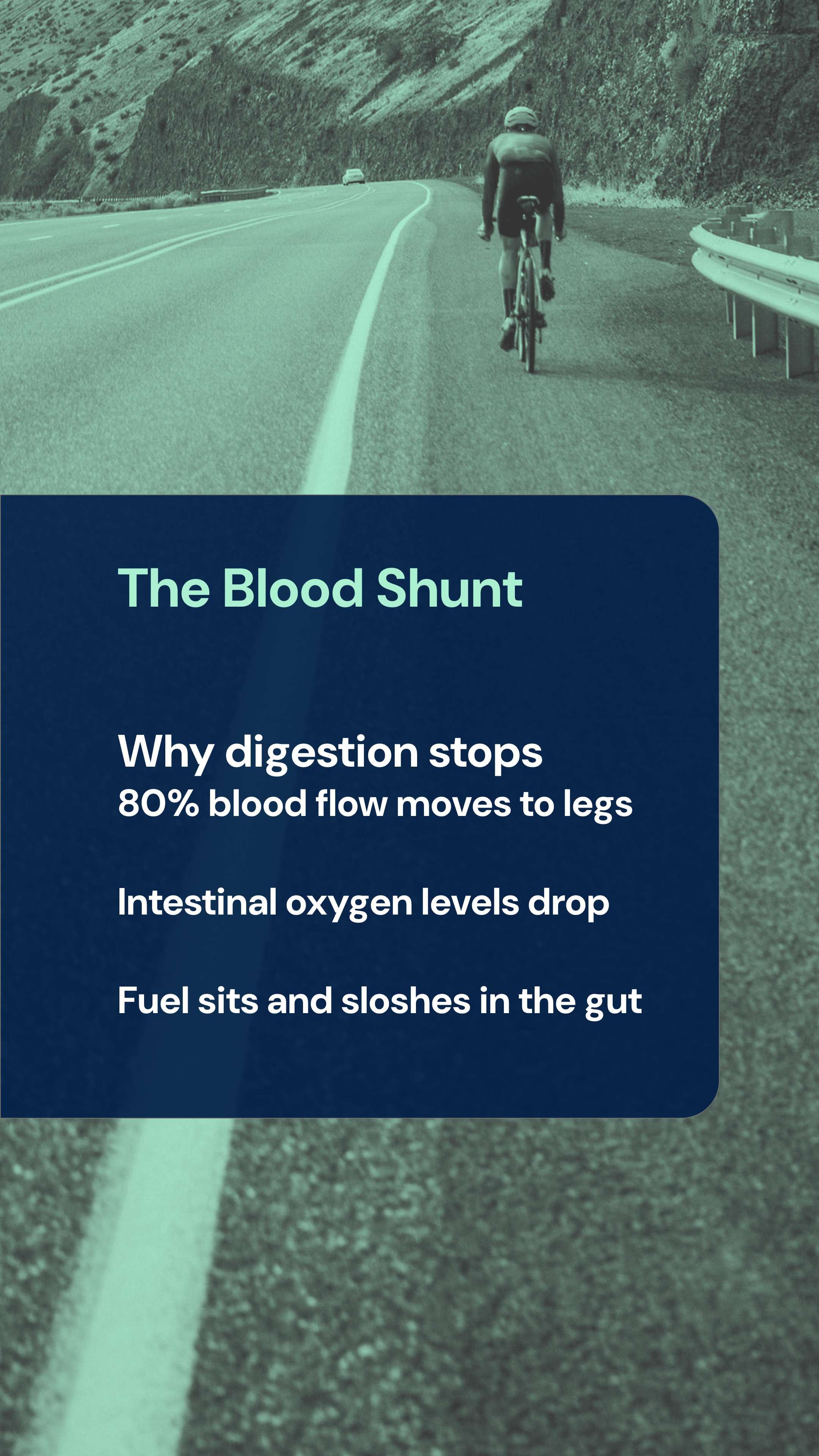
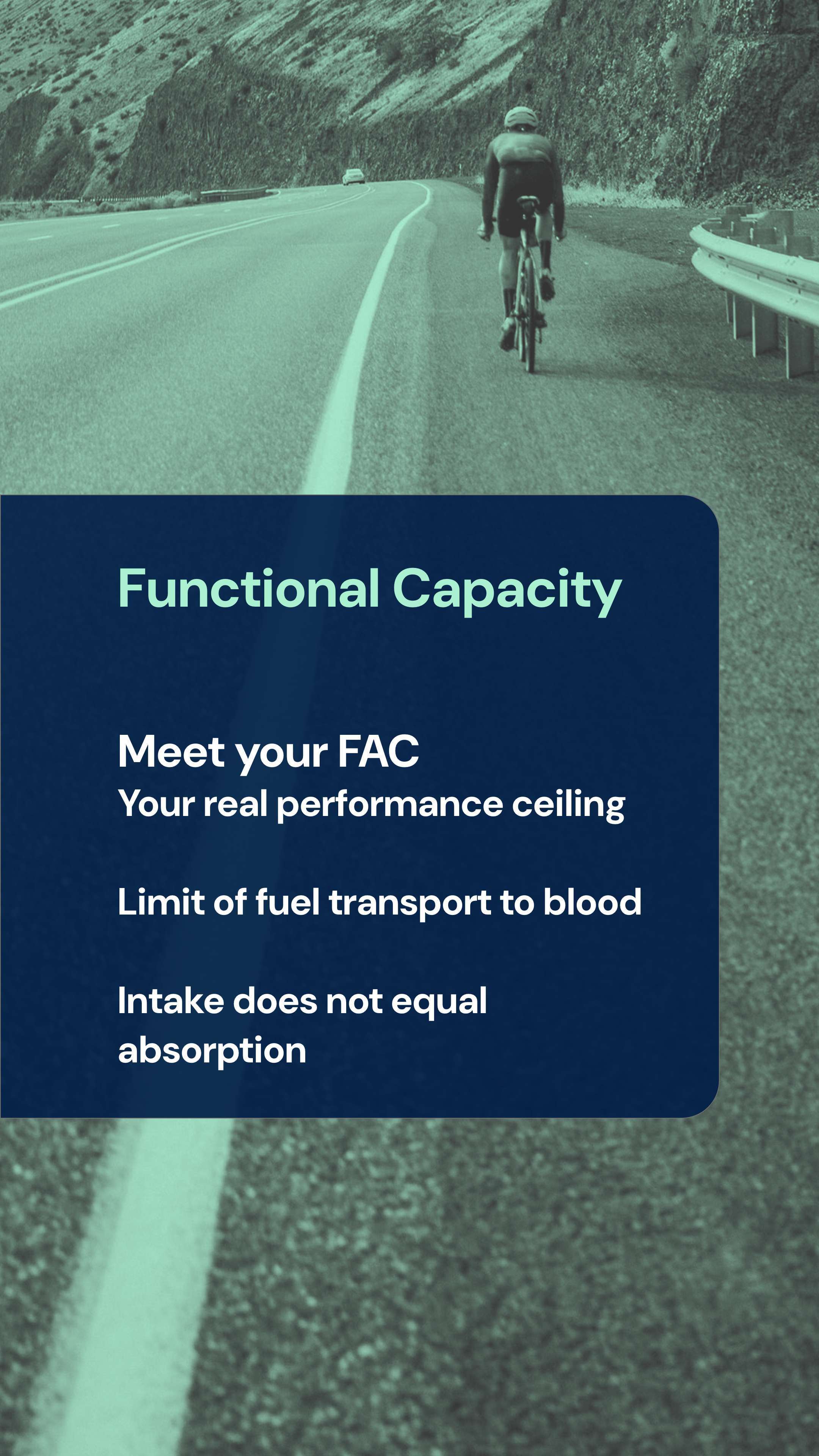
Infographic explaining why the gut fails during ultra-distance cycling due to blood shunting.
Why digestion stops
Meet your FAC
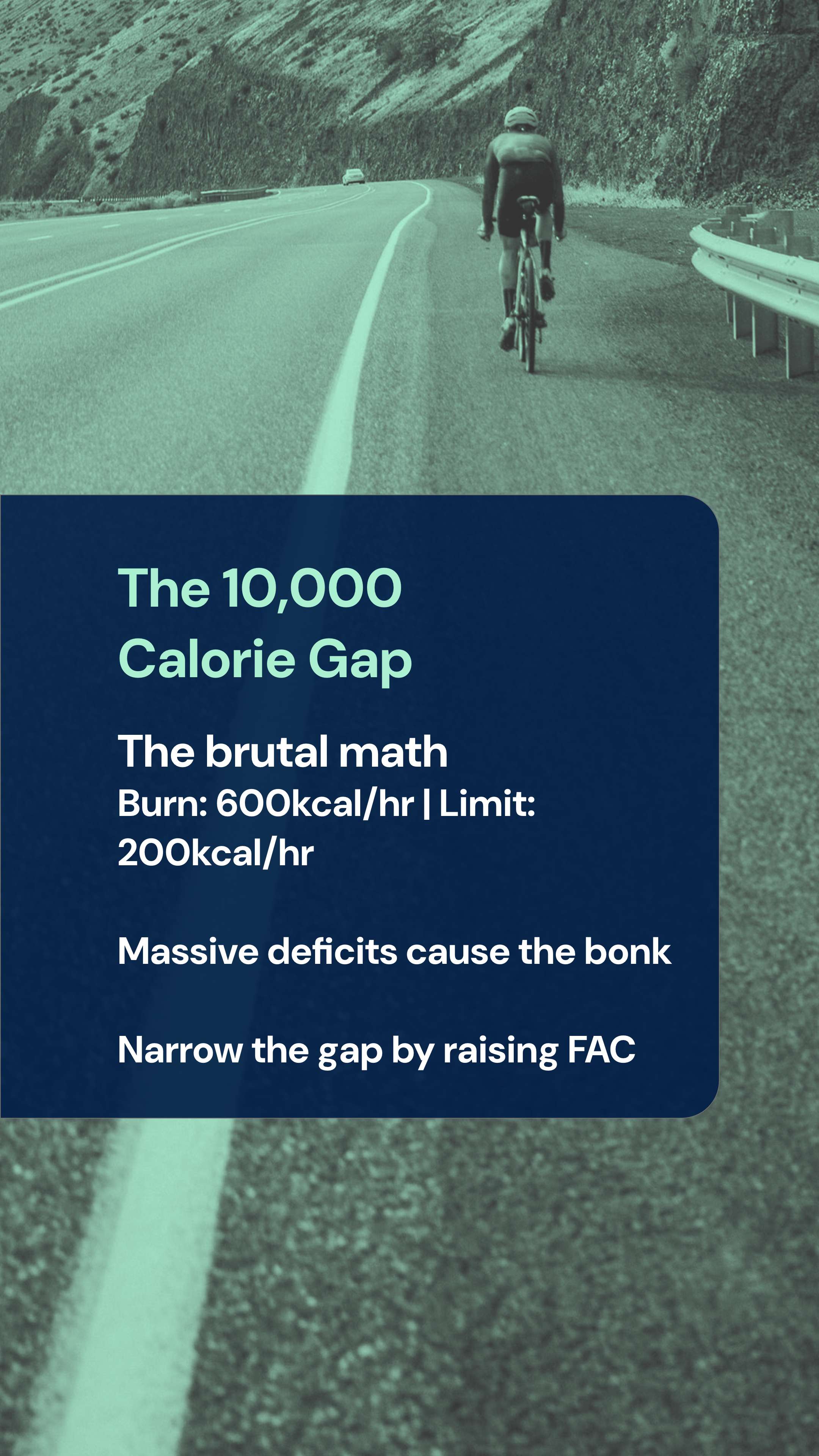
The brutal math
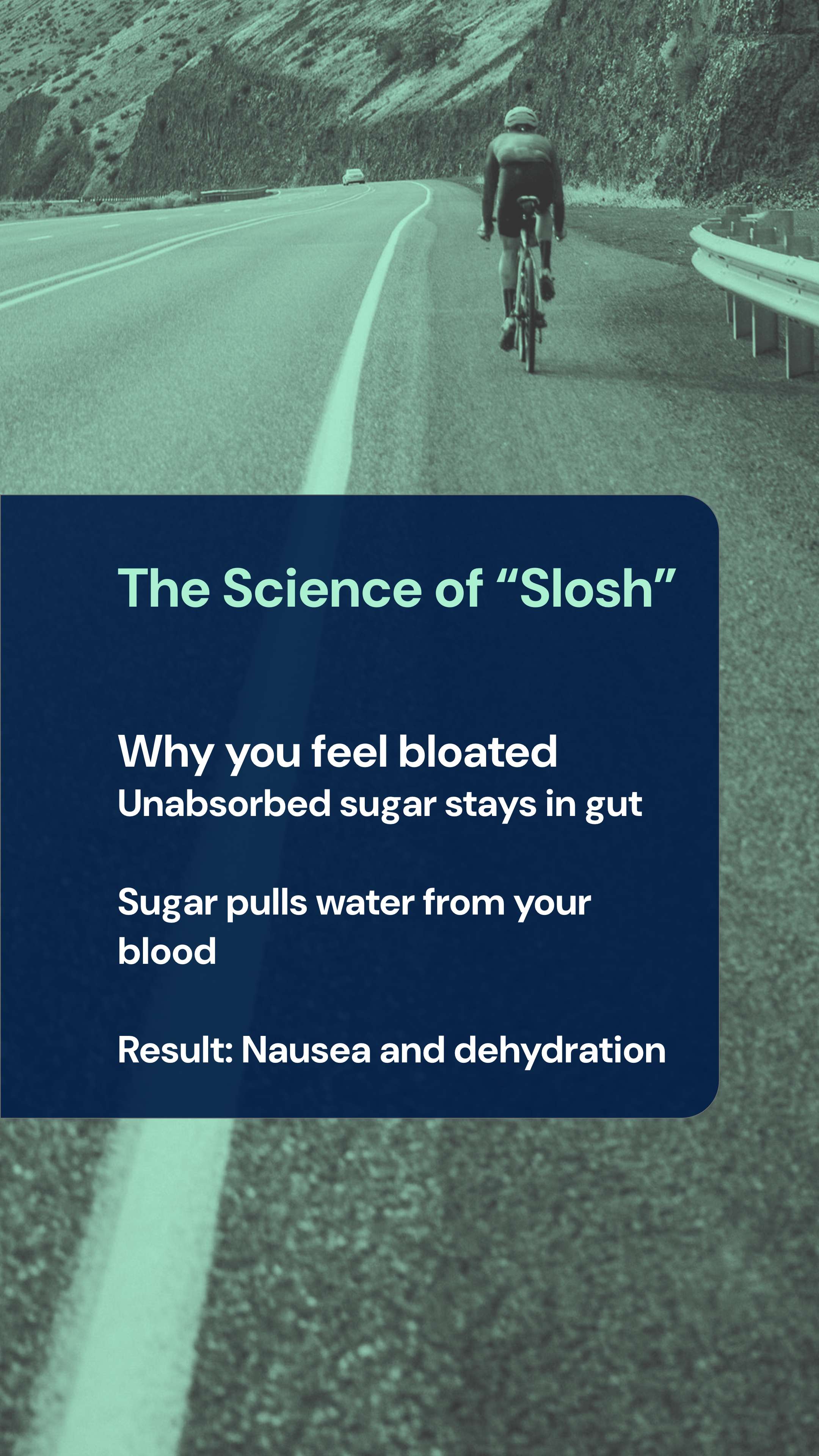
Why you feel bloated
Raising your ceiling
The 3-hour field test
Help in training with Boundary Cycle Coach

The Iron Gut: The science of digestive resilience in ultra-distance cycling

Master the science of Functional Absorptive Capacity to stop gastrointestinal distress from ending your race and learn how to train your gut to process the high-volume fuelling required for ultra-distance cycling.
Coaching & training plans
Personalised coaching and training plans available from £60/month

In the world of ultra-distance cycling, we spend thousands of pounds on aerodynamic optimisation, ceramic bearings, and ultra-lightweight carbon. We obsess over Power-to-Weight ratios and VO2​ max. Yet, the statistics from events like the Transcontinental or the Pan Celtic Race tell a recurring story: the most common reason for a DNF (Did Not Finish) isn’t a lack of leg power—it is the total collapse of the digestive system.

We have all been there. It is 3 AM, you are 300km into a 600km audax, and the very thought of an energy bar makes you want to heave. Your stomach feels like a bloated, sloshing lead weight. I’ve been there myself, staring blankly at a petrol station shelf in the middle of the night, physically unable to swallow a single calorie despite knowing I was "bonking."

For years, the community treated these moments as "bad luck" or a lack of mental toughness. But the research into Exercise-Induced Gastrointestinal Syndrome (Ex-GIS) proves otherwise. Your gut is not a static organ; it is a trainable system. If it fails, it isn't because you are "weak"—it’s because you haven't trained it to handle the specific physiological demands of ultra-endurance.

The physiology of the "Blood Shunt" in endurance cycling

To understand how to fix the problem, we have to understand the physiology. During long-duration exercise, your body undergoes a process called splanchnic hypoperfusion. Essentially, your body prioritises survival by shunting up to 80% of blood flow away from the stomach and intestines to the working muscles and the skin for cooling.

This lack of oxygen to the gut (ischaemia) causes the intestinal lining to become more permeable—what is commonly referred to as "leaky gut." Combined with the constant mechanical jarring of the bike and the heat produced by sustained effort, this leads to systemic inflammation, nausea, and the dreaded "slosh" where nutrients sit in the gut rather than moving into the bloodstream.

Ultra-cycling nutrition: Why "eating by feel" leads to failure

Most ultra-riders significantly underestimate the caloric deficit they are creating. A rider moving at a steady endurance pace might burn between 500 and 800 calories per hour. However, the average untrained human gut can only absorb roughly 200 to 250 calories per hour of mixed nutrients.

Over a 24-hour period, that creates a deficit of nearly 10,000 calories. By day three of a multi-day event, that deficit becomes an existential threat to your performance. The only way to survive is to narrow that gap by increasing your Functional Absorptive Capacity (FAC).

Measuring your "Functional Absorptive Capacity" (FAC)

In my coaching practice, we talk about a metric that is arguably more important for ultra-cycling than FTP: Functional Absorptive Capacity.

While FTP tells us what your legs can produce, your FAC tells us how much fuel your gut can actually transport into your bloodstream while under the stress of a 15-hour ride. If your legs can push 200W, but your gut can only absorb enough fuel for 150W, your race has a built-in expiry date.

How we quantify the "Limit"

We don't rely on trial and error. We use a Gut-Stress Field Test to find your specific absorption ceiling. By incrementally increasing carbohydrate intake during a controlled endurance-zone ride, we track the relationship between caloric intake and a Gut Comfort Score.

We are looking for the "Saturation Point." This is the moment where your SGLT1 transporters (the "gates" in your intestinal wall) reach their limit. When this happens, unabsorbed glucose sits in the small intestine, drawing water out of your blood via osmosis. This is the physiological cause of the bloating and nausea that many riders mistakenly attribute to "drinking too much."

How to test your gut: The 3-hour "Step-Up" protocol

If you want to find your current baseline, try this protocol on your next endurance-paced (Zone 2) training ride. Use a 1–10 scale to rate your gut comfort (1 being perfect, 10 being "nausea-induced stop").

Hour 1: Target 40g of carbohydrates (e.g., one large banana + 500ml of standard electrolyte drink).

Hour 2: Increase to 60g of carbohydrates (e.g., one energy bar + 500ml of carbohydrate-mix drink).

Hour 3: Increase to 80g+ of carbohydrates (e.g., two gels + 600ml of carbohydrate-mix drink).

The Result: If your comfort score jumps significantly during Hour 3, you have found your current Functional Absorptive Capacity. This is the ceiling we work to raise through periodised coaching.

The 3-step protocol to an "Iron Gut"

As a coach, my focus is not on prescribing clinical nutrition, but on managing the physiological adaptation of your digestive system. We treat the gut with the same periodisation we apply to your intervals.

1. Upregulating Carbohydrate Transporters - Research confirms that the gut is highly adaptable. Consuming high carbohydrates in training (targeting 60g–90g per hour) increases the density and activity of SGLT1 transporters. By doing this in training, you are literally building more "gateways" for energy to enter your bloodstream.

2. The "Buffer" Training Ride - We integrate specific threshold efforts while following your race-day intake to see how your system responds when blood flow is being pulled away from the gut most aggressively. We want to find your "absorption ceiling" before you reach the start line.

3. Managing Mechanical and Postural Stress - Ultra-cycling involves constant "vertical oscillation." This mechanical stress irritates the gut lining. We look at your core stability and bike fit; a collapsing core in the 15th hour puts immense physical pressure on the gastric system. A better fit is about giving your digestive system "breathing room."

High-altitude gut training for Alpine events

Digestive challenges compound at altitude. At 2,600m on the Galibier, your body processes food differently than at sea level, reduced oxygen affects not just your legs but your entire system, including digestion. For events like L'Etape du Tour (170km, 5,400m of Alpine climbing), you're asking your gut to process substantial calories whilst climbing consecutive passes at altitude when appetite naturally disappears. 

This requires specific gut training: practicing sustained fuelling during long climbing efforts, testing what works when you're hours into a ride and nothing appeals, and developing systems that function when altitude compounds the challenge. Your gut adaptation must match the specific demands of your event. Multi-hour climbing at altitude presents different challenges than flat ultra-distance riding. 

Training your Functional Absorptive Capacity for Alpine climbing conditions means progressive practice during long rides with significant elevation, not just increasing volume on flat routes.

The coach’s perspective: Don’t leave it to chance

I have spent years deconstructing my own "dark zones" and GI failures. What I’ve learned is that a training plan that only looks at Power and Heart Rate is only half a plan.

If you are targeting a major ultra-event, your training must include a protocol for digestive resilience. We need to ensure that when you are 48 hours into a race, your "internal engine" is just as capable as your legs. In my coaching, we build the system so that when the 2 AM wall hits, your body is actually capable of processing the fuel you give it.

Ready to build a more resilient engine?

If you are tired of your stomach being the "limiter" in your performance, let’s change the way you prepare. I work with riders to integrate these scientific gut-training protocols into their seasonal plans, ensuring you arrive at the start line with a system that can go the distance.

Reach out for a free coaching consultation if you too have had gut problems during rides.


Research References & Footnotes

Costa, R. J. S., et al. (2017). Systematic review: Exercise-induced gastrointestinal syndrome—implications for health and intestinal disease. Alimentary Pharmacology & Therapeutics. Read the Study

Jeukendrup, A. E. (2017). Training the Gut for Athletes. Sports Medicine. Read the Study

Pfeiffer, B., et al. (2012). Carbohydrate oxidation from a drink during 60 min of running: 2:1 glucose:fructose vs. glucose only. Medicine & Science in Sports & Exercise. Read the Study


Glossary of Terms

Absorptive Capacity (Functional): The practical limit of the gastrointestinal tract to transport nutrients into the bloodstream while under exercise-induced stress.

Anorexigenic Effect: The biological suppression of hunger signals due to high levels of stress hormones like cortisol.

Ex-GIS (Exercise-Induced Gastrointestinal Syndrome): A suite of symptoms caused by reduced blood flow and heat stress in the gut during exercise.

GLUT5: The specific transporter protein responsible for moving fructose across the intestinal wall.

Ischaemia (Intestinal): A restriction in blood supply to the gut tissues, common during "blood shunting" to working muscles.

Osmotic Pull: When unabsorbed sugars draw water from the blood into the gut, causing bloating and "sloshing."

SGLT1: The primary transporter protein for glucose and sodium in the small intestine.

Splanchnic Hypoperfusion: The technical term for reduced blood flow to the digestive organs during exertion.

Reach out if you've hit a plateau in your training or want some help to improve your cycling performance. 💪 🚴🏼‍♂️

Frequently asked questions

This is often caused by osmotic pull. When you consume more carbohydrates than your SGLT1 transporters can handle (exceeding your FAC), the unabsorbed sugar sits in your small intestine. This creates a gradient that actually pulls water out of your bloodstream and into your gut, leading to that heavy, sloshing sensation and potential nausea.

Yes. Research shows that the intestinal tract is highly plastic. By consistently consuming high-carbohydrate loads (60g–90g/hr) during specific training rides, you can increase the density and activity of glucose transporters in as little as two to four weeks. This upregulates your ability to move fuel into the blood even when blood flow is restricted.

Not necessarily. While real food helps with "flavour fatigue," it is often more complex to break down. High-fibre or high-fat "real" foods require more blood flow for digestion—the very blood flow that is being shunted away to your legs. For many riders, a protocol involving specific carbohydrate ratios (Glucose:Fructose) is easier to absorb under high stress.

Coaching & training plans
Personalised coaching and training plans available from £60/month
PBP knowledge
Qualification Timeline
Start Groups
Control Congestion
Multi-Day Fatigue
Nutrition Challenge
Time Pressure
Beyond Qualification
Train for PBP

Paris-Brest-Paris: Understanding the qualification path and what the event demands

Paris-Brest-Paris 2027 qualification requirements explained: the two-year pathway, control logistics, and unique challenges of completing 1,200km across France in 90 hours.
Paris-Brest-Paris coaching & training plans
Personalised coaching and training plans available from £60/month

Paris-Brest-Paris isn't just another long ride. It's the world's oldest cycling event still running, dating back to 1891, and it happens once every four years. The next edition runs in August 2027, and if you're considering it, you need to understand the two-year qualification pathway that starts in 2026.

1,200 kilometres from Paris to Brest and back. 90 hours to complete it. Several thousand riders from across the globe, all starting within a few days of each other. It's randonneuring's equivalent of a pilgrimage. Riders speak about it differently than other events. But respect and romance aside, PBP presents specific challenges that catch out riders who underestimate what 1,200km across France actually demands.

This isn't about scaring anyone off. It's about understanding what you're signing up for before you book the ferry.

What is Paris-Brest-Paris?

Paris-Brest-Paris is a 1,200km randonnée: a non-competitive long-distance cycling event where riders must complete the distance within a set time limit whilst passing through mandatory controls. The route runs from Rambouillet (southwest of Paris) to Brest on the Brittany coast, then back to Rambouillet. The event covers approximately 1,218km with 11,500 metres of climbing.

You have 90 hours to finish. That's 3 days, 18 hours. Unlike many UK audax events, there's no extended time limit option. 90 hours is what everyone gets.

The event runs every four years, typically in August. Places are strictly limited to 8,000 riders, and the event typically sells out during the priority registration phase. This is why the qualification process matters so much.

PBP isn't a race. There are no prizes, no podiums, no age-group rankings. You're riding for a finisher's medal and the satisfaction of completing something that most cyclists never attempt. But don't mistake "non-competitive" for "easy." The 90-hour limit is tight enough that poor pacing, inefficient controls, or inadequate sleep planning will see you running out of time before Rambouillet.

The Two-Year Qualification Pathway

PBP 2027 requires a two-year qualification process. This isn't like entering a sportive where you simply register and turn up. You need to plan ahead. An experienced audax coach can help guide you through the qualification process with comprehensive audax training plans.

Phase 1: Priority Registration Rides (November 2025 to October 2026)

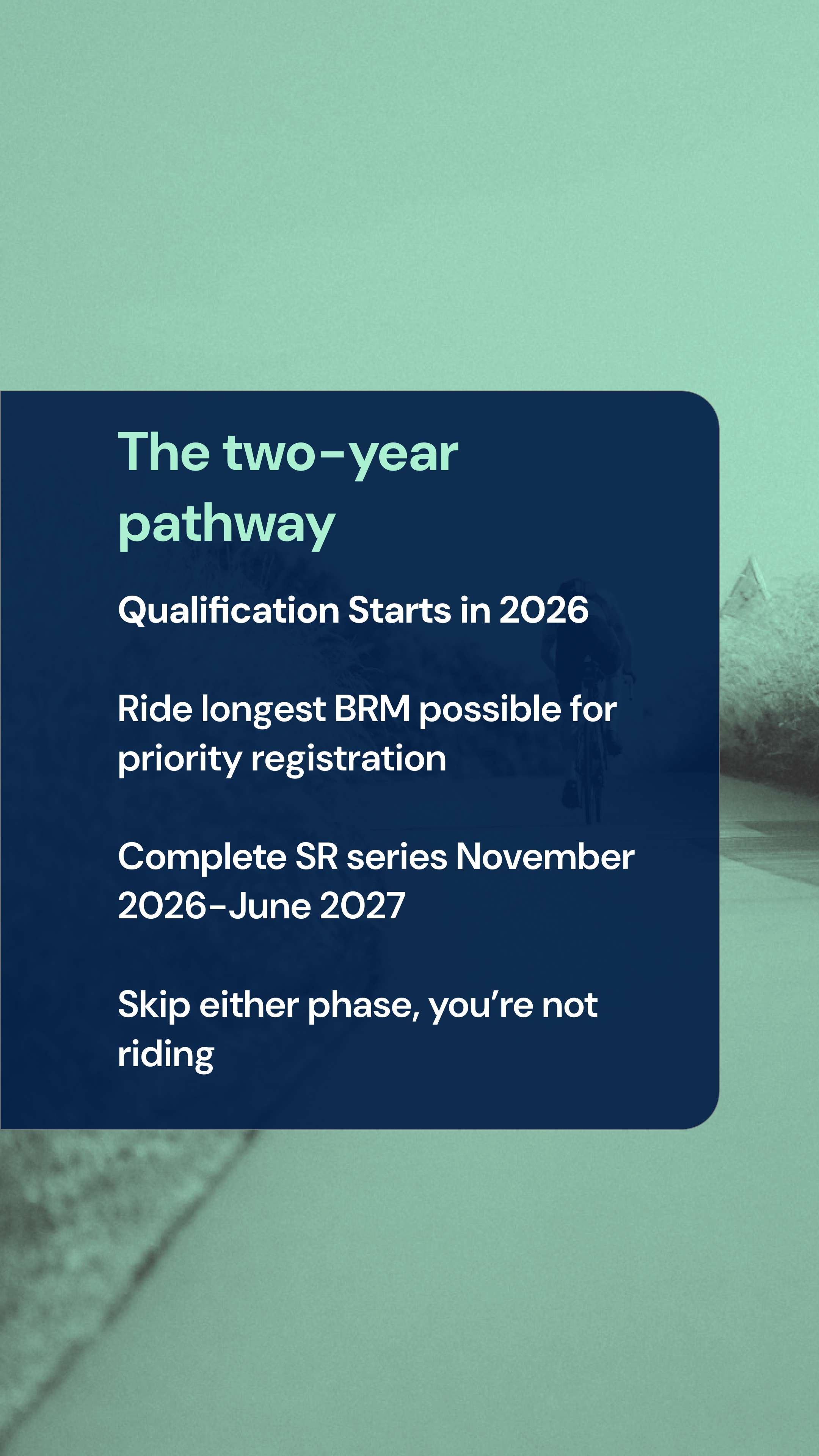
During 2026, you should ride the longest Brevet de Randonneurs Mondiaux (BRM) distance you can manage. These rides aren't mandatory, but they're effectively essential if you want to secure a place. PBP is limited to 8,000 riders, and spots typically sell out before general registration opens.

Your longest 2026 ride determines when you can pre-register in early 2027:

  • Complete 1000km or 1200km in 2026: Priority registration opens mid-January 2027
  • Complete 600km in 2026: Priority registration opens late January 2027
  • Complete 400km in 2026: Priority registration opens mid-February 2027
  • Complete 300km in 2026: Priority registration opens late February 2027
  • Complete 200km in 2026: Priority registration opens mid-March 2027
  • Complete no qualifying rides in 2026: You're hoping for leftover places after March, which is risky

The message is clear: if you're serious about PBP 2027, you should be riding long brevets during 2026. Without a 2026 ride, you may not get a place at all.

Phase 2: Mandatory Qualification (November 2026 to June 2027)

Once you've pre-registered in early 2027, you must complete a Super Randonneur (SR) series to validate your entry. All rides must be ACP-sanctioned (Audax Club Parisien certified) brevets.

The SR series requires completing four distances:

  • 200km brevet (maximum 13.5 hours)
  • 300km brevet (maximum 20 hours)
  • 400km brevet (maximum 27 hours)
  • 600km brevet (maximum 40 hours)

All four must be completed between November 2026 and June 30th 2027. Each ride must have a unique homologation number. You can substitute a longer ride for a shorter one (for example, complete two 600km rides instead of a 400km and a 600km), but you must still have four separate brevet completions with different homologation codes.

Miss the June 30th deadline for your SR series, and you lose your entry despite having paid your deposit and secured your place.

Phase 3: Registration Timeline

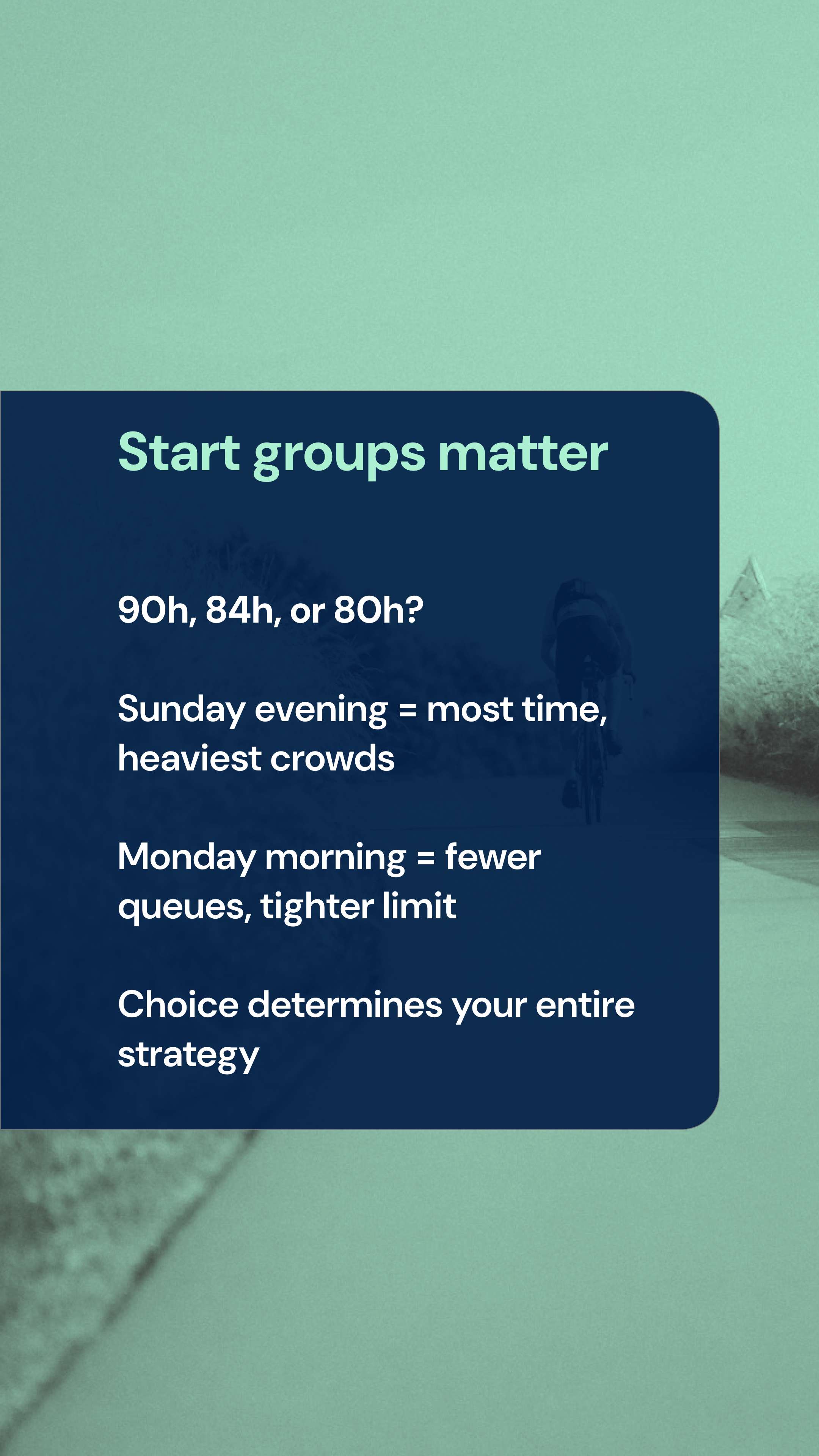
  • January to March 2027: Pre-register based on your 2026 ride. Pay €50 deposit and select your start group and wave. The 90-hour group (Sunday evening start) is most common, the 84-hour group (Monday morning start) avoids early control congestion, and the 80-hour group (Sunday afternoon start) suits faster riders.
  • May 29th 2027: Full registration opens. Enter homologation codes for at least three of your four 2027 qualifiers
  • June 12th 2027: Deadline to initiate full registration. Miss this and your reserved spot may be released
  • July 4th 2027: Final deadline to upload your fourth qualifying ride code

In the UK, Audax UK (AUK) organises brevets that count toward your qualification. Check the AUK calendar early. Popular 600km rides fill months in advance, and if you miss the limited 600km opportunities in your region during spring 2027, you may need to travel considerable distances to find another before the June 30th deadline. Spring and early summer see the most brevet opportunities; options become sparse by late June.

The two-year process is deliberate. Ride long distances in 2026 to secure your priority registration slot. Complete your mandatory SR series in 2027 to validate your entry. Skip either phase, and you're not riding PBP.

The Control Challenge: Crowds and Chaos

Controls at PBP bear no resemblance to controls at smaller UK audax events.

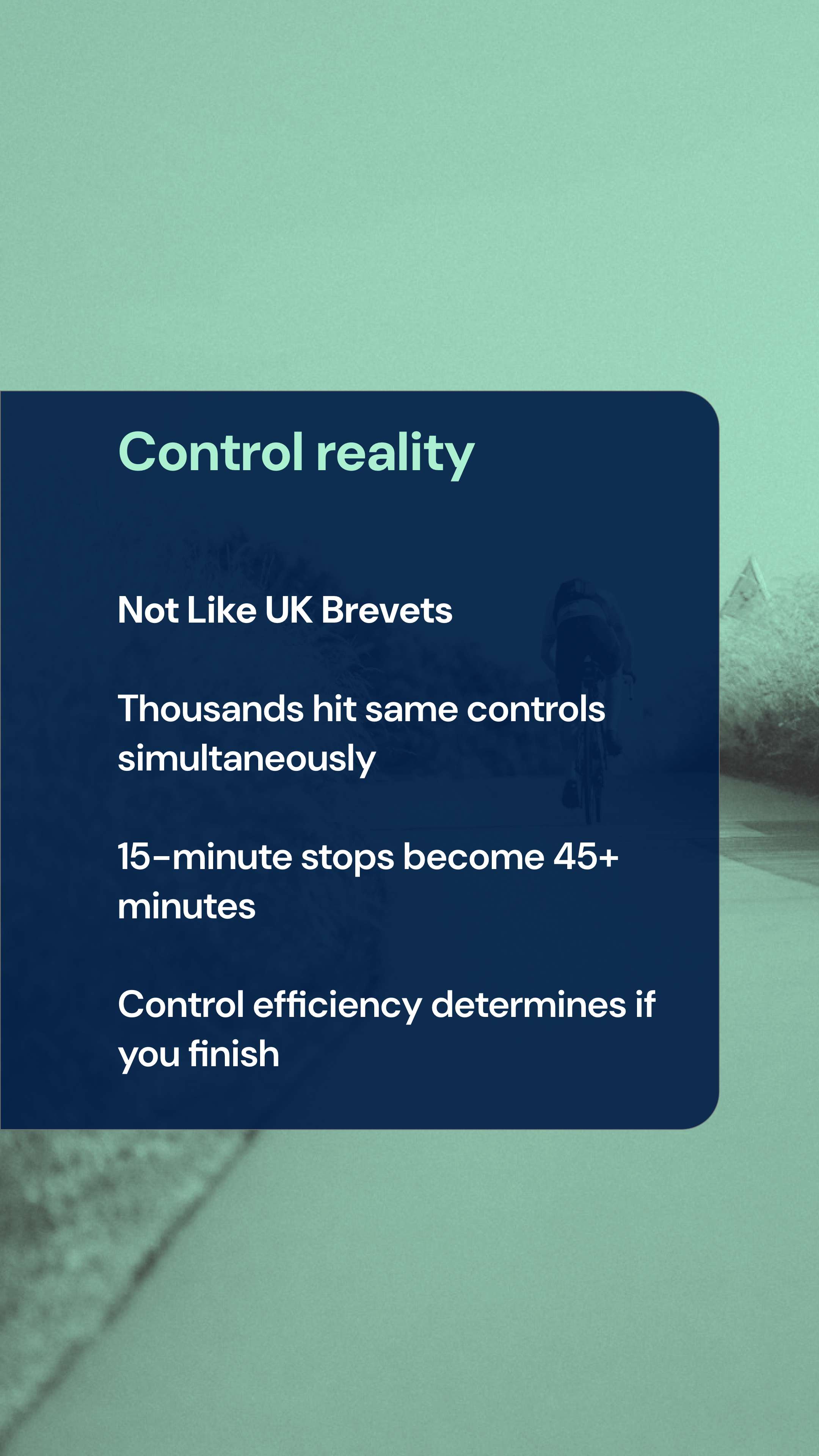
At a typical 400km UK brevet, a control might be a village hall with 20 riders, a volunteer stamping brevet cards, and perhaps some biscuits. You're in and out in five minutes.

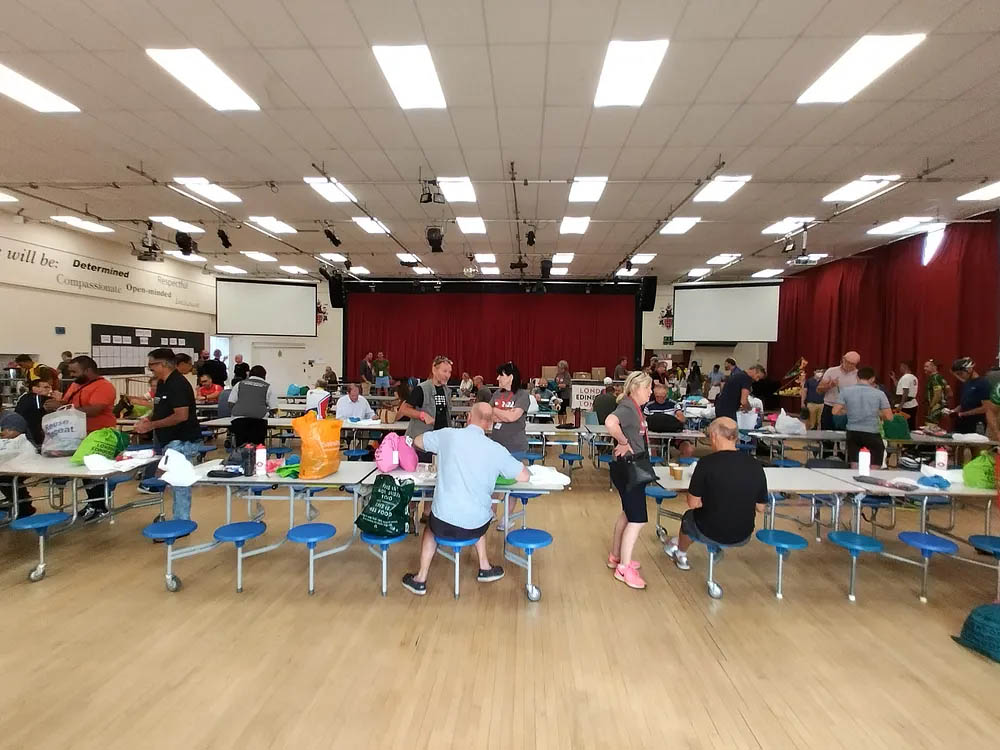
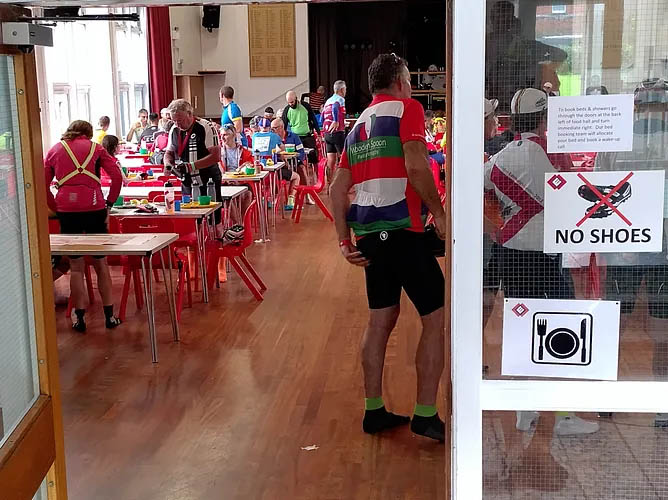
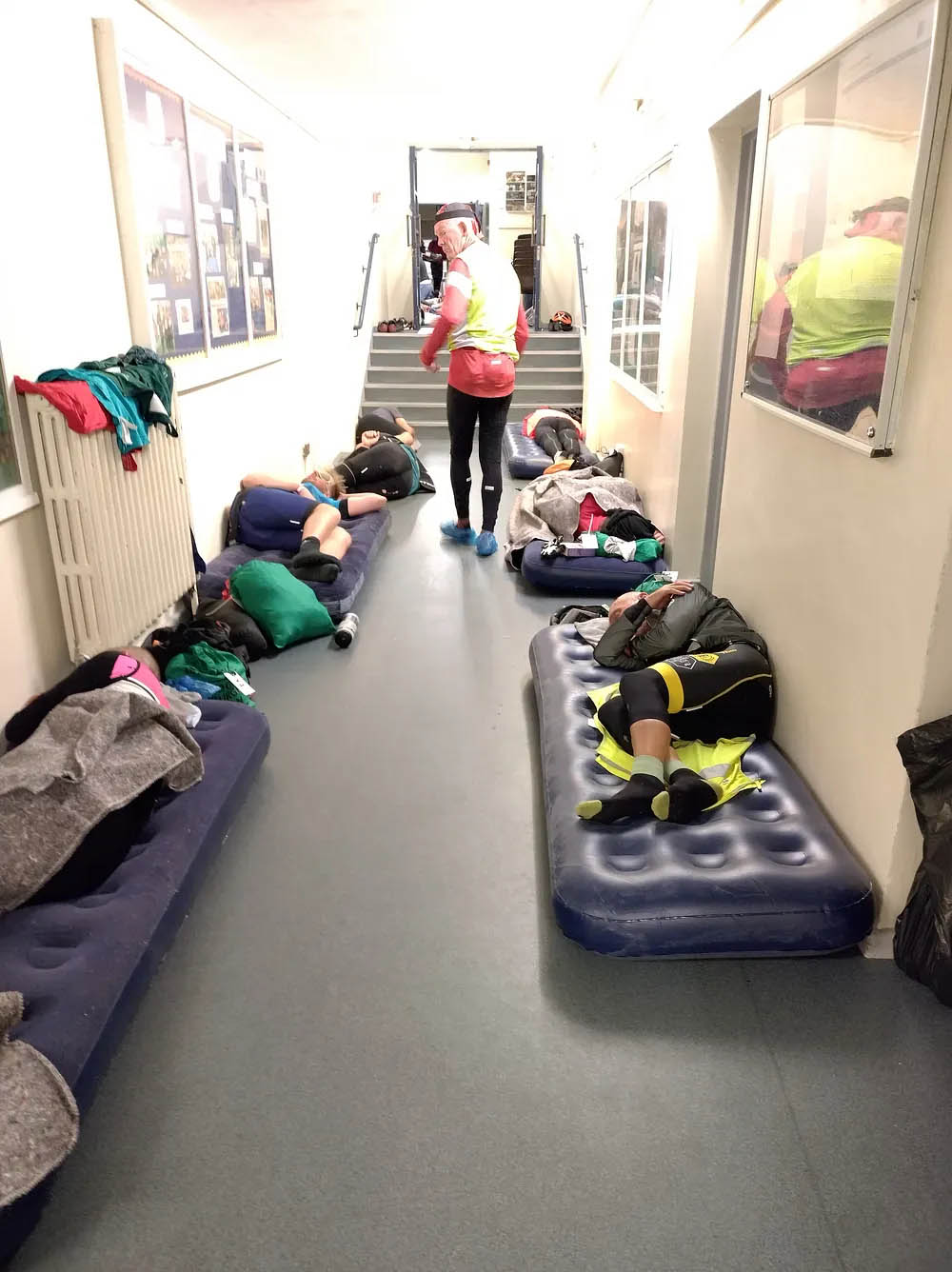
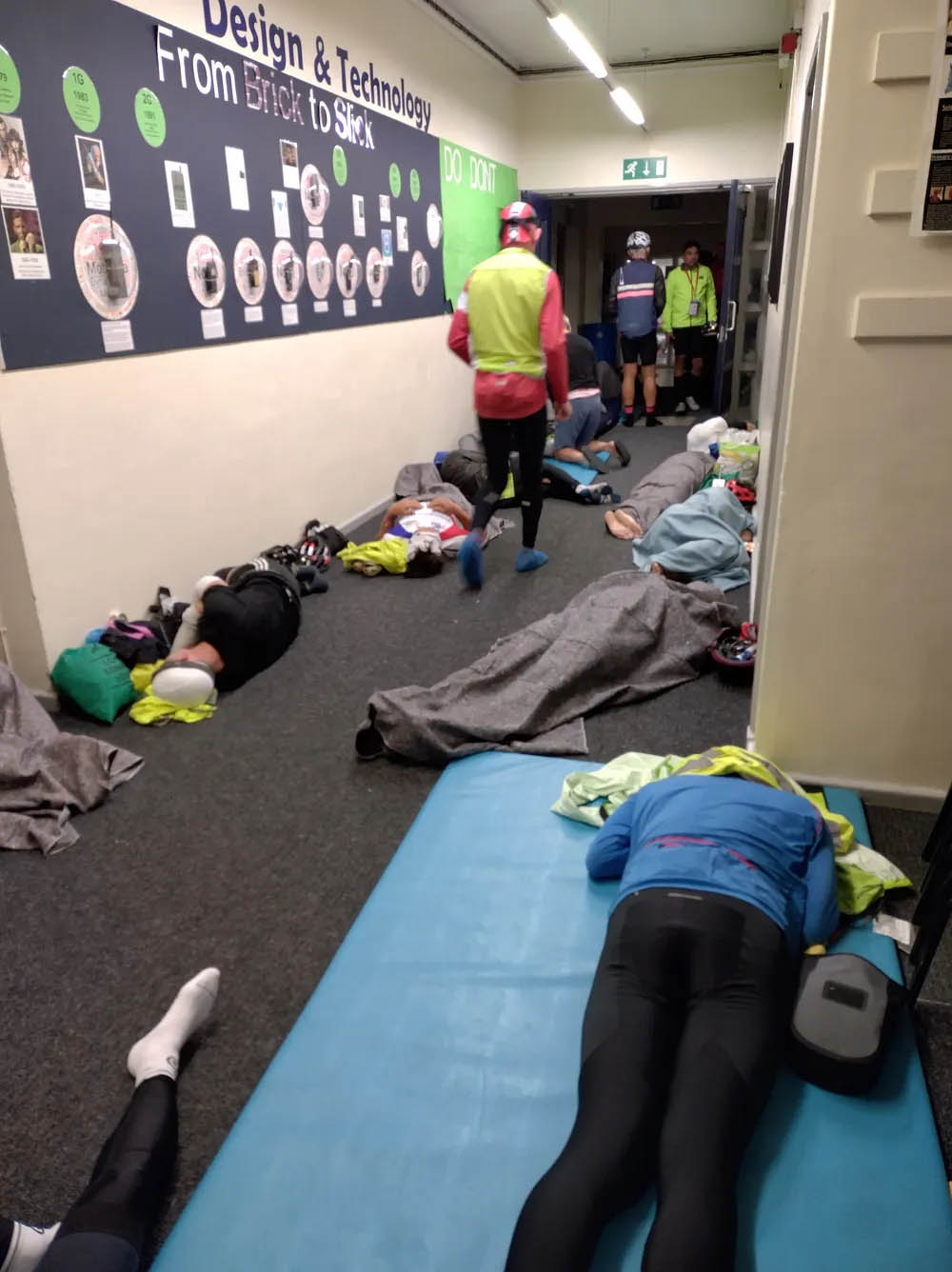
At PBP, controls are secondary schools, sports halls, and community centres temporarily converted into logistics hubs for thousands of cyclists. Arriving at a major control at peak times (particularly evening controls when most riders stop for dinner) means joining queues. Queues for the brevet stamp. Queues for food. Queues for toilets. Queues for the shower, if there are showers. What should take 15 minutes can easily consume 45 minutes or more if you arrive when hundreds of other riders have had the same idea.

Having ridden London-Edinburgh-London twice, I've experienced busy controls, but PBP operates at a completely different scale. LEL has perhaps 500-1,000 riders spread across multiple start groups. Even at Brampton, which sees the heaviest traffic as riders converge from different routes, you're dealing with dozens of riders at a time, not hundreds. The queues exist, but they're manageable. You can usually find floor space to sleep. The food queue moves.

PBP multiplies that by a factor of six or seven. With several thousand riders on the same route hitting the same controls within relatively narrow time windows, the scale of congestion is considerably larger. Major controls become bottlenecks that you cannot avoid but must manage. Based on reports from riders who've completed PBP, the shower queues, sleeping arrangements, and food service all operate under significantly more pressure than LEL controls.

Some riders try to minimise control time by carrying more food and only stopping for the mandatory brevet card stamp. This works on shorter brevets but becomes increasingly difficult over 1,200km. You cannot carry three days' worth of calories, and the mental toll of never properly stopping catches up eventually. You'll need to eat at controls, which means accepting that time spent queuing is part of the event.

The logistics of control stops become critical to your time management. At LEL, I learned that arriving at Brampton slightly off-peak meant finding a sleeping spot more easily and getting better rest. The same principle of timing your control arrivals to avoid peak congestion will apply at PBP, though with a field six times larger, even off-peak periods will be busier than LEL's peak times.

Understanding how to manage control stops efficiently becomes crucial when you're working within a 90-hour limit. Every unnecessary minute spent queuing or searching for facilities is time you're not riding or sleeping properly. This isn't a criticism of PBP's organisation. It's simply the reality of moving several thousand riders through the same infrastructure. But you need to build extra time into your schedule for control stops and accept that efficiency at controls will directly impact whether you finish within 90 hours.

Navigation: Following the Route in France

The route for the 21st edition (August 2027), Paris-Brest-Paris will feature a redesigned, more scenic and rider-friendly route. The route rides a clockwise loop through Brittany to reduce traffic conflicts. 

Stage towns & key checkpoints: Rambouillet · Mortagne-au-Perche · Villaines-la-Juhel · Fougères · Tinténiac · Brest · Loudéac
New additions to the route: Pontivy · Pleyben · Callac · Mont-Saint-Michel viewpoint · Chartres

PBP uses a marked route. Organisers place directional signs at junctions to guide riders. Follow the signs, and you follow the route.

In theory, this sounds straightforward. In practice, particularly during night sections or when fatigued, riders miss signs. Sometimes the signs are small. Sometimes they're placed awkwardly. Sometimes they're removed or damaged.

Most riders use a GPS device loaded with the route as backup. Relying entirely on following the rider ahead is risky. That rider might be lost too, and you won't realise until you're both 10km off-route.

French road signage differs from UK signage. Village names appear on signs, but the smaller hamlets and crossroads you're navigating through may not match exactly what's on your route sheet. Having a rough mental map of the route helps. Paris to Brest is generally west, Brest to Paris is generally east. This helps sanity-check your navigation.

Language barriers exist at controls and in villages. Not everyone speaks English, and at 2am when you're trying to find something or ask a question, communication becomes harder. Basic French phrases help. A translation app helps more.

Some riders report that following the route during the return leg from Brest becomes harder due to fatigue. You've already ridden 600km, you're sleep-deprived, and the roads start looking familiar but aren't quite the same. This is where navigation errors cluster: not on the fresh outbound leg, but on the exhausted return.

Weather: French Climate Variability

August in France usually means warm weather, but "usually" doesn't mean "guaranteed." PBP's route crosses Brittany, a region known for changeable maritime weather. Rain is possible. Strong headwinds coming off the Atlantic are possible. Heat is possible.

Previous editions have experienced both extremes. Some years have seen high temperatures causing dehydration problems for riders. Other years have brought cold, wet conditions with strong winds. Weather can define your PBP experience as much as fitness.

You'll need clothing for both heat and cold. Night temperatures can drop significantly, even in August. The Brittany coast brings different weather than inland areas. What's warm and dry early in the route might be cold and wet 200km later.

Rain gear needs to be functional, not token. If it rains properly, you could be riding in it for 12 hours or more. Cheap waterproofs that work for an hour fail after five hours. Your extremities suffer most in cold, wet conditions, and numb hands at 2am on French country roads aren't just uncomfortable, they're dangerous.

Prevailing westerly winds can make sections of the return leg from Brest slower than the outbound journey. Budget extra time for the return. It's not simply a mirror of the outbound ride.

The 90-Hour Time Pressure

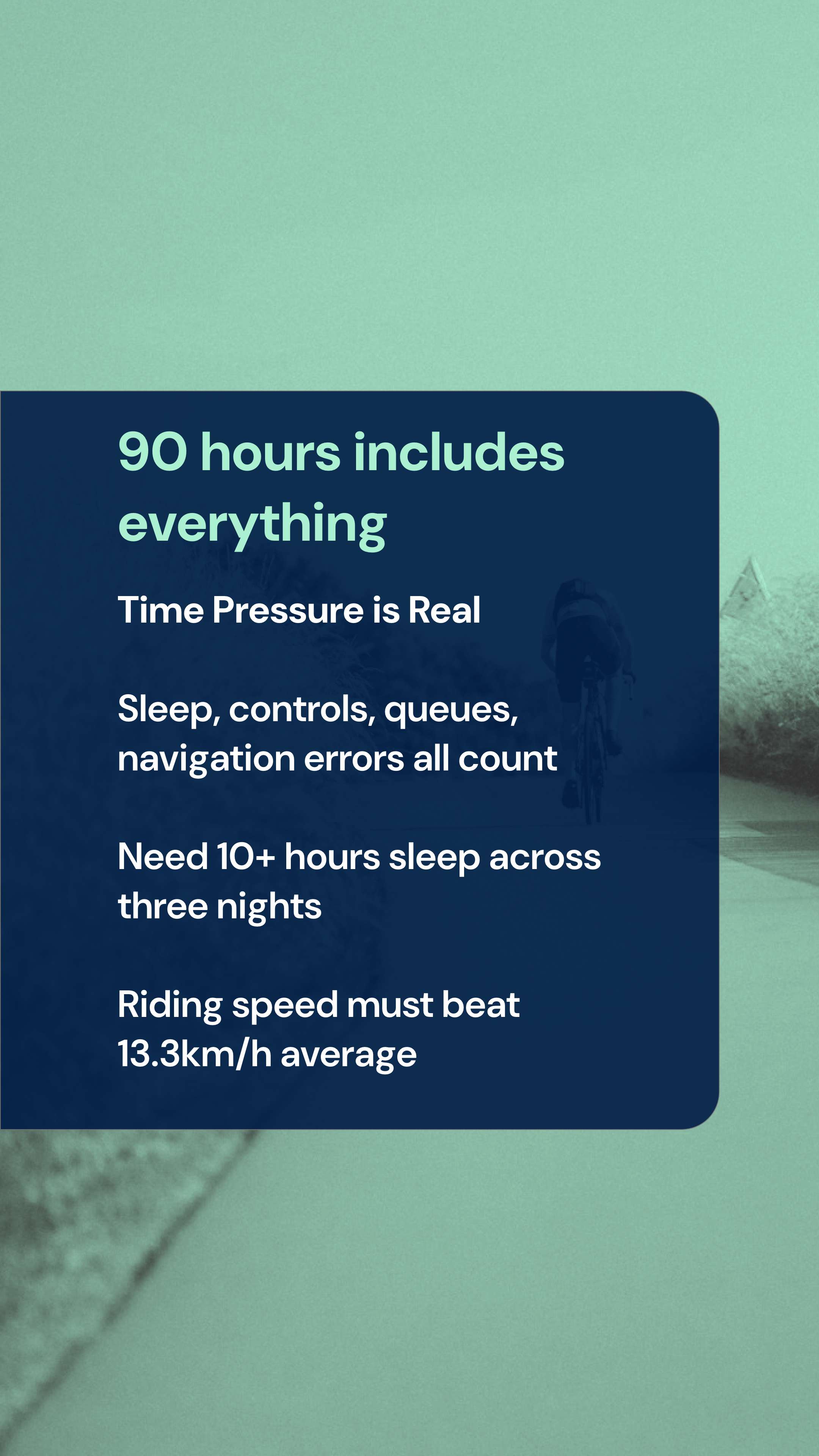
90 hours sounds generous. 1,200km divided by 90 hours is 13.3km/h average, barely faster than walking pace. Surely anyone finishing 600km brevets can manage that?

But 90 hours includes everything. Every control stop. Every meal. Every moment spent queuing for a brevet stamp. Every navigation error. Every sleep period. The actual time you spend riding needs to be significantly faster than 13.3km/h to account for all the time you spend not riding.

Most riders need sleep. Exactly how much varies enormously. Some riders operate on 90-minute power naps, others need 3-4 hour blocks to function. But everyone needs something. If you sleep 4 hours on night one, 4 hours on night two, and 3 hours on night three, that's 11 hours gone from your 90-hour budget. Add 30-45 minutes per control across multiple major controls, and you've lost more hours. You're now looking at riding 1,200km in considerably less than 90 hours, which means your average riding speed needs to be meaningfully faster than 13.3km/h.

The time limit catches riders who haven't practiced efficient control stops, haven't tested their sleep requirements on multi-day rides, or haven't paced conservatively enough early on. By the time you realise you're running out of time, you're often too fatigued to significantly increase your pace.

Multi-Day Fatigue: Beyond Qualification Distance

Completing a 600km brevet proves you can ride 600km. It doesn't necessarily prove you can ride 600km and then ride another 600km.

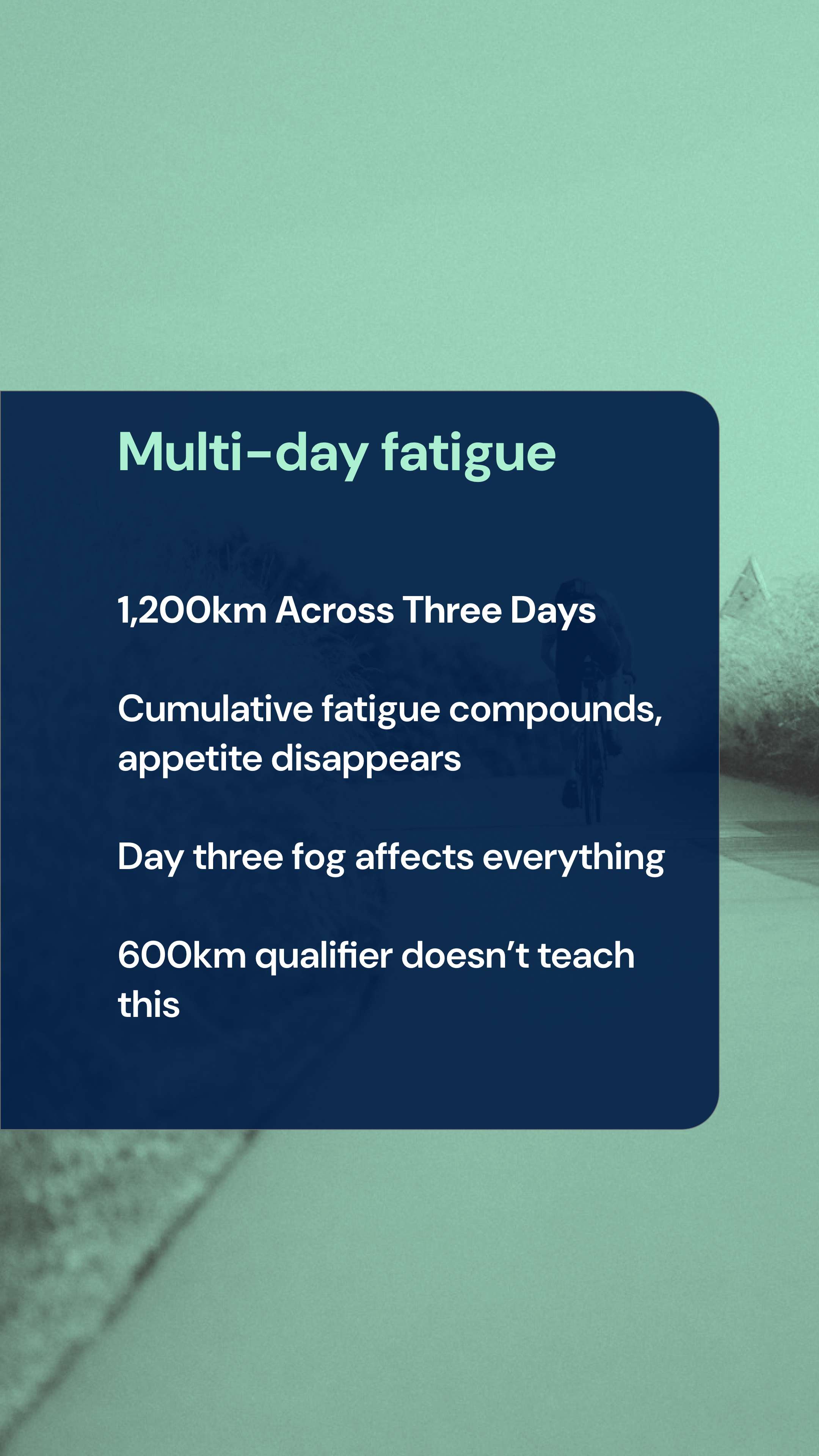
The fatigue that accumulates over multiple days feels different from single-day fatigue. After 24 hours riding, you stop, sleep properly, recover. At PBP, you get minimal recovery. By day three, cumulative fatigue affects decision-making, bike handling, and motivation in ways that day-one fatigue doesn't.

Simple tasks become difficult. Eating becomes a chore rather than a pleasure. Sleep becomes something you desperately crave but struggle to get properly. The mental fog that descends after multiple days makes everything harder, including the calculation of whether you're still on pace for the time limit.

Physical issues that might be minor irritations on a 400km brevet become serious problems over 1,200km. A slightly uncomfortable saddle becomes unbearable after two days. Hands that feel fine for 12 hours go numb after 40 hours. Minor knee discomfort becomes significant pain.

The hardest part of PBP often isn't any specific section of the route. It's the middle period when you're deep into the event, your body is breaking down, and the finish still feels distant.

Nutrition and Hydration: The Three-Day Challenge

Fuelling 1,200km over multiple days presents different challenges than fuelling a single 600km brevet.

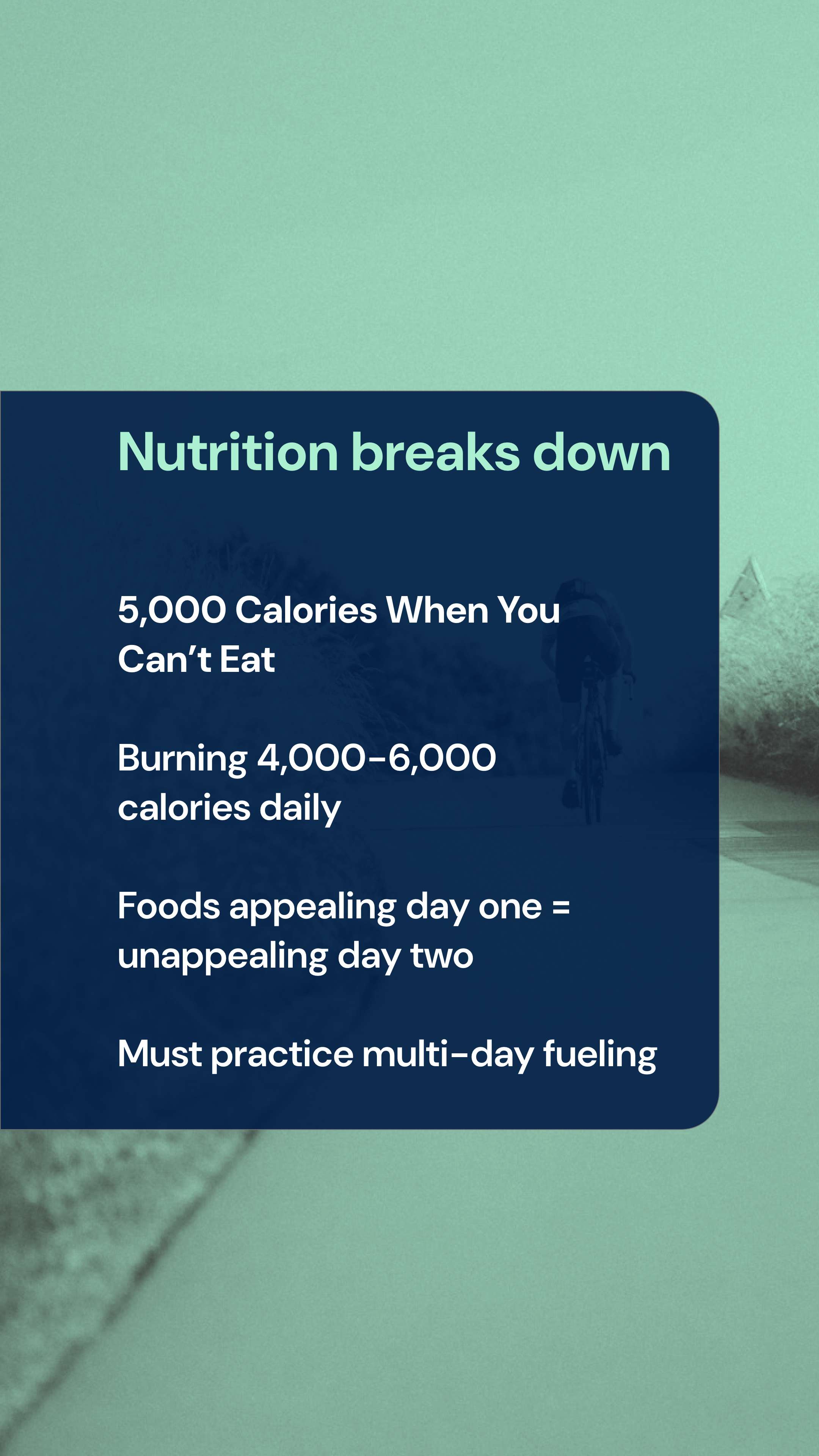
On a 600km ride, you can afford to under-eat slightly and make up the deficit afterwards. Over three days at PBP, cumulative calorie deficits catch up. You're burning 4,000-6,000 calories per day whilst trying to consume enough to keep functioning. By day two, many riders struggle to eat at all. Foods that tasted good on day one become unappealing. Your appetite diminishes precisely when you need calories most.

Control food at PBP is substantial. French controls typically offer hot meals, soup, pasta, bread, cheese, fruit, and sweet options. The food is good, but you're eating it whilst exhausted, often at 2am, surrounded by hundreds of other riders. What should be a pleasant meal becomes functional refuelling.

The challenge isn't just calories. It's maintaining hydration across multiple hot August days whilst managing electrolyte balance. It's eating enough at each control without overloading your stomach before riding. It's carrying sufficient backup food for the 80-100km between controls without weighing yourself down. It's forcing food down when you're not hungry but know you need it.

Some riders develop their nutrition strategy through trial and error on qualification rides. Others arrive at PBP having never practiced three consecutive days of riding and eating. The difference shows by Brest. Riders who've tested their multi-day nutrition systems know what foods they can tolerate when exhausted, how often they need to eat, and how to balance control meals with carried snacks. Those who haven't often struggle with energy crashes, digestive issues, or simply not eating enough to sustain the effort.

This isn't about having the perfect nutrition plan. It's about having practiced enough to know what works for your body across multiple days of hard riding. The 600km qualifier doesn't teach you this. Systematic preparation does.

International Logistics: Getting to France

You're riding in France, which means getting yourself and your bicycle across the Channel.

Ferry options include Dover-Calais, Portsmouth-Caen, and Portsmouth-St Malo. Some riders drive to France, others take the Eurostar to Paris then travel to Rambouillet. Whatever option you choose, factor in bike transport logistics. Trains may require bikes to be bagged or boxed, ferries usually allow bikes but check capacity and booking requirements in advance.

Rambouillet is southwest of Paris, roughly 50km from the capital. Accommodation in Rambouillet fills well in advance. Some riders prefer to stay in Paris and travel to the start on event day, though this adds complexity when you're already preparing for a 1,200km ride.

Understanding Start Groups and Time Limits

PBP uses three start groups, each with different departure times and time allowances:

90-Hour Group (most common): Starts Sunday August 22nd between 17:45 and 21:00. This is the standard group for most riders, offering the most buffer for sleep and mechanical issues. Most riders choose this option.

80-Hour Group (fast riders): Starts Sunday August 22nd between 16:00 and 17:00. For experienced riders who can maintain higher speeds and manage minimal sleep. This earlier start means you're ahead of the main field.

84-Hour Group (daylight preference): Starts Monday August 23rd between 05:00 and 06:00. For those who prefer to sleep Sunday night and ride mainly in daylight hours. Starting Monday morning means fewer crowds at the first controls as you're riding behind the main bulge of Sunday starters.

Your choice of start group determines your entire race strategy. The 90-hour group faces the heaviest congestion at early controls (Mortagne, Villaines, Fougères) as thousands of riders hit these points simultaneously. The 84-hour group avoids this congestion but has less time overall. The 80-hour group starts earliest but requires the fastest pace.

The Wave Start System

Within your chosen start group, riders are released in waves of approximately 300 riders every 15-20 minutes. Waves are designated by letters (Wave A, Wave B, etc.). You select your specific wave during registration, which is why pre-qualifying with a 2026 ride matters: it grants early access to select the most desirable wave times within your chosen group.

Tandems, triplets, and recumbents typically have dedicated waves. There's also traditionally a women's wave on Sunday at 17:15 for those who wish to ride together.

Your clock starts the moment your wave crosses the starting mat and doesn't stop for sleep, meals, or repairs. Each control point has specific closing times, typically spaced every 80-100km. Arrive after a control has closed, and you're disqualified regardless of how much time remains on your overall limit.

Mandatory Equipment

Before you're allowed to start, you must pass a bike check in Rambouillet. Required equipment includes:

  • Front and rear lights (permanently fixed, not removable)
  • Backup lights for both front and rear
  • Reflective vest meeting EN ISO 20471 standards
  • Helmet (mandatory for the entire event)

Fail the equipment check, and you won't be allowed to start. Check the official PBP equipment list well before the event as requirements may be updated.

Currency is euros. Your UK bank card works but check foreign transaction fees. Having cash for controls helps. Not all accept cards, especially smaller controls in rural areas.

Is PBP Right for You?

Paris-Brest-Paris isn't the natural next step after completing a 400km brevet. It's several significant steps beyond that.

You should be comfortable riding 200-300km regularly. Not occasionally. Regularly. The 600km qualifier gives you a sense of distance, but PBP doubles it and adds international logistics, larger crowds, and tighter time management.

You need to have tested your ability to function on limited sleep across multiple days. One night of disrupted sleep is manageable. Multiple nights of minimal sleep whilst continuing to ride requires knowing how your body responds and how much sleep you actually need.

You should be confident navigating in unfamiliar areas, ideally using both GPS and map reading. Getting lost costs both time and mental energy.

If you haven't ridden multi-day events before, gaining that experience before attempting PBP makes sense. Qualifying brevets are single-day events. PBP is multi-day. The skills aren't identical.

None of this means PBP is impossible or that you shouldn't attempt it. Thousands of riders successfully complete it every four years, including many doing it for their first time. But they're the riders who understood what they were signing up for, prepared systematically, and respected the distance.

PBP rewards preparation, conservative pacing, and robust systems for managing controls, sleep, and nutrition. It punishes overconfidence, poor planning, and underestimating what 1,200km across France actually demands. If you're ready to commit to PBP 2027 and want structured support through both the 2026 priority rides and 2027 qualification series, event-specific coaching for Paris-Brest-Paris can guide that preparation systematically.

Preparing for PBP: Beyond the Qualification Rides

Completing your Super Randonneur series proves you can ride the distances. It doesn't automatically prepare you for the multi-day fatigue, control management, and pacing discipline that PBP demands.

The riders who finish strong are those who've practiced sleeping with hundreds of other riders around them, tested their nutrition over consecutive long days, and developed conservative pacing strategies that work for 1,200km, not just 600km. They've ridden overnight multiple times. They've navigated when exhausted. They've managed multi-day fatigue, not just single-day efforts.

The SR series qualifies you to enter PBP. Systematic multi-day preparation gets you to finish. If you want structured preparation that addresses these demands, not just the qualification requirements, Paris-Brest-Paris coaching provides the framework.

Your Timeline for PBP 2027

If you're considering Paris-Brest-Paris 2027, here's your timeline:

2026 (Priority Registration Phase): Ride the longest BRM distances you can during 2026. Aim for 600km or longer to secure early priority registration in January 2027. Without a 2026 ride, you risk not getting a place at all.

Early 2027 (Pre-Registration): Based on your longest 2026 ride, pre-register during your allocated window (January to March 2027). Pay your €50 deposit and select your start group and wave. The 90-hour group (Sunday evening start) is most common, the 84-hour group (Monday morning start) avoids early control congestion, and the 80-hour group (Sunday afternoon start) suits faster riders.

November 2026 to June 2027 (Mandatory Qualification): Complete your Super Randonneur series: 200km, 300km, 400km, and 600km brevets. All must be ACP-sanctioned rides with unique homologation numbers. Don't leave your 600km until late spring. The deadline is June 30th 2027, and if you fail a late attempt, there won't be time for another.

May to July 2027 (Final Registration): Upload your SR series homologation codes by the deadlines (May 29th for three rides, July 4th for the final ride). Miss these deadlines and you lose your place despite having qualified.

August 2027: Ride 1,200km across France. Return to Rambouillet within 90 hours. Collect your finisher's medal.

The registration will open, and thousands of riders will commit to something genuinely difficult. Make sure you're ready for what you're committing to.

Read our Paris-Brest-Paris coaching guide that prepares you for the the challenges.

Reach out if you've hit a plateau in your training or want some help to improve your cycling performance. 💪 🚴🏼‍♂️

Paris-Brest-Paris coaching & training plans
Personalised coaching and training plans available from £60/month
Ultra-distance cycling preparation
What really end ultra distance rides
Bike fit matters most
Eat what you can
Prep like it's a race day
Boundary works with time-crunched athletes

Beyond the miles: Ultra-distance cycling preparation that actually matters

What destroys ultra-distance attempts (and how to avoid it)
Coaching & training plans
Personalised coaching and training plans available from £60/month

After years riding ultra distance events myself, I've observed the same patterns that repeatedly affect the likelihood of success. Here's the truth: it's rarely fitness that derails these attempts. It's the preparation details that seem minor until they become event-ending problems.

Bike fit: it's important for good reason
Your bike fit must be dialled in for ultra-distance efforts. Position issues barely noticeable during 3-hour rides become significant at 8 hours, genuine problems at 12 hours, and potentially event-ending at 18+ hours.

Professional fitting is non-negotiable: Investment in a proper bike fit. I recommend this for all my coached riders. It's that important.

Test with full load: Your bike handles completely differently when loaded with gear. Do your longer training rides with everything mounted and loaded.

Here's where I disagree with some: I tell riders to prioritise comfort over aerodynamics. The fastest position is the one you can sustain for 16 hours a day, not the one that saves you 10 watts in a wind tunnel.

Nutrition: forget everything you think you know
Daily energy expenditure reaches 8,000 calories during 16-hour riding days. You can realistically consume maybe 3,500-4,000 calories without digestive rebellion. For post-event recovery, specific protein and carb targets help rebuild what these massive efforts deplete.

Most coaches will tell you to optimise macronutrients and time feeding perfectly. I take a more flexible approach after watching too many riders fail with "perfect" nutrition plans.

Practise eating without appetite: By hour 8, food becomes unappealing. At hour 12, even familiar foods trigger nausea. Yet energy intake remains essential.

In those cases I tell riders to ignore nutrition plans entirely. If you're craving a McDonald's cheeseburger at hour 14, eat the cheeseburger. In fact, eat two of them. Your body knows what it needs better than any plan.

My approach: Ultra-distance nutrition prioritises calories by any means necessary. I've had riders succeed on chocolate milk, petrol station sandwiches, and ice cream because that's what they could stomach. During the event itself, energy management and pacing become the primary concerns for multi-day success. The nutrition police hate this, but finish line riders don't care about optimal macronutrient ratios.

Sleep management: the skill nobody talks about properly
Most sleep advice focuses on duration, but I've learned timing matters more. Understanding why rest builds fitness helps frame sleep as performance tool rather than weakness. Some riders need 4 hours in one block; others function better on two 90-minute periods. Individual variation is enormous.

Plan minimum requirements: Most successful ultra riders need 2-4 hours nightly to maintain safe function. But some can function on 90 minutes and others need 5 hours. Practise in training to find what works best for you.

Master strategic napping: Twenty-minute power naps often provide more recovery than longer sleep periods when operating under time constraints.

Carry emergency sleep gear: Even when planning accommodation, carry lightweight bivouac gear. A basic system weighs under 2kg while providing crucial flexibility.

I'm still learning about sleep management, both from my own experience and from working with coached riders, and I'm convinced sleep strategy is more individual than any other aspect of preparation.

Electronics and power management
It's possible to get quite nerdy about power management but this is important. I've seen too many good rides ended by dead batteries - including rides of my own.

Calculate realistic power requirements: GPS units consume 15-20Wh during 16-hour operation. Lighting adds 10-15Wh. Phone usage, satellite trackers typically total 40-60Wh daily consumption.

Select charging methods: Dynamo hubs provide 3-6 watts continuous generation but require compatible equipment. Battery banks offer 10,000-20,000mAh storage but add weight. Mains charging works but requires route planning around availability.

Here's where I'm probably more paranoid than necessary: I always recommend two independent charging systems. Yes, it's overkill but when one fails you'll be thankful you have the backup.

Weather preparation: expect the worst
Always prepare for worse conditions than forecast because weather predictions beyond 3 days are essentially guesswork.

Protect electronics from precipitation: Test waterproofing by putting devices in sealed bags and exposing them to a lot of water. It sounds extreme, but "waterproof" equipment fails more often than manufacturers admit.

Manage heat and cold: Cold weather decreases battery performance so plan ahead if you know your event is in cold climates.

Common preparation oversights
Inadequate system integration testing: This is the mistake I see most often. Riders test their GPS, test their lights, test their bags but never test them all together during a 12-hour ride.

Underestimating time requirements: Plan for 75% riding time, 25% for everything else that takes longer than expected.

Equipment overconfidence: Gear comfortable for 6-hour rides may become problematic after 12+ hours.

Sometimes I tell riders to deliberately create problems during training to help learn how to solve problems when they're manageable and prepare you for when they become critical.

My coaching approach: prevention over optimisation
My philosophy has evolved significantly over the years. I started out focusing on optimisation trying to find perfect positions, ideal nutrition timing, and efficient training protocols. But now I've moved away from that rigid approach.

Now I prioritise prevention over optimisation. I'd rather have a rider finish successfully with suboptimal equipment than abandon with perfectly optimised gear they haven't properly tested.

The coaching process begins 6 months before target events, allowing time for bike fitting, equipment testing, and skills development. For time-crunched athletes, building endurance with limited training hours requires strategic session selection and quality focus. We identify potential failure points specific to your event and individual characteristics, then develop targeted solutions. My approach emphasises robustness over efficiency.

Essential preparation checklist

Critical equipment verification:
[  ] Professional bike fit completed and tested over multiple extended rides
[  ] All components tested over 500+ miles of actual use
[  ] Navigation: primary GPS, backup GPS, phone with offline maps
[  ] Power management: daily consumption calculated, charging strategy tested
[  ] Lighting: primary and backup systems with spare batteries
[  ] Sleep system tested if required
[  ] Repair kit customised for your specific setup

Final preparation tasks:
[  ] Route loaded and verified on all devices
[  ] Weather forecasts checked, equipment adjusted accordingly
[  ] All bookings confirmed, emergency contacts programmed
[  ] Nutrition strategies tested during longest training efforts
[  ] Waterproofing tested in sustained wet conditions

The foundation of success
Ultra-distance cycling success depends on thorough preparation addressing the complete challenge, not just physical demands. Events are decided by preparation details: correct bike fit, practised nutrition strategies, reliable electronics, and appropriate fatigue recognition.

The strongest riders aren't necessarily those who finish successfully. Success belongs to those who've prepared systematically and understand that avoiding problems often matters more than optimising performance.

This preparation process can seem overwhelming when approached individually. Working with an experienced coach provides structure, accountability, and personalised guidance that addresses your specific requirements.

If you're considering an ultra-distance challenge and want systematic preparation support, I'd welcome the opportunity to discuss how coaching can help you achieve your goals safely and successfully. The investment in proper preparation almost always determines the difference between a successful adventure and an expensive disappointment.

Reach out if you've hit a plateau in your training or want some help to improve your cycling performance. 💪 🚴🏼‍♂️

Coaching & training plans
Personalised coaching and training plans available from £60/month
Sick days and saddle time
 When you wake up feeling off
Why rest is part of training
How to mentally handle illness
Getting back on the bike
If illness keeps returning
Need help?

Sick days and saddle time — how riders should handle illness

There is a moment most riders have faced. You wake up and something is not quite right. Your head feels thick, your throat is sore, maybe there is a slight weight in your chest. It is not dramatic, just enough to make you second-guess your plans.
Coaching & training plans
Personalised coaching and training plans available from £60/month

The kettle goes on and your mind starts flipping through the options. The plan said tempo. Your legs feel dull. Heart rate seems a bit off. You wonder if a gentle spin might clear the fog. That is usually the moment to stop and ask a better question. Not “should I ride?” but “what is my body asking for?”

Riders tend to be good at pushing on. We are used to being tired. We expect discomfort. Many of us even take a kind of pride in carrying on regardless. But illness is not the same as fatigue. It is not a signal to push through. It is your body asking for space to heal. When you are fighting something off, even mild symptoms can tip the balance. Riding anyway might feel fine in the moment, but it can draw out your recovery, deepen the fatigue or trigger a setback that takes much longer to recover from. What feels like a brave decision in the morning can turn into a frustrating two-week stop that could have been avoided with one quiet rest day.

There is a rough rule of thumb known as the neck rule. If your symptoms are above the neck, like a runny nose or a mild sore throat, and you otherwise feel okay, you might get away with a gentle ride. But if the symptoms are below the neck, like a chesty cough, muscle aches, or any fever, you are better off staying off the bike. Even in mild cases, the real test is how you feel after. If a short spin leaves you feeling worse, it was too much. There is no fitness gained by overriding your immune system.

What is usually behind the urge to ride is not stubbornness but fear. Fear that the progress you have made will disappear. That time off will undo all the work. But the science is reassuring. You can miss a week of training without any meaningful drop in aerobic fitness. The adaptations that matter most for distance riding, the deep aerobic base, metabolic efficiency, mental resilience, those do not vanish in a few days. (For more on why rest builds fitness rather than destroys it.) If anything, short breaks can actually help. They give your system space to reset, especially if you have been stacking fatigue for weeks. I have seen athletes come back stronger after illness, not because they trained through it, but because they rested properly and returned with a fresh perspective.

When it comes time to get back on the bike, keep it simple. Your body will usually give you a clear signal. Your resting heart rate comes back to baseline, your sleep improves, your mood lifts, and you start to feel a genuine urge to move again. That is when you can test the waters. Begin with something light and short. No structure, no targets, just easy pedalling at Zone 1 intensity. Treat it as a conversation with your body. If it feels good, you can continue. If it does not, wait another day. One quiet day now is always better than ten forced days later.

Here is a way to ease back in. For the first few rides, keep the duration short and the intensity very low. Think of it as active recovery, not training. Focus on how your breathing feels, how your legs respond, and how you feel afterwards. If everything checks out, you can gradually build duration. After three or four solid rides with no setbacks, you can start to fold in light structure. But avoid the trap of trying to make up for lost time. There is nothing to catch up on. Fitness is not built in a single session. It is built in rhythm.

If illness becomes a regular disruption, it is worth stepping back to ask why. Sometimes it is just bad luck. But often there are clues. Are you fuelling properly during your long rides? Is your recovery matching your training load? (See post-ride recovery protocols for sleep, nutrition, and monitoring guidelines.) Is stress outside training piling up without you noticing? These are all things that chip away at resilience. You do not need to overhaul everything. Just notice the patterns. Take the feedback and make a small adjustment. Your immune system is part of your training too.

There is no glory in pushing through illness. The strongest riders are not the ones who train no matter what. They are the ones who listen, adapt and respond. Rest is not time lost. It is part of the work. When you treat it with the same respect you give to intervals and endurance blocks, you stop fearing it. You start to trust that you are not losing fitness by resting, you are protecting it.

So next time you feel something coming on, take a step back. Give your body a chance to do what it needs. The road will still be there. And when you come back to it, you will ride with a little more calm, a little more patience, and a deeper trust in your own judgement.

Reach out if you've hit a plateau in your training or want some help to improve your cycling performance. 💪 🚴🏼‍♂️

Coaching & training plans
Personalised coaching and training plans available from £60/month
Multi-day ultra-distance cycling pacing guide
Stop chasing speed
Ride at 60 to 70% effort
Watch for heart rate drift
Fuel to match effort
Pacing is a mindset
Boundary works with time-crunched athletes

How to pace multi-day rides over 200 miles without blowing up

How to pace multi-day ultra rides without burning out including power targets, fuelling tips, and what to watch for when things start slipping.
Coaching & training plans
Personalised coaching and training plans available from £60/month

Pacing isn’t some abstract concept when you’re riding 200 miles a day. It’s the thing that decides whether you’re still rolling on day four, or sitting in a bus stop with your head in your hands wondering where it all went wrong.

Go out too hard and you might feel like a hero for a few hours. But ultra riding isn’t about the first few hours. It’s about the quiet middle, the long grind in the dark, the cold mornings when your legs feel like planks. Pacing is what holds it all together.

This isn’t about riding slow. It’s about riding smart.

Stop thinking about speed. Start thinking about energy
Speed is a vanity metric in ultra distance. It changes with wind, terrain, temperature, traffic. Try to chase it, and you’ll end up burning more energy than you can afford.

Instead, treat energy like a budget. You’ve only got so much each day. Use it all before the last climb, and that climb will chew you up and spit you out. Ride steady, save your matches, and you’ll have something left when it matters.

Here’s a rule worth remembering: if your breathing’s heavy and your legs are biting back, you’re overdoing it. Doesn’t matter what your average speed says. Doesn’t matter how fast the rider next to you is going. Your job is to last, not to win the morning.

Heart rate, power, and perceived effort — pick your weapon
If you train with power, great. If you prefer heart rate, also fine. If you go by feel, you’re in good company. What matters is understanding what “sustainable” actually feels like.

As a guide:

  • Power: Around 60 to 70 percent of your threshold, though that’s a ceiling not a target
  • Heart rate: Usually low Zone 2, somewhere between 60 and 75 percent of your max
  • Perceived effort: Think 4 out of 10. Calm breathing, no strain, legs ticking over without tension (similar to proper easy ride intensity)

The mistake most people make is treating this like a steady zone to hold. In reality, it’s about restraint. You’ll have moments when you feel invincible. That’s when you need to back off the most.

One more thing, keep an eye on heart rate drift. If your heart rate keeps creeping up while your power stays the same, your body’s working harder than it should. Take that seriously.

Multi-day pacing starts the night before
People always ask about what to eat, what to pack, what to wear. But one of the biggest things that affects how you pace is how you sleep.

Ride too hard and your body won’t shut down properly. Your heart rate stays high, your digestion goes haywire, and you wake up groggy even after seven hours in a bivvy bag. That fatigue compounds day after day. (Learn more about why rest and recovery build fitness.)  Before you know it, you’re dragging yourself through the morning miles with zero appetite and a headache that won’t go away.

If you finish a day’s ride and your heart’s still racing 90 minutes later, it’s a clear sign you overcooked it.

Good pacing gives your body the best shot at recovery. That means lower post-ride stress, calmer digestion, and a better shot at actual sleep — not just lying down for hours hoping to drift off.

Fuel follows effort, not the other way around

You can eat all the right food and still bonk if your pace is wrong. That’s the part people often miss.

Go too hard and your body leans heavily on carbs. But your gut can only process so much, especially when it’s stressed. (For comprehensive post-ride recovery nutrition protocols, including protein and carb timing.) That’s when you get nausea, bloating, or that sudden drop where everything feels wrong. It’s not always the food’s fault. Sometimes your effort is the problem.

The fix? Ride at a level that lets you burn more fat. That takes pressure off your digestive system and spreads the load. You’re not trying to be low carb. You’re trying to be steady enough that your body stays calm.

Basic fuelling principles still apply:

  • Eat early, before you’re hungry
  • Eat often, small, regular snacks beat giant stops
  • If your stomach starts complaining, ease off before blaming the food

The golden rule: if your gut goes quiet, listen.

The emotional side of pacing
Here’s the bit that catches people out: pacing isn’t just physical. It’s emotional.

You’re fresh, the sun’s out, your legs feel good. Of course you want to push a bit. But pushing a bit when you feel strong is exactly how you ruin the second half of your day.

Or maybe someone passes you. They’re spinning up a climb and you don’t want to be left behind. That’s pride talking. And pride doesn’t care if you hit a wall six hours later. (This is similar to staying present and managing your mental game during endurance efforts.)

The best riders set pacing strategies before they even roll out. They know what they’re going to ignore. They know what’s worth chasing and what isn’t. And they stick to it, even when it feels too easy, or too boring, or too slow.

Trust me: restraint is a performance tool. It just doesn’t come with numbers or kudos.

Train pacing like a skill
You can’t learn pacing from reading about it. You have to feel it in your body, and the only way to do that is to practise it.

That means training rides where the goal isn’t speed, but consistency. Long sessions back to back. (For structured approaches to building endurance without massive volume, see how time-crunched riders build serious endurance.) Rides that start slow and stay slow. Sessions where you dial in fuelling, monitor how your body reacts, and notice what effort feels like after six hours in the saddle. These principles form the core of effective audax training plans.

You’ll start to recognise little signs like your hands swelling more when you push too hard, or your appetite fading when you’re skating the edge. These are the things no training plan can teach. You’ve got to live them. These pacing principles are essential for gran fondo events like Mallorca 312 and La Marmotte.

Five ways to know you’re pacing too hard
Pacing errors sneak up on you. But there are clues. Watch for:

  1. Rising heart rate for the same effort
  2. Food sitting heavy or appetite vanishing
  3. Sleep that feels shallow or fragmented
  4. Brain fog, mood swings, or poor decisions
  5. Legs that feel flat within the first hour

One on its own? Maybe just a bad day. Two or more? Ease off. You’re burning more than you can replace.

One last thing
You’re not riding to impress your bike computer. You’re riding to stay in the game. Multi-day efforts don’t reward the strongest rider. They reward the smartest one. The one who knows when to push and when to hold back. The one who finishes each day with just enough left in the tank to go again.

That’s the art. That’s the challenge. And that’s what makes it worthwhile.

If you’re gearing up for a big ride and want help building a pacing plan that actually works, get in touch. There’s no one-size-fits-all but there’s always a smarter way to ride. Learn more about audax coaching for ultra-distance preparation.

Reach out if you've hit a plateau in your training or want some help to improve your cycling performance. 💪 🚴🏼‍♂️

Coaching & training plans
Personalised coaching and training plans available from £60/month

How time-crunched riders can build serious endurance without riding 30 hours a week

Let’s be honest. Most of us don’t have the luxury of disappearing for six-hour rides every other day.
Coaching & training plans
Personalised coaching and training plans available from £60/month

Between work, family and everything else, time is tight. But here’s the good news, you don’t need a 25 hour training week to build rock solid endurance. You just need to train with purpose. And, crucially, you need to nail your nutrition.

Most rider don't have the luxury of time to do massive hours on the bike to train for ultra-distance events, however,  the trick isn’t more hours. It’s better hours, and fuelling those hours properly.

Why endurance isn’t just about long rides
The goal with aerobic endurance is to build your ability to ride for hours without falling apart. That means improving your fat oxidation, sparing glycogen, regulating blood sugar, and making sure your muscles and brain stay switched on deep into a ride.

That doesn’t just happen through volume. You can get a lot of those adaptations through targeted training sessions that stress the aerobic system without needing to ride forever.

But here’s the catch: if you’re only training 8 to 12 hours a week, every session matters. And the only way to consistently get the most out of each ride is to support it with the right fuelling before, during and after.

A weekly training structure that works
Here’s a simple example of how a week might look for a time-crunched endurance rider:

  • Two tempo sessions - These are your workhorse sessions. You might ride 2 x 20 minutes at low Zone 3, with 5 to 10 minutes recovery in between. Or 3 x 15 minutes. The effort feels steady and strong — you’re breathing harder but you could still hold a conversation in chunks.
    Fuel tip: Start with carbs before the session (30 to 50g), and sip a carb drink or take a gel halfway through. The goal is to avoid a dip in output during the final effort.
     
  • One to two steady Zone 2 rides - These might be 60 to 90 minutes midweek. The effort should feel easy, but don’t let your focus drift. This is true easy riding at conversational pace where you can chat freely without breathlessness. You’re training the aerobic system to be more efficient — that means keeping the power and heart rate in check.
    Fuel tip: If it’s under 90 minutes and you’re well-fed, you can ride these without carbs. But doing them fasted is rarely a good idea if you’ve got more sessions coming. Think about the whole week, not just one ride.
     
  • One longer ride (weekend) - This is your chance to go 3 to 5 hours if time allows. It should mostly be Zone 2, but you can include 2 x 20 minutes at tempo in the final hour to simulate riding under fatigue. If you're building towards multi-day ultra events, understanding energy management principles becomes even more critical with limited training time.
    Fuel tip: Aim for 60 to 90g of carbs per hour. That’s more than most riders think. Use a mix of drink mix, gels and real food if needed. Practise what you’ll use in events — this is as much about gut training as it is leg training.
     
  • Optional recovery spin - These short, low-intensity rides are mainly about keeping the legs moving and staying in the habit.
    Fuel tip: Not essential here. Just make sure you’re well-fed going in and focus more on hydration.

These time-efficient principles are exactly what I use when coaching riders for major Alpine sportives like L'Etape du Tour. A 170km route with 5,400m of climbing over legendary cols like the Galibier and Alpe d'Huez demands serious endurance, but most riders preparing for L'Etape can't train 30 hours weekly. The systematic approach outlined above - quality over volume, strategic intensity, and smart recovery - builds the climbing endurance and multi-hour capacity needed for L'Etape without requiring unrealistic training volumes.

Nutrition makes or breaks your week
Training breaks you down. Nutrition is what builds you back up. If you’re training on limited time, your margin for error is even smaller — you have to recover properly between sessions. Follow science-backed recovery protocols for sleep, nutrition targets, and monitoring to maximize adaptation from limited volume.

That means:

  • Daily energy intake needs to match training load - Don’t underfuel on rest days to chase weight loss. You need the calories to recover. Spread carbs across meals, not just around training.
  • Protein every 3 to 4 hours - You’re aiming for 20 to 30g of high-quality protein per meal or snack. This supports muscle repair and keeps energy stable.
  • Carbs are your fuel, not the enemy - Low-carb strategies have their place, but not if you’re trying to build endurance with limited training hours. You’ll just end up under-recovered and flat.
  • Hydration isn’t just about water - Include electrolytes, especially after sweaty indoor sessions or longer rides. Even mild dehydration hits performance and slows recovery.

One final thought
If you’re training 10 hours a week, you’re already making a serious commitment. Don’t let poor fuelling waste that effort. I’ve seen it so many times — riders smash a tempo session then skip lunch. Or go long on Sunday then eat like it was a rest day. Over time, that catches up with you. You lose quality, you burn out, and eventually, you plateau. Training is just one part of the picture. Nutrition is the glue that holds it together.

Want help tailoring this to your riding? I coach riders who need to balance work, kids and everything else around their riding. 

Reach out if you've hit a plateau in your training or want some help to improve your cycling performance. 💪 🚴🏼‍♂️

Coaching & training plans
Personalised coaching and training plans available from £60/month
Why easy rides matter more than you think
They help you absorb training
They build your aerobic engine
Crucial when coming back from injury
Mental reset and headspace
Need help with your training?

Why easy rides matter more than most riders think

Let’s talk about easy rides. Proper easy rides. The kind that feel almost insultingly gentle when you’re used to chasing numbers on a screen.
Coaching & training plans
Personalised coaching and training plans available from £60/month

I’ll be honest, as a coach I sometimes get pushback on easy rides set out in a training plan. Riders would look at their plan and think, “What’s the point of this? I can do more.” That’s exactly the problem. The assumption that more is always better.

The truth is, the ability to ride easy and not let your ego get in the way is one of the clearest signs of a mature athlete. And when I say easy, I don’t mean cruising just under threshold and calling it recovery. I mean zone 1 or low zone 2. The sort of ride where you could eat a flapjack and hold a conversation the entire time. Not just a sentence or two. A whole chat. Think: “I could be out with my mum and still not look like I’m trying.”

Easy rides are how the body learns to absorb training

This is the part that often gets missed. Training doesn’t make you stronger. Recovery from training does. If all you do is smash sessions and stack up intensity, you’re eventually going to burn out or hit a plateau. Your body never gets the chance to adapt.

Easy rides create space. They help your cardiovascular system stay sharp without adding muscular fatigue. They nudge along blood flow, clear waste products, encourage oxygen delivery to tissues. This is why post-ride recovery protocols emphasize Zone 1 rides in the days following hard efforts. All the behind-the-scenes work that’s essential if you want to come back stronger.

When you look at a properly structured plan, it’s not just a bunch of hard sessions. It’s a blend. Intervals, long rides, gym, skills work, rest days, and yes, those deceptively dull easy rides. They’re often placed the day after something tough or leading into a race block. Think of them like active recovery. A way to keep things ticking over without adding more stress.

They build aerobic depth

You know that feeling when you’re six hours into a ride and still feel like you’ve got something left? That’s not magic. That’s aerobic base. And a solid aerobic engine is built not on hero efforts but on consistency and volume. Volume you can only safely accumulate if a decent chunk of your riding is low intensity.

It’s how WorldTour riders can clock up 25 to 30 hours a week and still hit their targets. They’re not drilling it every time they swing a leg over the bike. For multi-day ultra-distance events, this ability to ride at sustainable intensity becomes non-negotiable. A lot of those hours are easy. Coffee spin pace. Fat-burning, endurance-building, tendon-friendly pace.

Easy rides for Alpine endurance

For riders preparing for multi-pass Alpine events, easy rides build the aerobic foundation that sustains power on consecutive climbs. L'Etape du Tour demands climbing capacity across the Croix de Fer, Galibier, and finally Alpe d'Huez when you're already fatigued. This requires an aerobic base that only months of consistent, mostly-easy riding can develop. The riders who race early cols and suffer by Alpe d'Huez typically haven't built sufficient aerobic foundation. Those who finish strong have done the boring, unglamorous base work. Sprint intervals won't prepare you for 8+ hours of sustained effort at altitude. Easy rides will.

When you’re returning from injury, easy is essential

This is a big one. If you’ve been off the bike for a while with a knee niggle, back pain, whatever it is, jumping straight back into intervals is a brilliant way to go straight back to physio.

Easy rides are the bridge. They’re how you get movement back into the system, test tolerance, gently reintroduce volume. Similar principles apply when returning from illness using gradual progression without pressure. You’re rebuilding tissue strength, coordination, confidence. It’s not sexy, but it works. I usually start with short, frequent, zone 1 rides. No power targets. Just feel. We build from there.

And it’s not just physical. There’s something psychologically valuable about moving again without pressure. Getting your rhythm back. Easing that anxiety that often comes after time off. Athletes are terrible at rest. Easy rides give you a low-stress way to start again.

It’s also about the headspace

I ride easy when I need to think. When I’ve had a long week, or there’s a problem I’m stuck on, or I just want to enjoy the act of turning pedals. You notice more when you’re not working hard. The seasons changing. New roads. That weird pub you’ve passed a hundred times but never really looked at. There’s something deeply good about those kinds of rides.

I tell the riders I coach to treat them like meditation with wheels. No pressure. Just ride. Mental training for endurance ride] often starts with this ability to stay present without chasing performance.

The trap of always doing too much

If you track your rides you’ll probably know what I mean when I say “performing for the feed.” That little voice in your head telling you not to upload a ride if it doesn’t look impressive. It’s rubbish, of course. But it’s powerful.

Coached athletes get around this by knowing the why. When a ride is easy on purpose, it becomes meaningful. Not something you’re embarrassed about. And often those are the sessions that set you up for a personal best in a month or two. Because your body’s ready. Because you haven’t cooked yourself trying to win imaginary internet points. Understanding why rest builds fitness helps you resist the urge to do more when less is smarter.

What an easy ride looks like in practice

For most people, easy means somewhere between 50 and 65 percent of your FTP. If you’re using heart rate, you’re probably in zone 1 or low zone 2. If you’ve got neither, use your breathing. You should be able to talk easily and never feel breathless. Legs should spin freely. No tension. No chasing anyone up a hill.

Duration depends on the rider and the goal. Sometimes it’s 45 minutes just to shake out the legs. Sometimes it’s three hours at a steady endurance pace. But the common thread is that you get off the bike feeling better than when you got on. You’re not drained. You’re recharged.

Learn to love them

If there’s one thing I’d say to every athlete who wants to get better, it’s this: learn to embrace the easy days. They’re not a sign of weakness. They’re part of the work. Just because you’re not suffering doesn’t mean you’re not getting better.

Honestly, some of my favourite rides have been the ones with no goal beyond spinning the legs and watching the world go by. Because that’s where the real gains come from. Not just the work you do, but how well you recover from it. Have you been making space for that in your training?

Reach out if you've hit a plateau in your training or want some help to improve your cycling performance. 💪 🚴🏼‍♂️

Coaching & training plans
Personalised coaching and training plans available from £60/month
How to train for an ultra distance event
Focus on aerobic endurance
Strength, sleep, recovery
Practise your fuelling strategy
Build mental resilience
Train for the real thing
Need help with your training

Ultra-distance cycling training guide

You've got a big ride on the horizon. How should you approach training for it? Here's a handy outline of how to prepare not just the training but also nutrition and sleep.
Coaching & training plans
Personalised coaching and training plans available from £60/month

1. Endurance and aerobic base development
Ultra distance events demand the ability to ride at low to moderate intensity for long hours, day after day. The foundation of training is building aerobic endurance through long, steady rides predominantly in Zone 2. Understanding why easy rides matter helps riders commit to this low-intensity foundation work. Progressively increase ride duration over time, starting from four to six hours and building up to rides of ten hours or more. Include back-to-back long rides on weekends to prepare for cumulative fatigue.

2. Structured periodisation
Training should follow a structured plan that cycles through phases of building and recovery. Typically, this includes three weeks of progressive overload (increasing duration and volume by around 10-15% each week) followed by a lighter recovery week. In the final phase before the event, include a gradual taper to allow full recovery while maintaining sharpness.

3. Strength, durability and conditioning
Off-bike strength work should be incorporated two to three times per week, focusing on core stability, glute activation, hamstring strength, and lower back endurance. Exercises such as single-leg deadlifts, planks, and rotational core work build resilience. On the bike, include low-cadence, high-torque intervals (e.g., 10-minute blocks at 60rpm) to develop muscular endurance.

4. Fuelling, hydration and digestion practice
Nutrition during ultra events is critical. Training rides must be used to practise eating and drinking strategies. Riders should aim to consume 40-60g of carbohydrates per hour and test different foods and drinks to understand what the gut tolerates under stress. Hydration and electrolyte balance should also be monitored and adapted depending on climate and duration.

5. Sleep management and fatigue exposure
Events that span multiple days require strategic sleep management. Training should occasionally include overnight rides or rides with sleep deprivation simulation to prepare the body and mind for disrupted sleep patterns. Understanding personal limits and recovery needs is key.

6. Recovery and fatigue monitoring
Managing recovery is essential. Use resting heart rate, heart rate variability, perceived fatigue scores and general wellness check-ins to guide training load. Science-backed recovery protocols provide specific targets for sleep, nutrition, and monitoring metrics. Include easy recovery rides, flexibility work, and adequate sleep as core parts of the programme.

7. Mental preparation and psychological resilience
Mental toughness can be trained like physical endurance. Incorporate sessions that expose the rider to adversity: riding in poor weather, long solo rides without music, dealing with navigation challenges. Mental training strategies like visualisation and staying present build the resilience needed for ultra efforts. Mental skills such as visualisation, positive self-talk, and breaking down challenges into smaller tasks should be practised deliberately.

8. Equipment, comfort and logistics planning
Comfort is critical for success. A professional bike fit should be undertaken early. Beyond the miles, ultra-distance preparation addresses the complete challenge including bike fit, nutrition, electronics, and sleep management. Regular training rides should test saddle, handlebars, clothing, lighting, and navigation equipment. Identify and address issues with contact points (hands, feet, saddle) during training to avoid problems during the event. Pack lists, contingency plans, and mechanical repair skills should also be part of preparation.
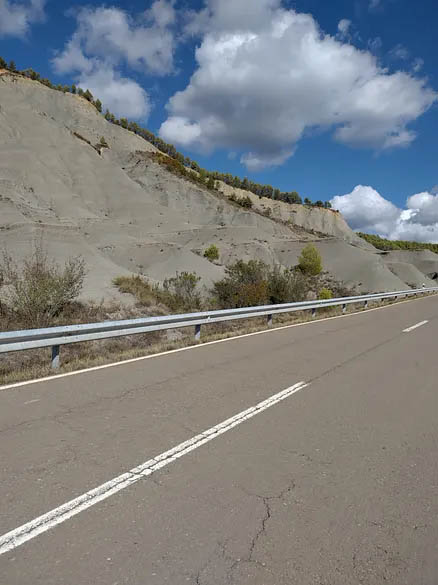
9. Specificity and event-specific preparation
Training must reflect the demands of the event. If the course is hilly, incorporate extensive climbing. If gravel or poor road surfaces are expected, ride similar terrain. Practise carrying full gear if bikepacking is involved. Train in similar temperatures and conditions wherever possible. UK-specific audax training plans integrate calendar events strategically. Learn more about audax coaching for British brevets. 

As the event nears, the focus will shift towards more specific simulations, including night riding, sleep management, and terrain replication. For multi-day events specifically, energy management and pacing strategies determine success or failure. Ultimately, consistency over many months — not perfection in any single week — is what prepares a rider for the demands of ultra distance events.

Reach out if you've hit a plateau in your training or want some help to improve your cycling performance. 💪 🚴🏼‍♂️

Coaching & training plans
Personalised coaching and training plans available from £60/month

You trained hard, now recover smarter 🥑 🥛 🛌

You did the training. Smashed out a big ride, now here’s your number one job: rebuild and recharge.
Coaching & training plans
Personalised coaching and training plans available from £60/month

Forget about "bouncing straight back" — a smart recovery plan now means you'll be riding stronger later.

First 24 hours:

  • Get as much sleep as you can. Aim for 8–10 hours (seriously). Deep sleep boosts recovery hormones.
  • Keep sipping fluids and mix in electrolytes to replace what you lost out there.
  • Move a little: think 20–30 mins walking or spinning, easy enough to nose-breathe the whole time.

Next few days:

  • Short easy rides only, keeping heart rate super low (<60% of max, Zone 1). This is true easy riding at conversational pace where you can chat freely without breathlessness.
  • Stretch, do some mobility work, and check in with your body.
  • No “training sessions” yet — save the big sessions for when your legs feel fresh again. Understanding why rest builds fitness rather than destroys it helps you commit to proper recovery.

Fuel up right:

  • Hit your protein goals (1.6–2.2g/kg bodyweight) to rebuild muscle.
  • Refill your carbs properly (5–7g/kg/day) so you are not running on empty.
  • Load up on colourful veg, berries, oily fish — anything that fights inflammation and boosts recovery.

Bonus tip:

  • Keep an eye on your morning heart rate and general mood. If your heart rate stays high or you feel flat, give it more time. If you're feeling genuinely unwell rather than just tired, learn when to rest versus when to push through using the neck rule. Recovery is a long game — and it is where real fitness happens.

Be patient with the recovery and listen to your body. You'll be back out on the bike soon enough but in better shape to start training again.

Reach out if you've hit a plateau in your training or want some help to improve your cycling performance. 💪 🚴🏼‍♂️

Coaching & training plans
Personalised coaching and training plans available from £60/month

Mental training for endurance rides

Cycling isn’t just about strength – your mental game is key to powering through tough rides, challenging climbs, and race-day fatigue.
Coaching & training plans
Personalised coaching and training plans available from £60/month

To tackle those long, gruelling rides, mental preparation is just as important as physical training. Here’s how to strengthen your mind for your hardest rides:

1️⃣ Visualisation: Picture the journey. See yourself conquering hills, cruising through valleys, and reaching the finish line. This mental prep builds confidence and helps you tackle tough moments.

2️⃣ Positive self-talk: Replace doubt with motivation. Instead of thinking “I can’t,” say “You’ve got this. You’ve trained for this.” Remind yourself of past successes.

3️⃣ Stay present: Don’t get overwhelmed by the distance. Focus on small goals – like reaching the next kilometre or counting pedal strokes. This approach mirrors pacing strategies for multi-day ultra rides where breaking the journey into chunks prevents overwhelm. Keeping your mind engaged helps avoid negativity.

4️⃣ Embrace discomfort: Mental toughness grows when you lean into the struggle. Accept pain as part of the process and push yourself further each time.

5️⃣ Set small goals: Celebrate mini victories – whether it's reaching the top of a climb or hitting a pace goal. These achievements build momentum and motivation.

6️⃣ Mindfulness & breathing: Focus on your breath to stay calm and energised. Deep breathing helps you stay in the moment and fight fatigue. This ties into why easy rides become meditation with wheels – creating headspace without performance pressure.

7️⃣ Use mantras: Keep a word or phrase like “strong” or “keep pushing” in mind to stay focused and energised when the going gets tough.

8️⃣ Celebrate small wins: Every victory counts. Conquering a climb or hitting your target speed boosts confidence and reinforces positivity.

9️⃣ Handle setbacks: Not every ride goes perfectly. When challenges arise, treat them as learning experiences. What can you do better next time? For handling illness setbacks specifically, learn when to rest versus when to push through.

🔟 Stay inspired: Reconnect with your “why” – whether it’s fitness, mental clarity, or the love of cycling. Staying connected to your purpose can power you through tough moments.

Practical takeaway: Long Mountain Climbs

Long climbs become mentally manageable when you break them into smaller pieces. Instead of thinking "I have 13km to climb," focus on "I'll ride to that next bend" or "I'll count the next 5 switchbacks." Take Alpe d'Huez on L'Etape du Tour: 21 switchbacks after you've already climbed 5,000m over the Croix de Fer, Télégraphe, and Galibier. Thinking "21 switchbacks whilst exhausted" is paralysing. Breaking it into "7 bends at a time" makes it rideable. First section to bend 7. Reset. Next section to bend 14. Reset. Final push to bend 21. This segmentation technique works on any sustained climb: identify natural break points (bends, landmarks, gradient changes) and commit only to reaching the next one. Your mind can handle 500m efforts repeated. It struggles with "13km of pain."

Remember, your mental game is just as important as your physical training. Practice these tips and watch your mental resilience grow on every ride.

Reach out if you've hit a plateau in your training or want some help to improve your cycling performance. 💪 🚴🏼‍♂️

Coaching & training plans
Personalised coaching and training plans available from £60/month

Make use of your club rides to get some secret training done 🚀 🚴🏼‍♂️

Club rides are a great way to have fun on the bike, but they often don't fit into a personalised training plan.
Coaching & training plans
Personalised coaching and training plans available from £60/month

Sometimes the group dynamics just don't fit with where you are in training but that doesn't mean that they have to junk miles. As discussed in whether club rides help or hurt structured training, the unstructured nature can derail your training goals. With a few simple drills, you can turn any group ride into a productive training session—without being that person pulling off the front!

Here are a few ways to train without affecting the group dynamic:

✅ Low-torque pedalling – Use an easier gear at a high cadence (90–100 RPM) to refine your pedal stroke and improve efficiency. This differs from truly easy Zone 1 recovery pace because you're maintaining group speed while working on technique.

✅ Engage your core on climbs – Loosen your grip and keep your upper body stable and activate your core to improve power transfer and reduce wasted energy. This will drive more power through the pedals.

✅ Single-leg focus – Mentally isolate each leg while pedalling to smooth out imbalances and strengthen weak spots.

✅ Seated acceleration – Instead of standing to surge, stay seated and push a slightly bigger gear to build strength and endurance. This technique is also valuable for multi-day ultra-distance pacing where seated efforts conserve energy.

These small drills can be integrated into your club rides without disrupting the group dynamic and annoying your buddies with the added bonus that nobody even needs to know you're doing them!
 

Reach out if you've hit a plateau in your training or want some help to improve your cycling performance. 💪 🚴🏼‍♂️

Coaching & training plans
Personalised coaching and training plans available from £60/month

Are club rides helping or hurting your training? 🤔

Club rides are a big part of cycling culture. They keep you motivated, build camaraderie, and can push you to ride harder.
Coaching & training plans
Personalised coaching and training plans available from £60/month

But if you’re training for a specific goal, they might not always be the best option.

Here’s why:

✅ Unstructured efforts – Most club rides are a mix of efforts that aren't truly easy Zone 1 pace, surges, and all-out efforts. That unpredictability makes it hard to hit specific training targets.

✅ Recovery gets overlooked – If a club ride leaves you too fatigued, it can impact your ability to complete key workouts in the days after. Smart training balances intensity with proper recovery. Learn more about post-ride recovery protocols including sleep, nutrition, and monitoring.

✅ Progressive training builds fitness – The best way to improve endurance, power, and speed is with structured training that gradually increases workload while allowing time for adaptation.

So, should you skip club rides altogether? Not necessarily! They can be great for morale and race simulation, but it’s important to integrate them wisely into your training plan. One approach is to turn club rides into stealth training sessions using targeted drills. A structured approach ensures you’re getting the best of both worlds—fun group rides and performance gains.

Reach out if you've hit a plateau in your training or want some help to improve your cycling performance. 💪 🚴🏼‍♂️

Coaching & training plans
Personalised coaching and training plans available from £60/month

Why will your coach ask you to rest? 😴

Ever wondered why your coach asks you to take a rest day?
Coaching & training plans
Personalised coaching and training plans available from £60/month

It’s easy to think that more training = more gains, but here’s the truth: you get stronger when you rest, not just when you ride.

Training can push your body to its limits, breaking down muscle fibres, depleting energy stores, and stressing your nervous system. But, if you don’t give your body time to recover, you’ll start feeling sluggish, struggle to hit your targets, and risk injury or burnout.

So what’s the best way to recover? Balance is key. Some days should be full rest — feet up, proper sleep, and good nutrition. Other days, an easy spin (think coffee ride effort!) can help blood flow and loosen stiff legs. For more on what truly easy riding looks like, including Zone 1-2 intensity and conversational pace guidelines. Studies show that muscle repair, glycogen replenishment, and neuromuscular adaptations occur after training, not during it (Knuiman et al., 2018).

Sleep is your secret weapon. Aim for at least 7 – 9 hours a night to help your muscles repair and keep your energy levels high. 7+ hours per night enhances endurance and cognitive function (Halson, 2014). And don’t forget nutrition — protein rebuilds muscle, and carbs restock your fuel stores. For specific targets and timing, see post-ride recovery protocols including protein and carb calculations.

How do you know if you’re overtraining? Watch out for signs like a higher-than-normal resting heart rate, constant fatigue, or feeling demotivated. Tools like heart rate variability (HRV) tracking can help spot when you need extra rest. If symptoms persist or you're dealing with illness, read about when to rest versus when to push through using the neck rule.

Recovery isn’t lazy — it’s smart training. Give your body what it needs, and you’ll be stronger, faster, and ready to go the distance.

Sources:
Knuiman, P., et al. (2018). Optimising Post-Exercise Recovery: Nutritional Considerations.

Halson, S. (2014). Sleep in Elite Athletes and its Implications for Performance.
 

Reach out if you've hit a plateau in your training or want some help to improve your cycling performance. 💪 🚴🏼‍♂️

Coaching & training plans
Personalised coaching and training plans available from £60/month

Trans Pyrenees № 2, 2022

First-hand race report from Trans Pyrenees Race 2022. 508 miles, 15,100m climbing over 3 days. Lessons on multi-day pacing, self-supported racing, and gravel climbing.
Coaching & training plans
Personalised coaching and training plans available from £60/month

How it started

I first heard of the Trans Pyrenees Race (TPR) back in 2019. It was the first year that the race had taken place. Part of the idea of the race that was launched by Lost Dot, which is the team behind the Trans Continental Race, was to create a race that could be completed in a week rather than the two weeks most riders need to complete its bigger brother.

In 2019, I dot watched and followed all the social media coming out of the TPR and I was in awe of the 107 riders that took to the start line and rode their way across the Pyrenees, not just once but twice, covering 1500 km in a week with an insane amount of climbing. It seemed unbelievable but I was hooked. When the registration window opened up for the 2020 edition of the race I naively applied. At the time I think my longest ride had only been probably 120 miles and I had certainly not done back to back days riding unsupported. It was a whole new world to me and one which would require a big step up in training. At the time, I had one year to get in shape.

Everything changed in 2020. I had secured a place in the race but the pandemic had taken hold so it was postponed. Roll forward another year and in 2021 the race was again postponed. The postponements were both a blessing and a bind. It certainly gave me more time to gain some experience in multi-day ultra distance cycling, but for two years the TPR loomed on the horizon forever in my thoughts. That itself was exhausting at times, let alone the increased load in training.

I used the extra time wisely by taking on a raft of new rides both off-road, on road, mixed terrain and then finally London Edinburgh London in August of 2022. All of these were building up to the big one — TPR № 2 2022.

The race

The format of the TPR involves passing through a series of official checkpoints (CP) as well as completing some set parcours (mandatory sections). This means that between the checkpoints and parcours, riders can choose their own route. Hours were spent pouring over available route options, comparing distance and elevation profiles of different routes to try and iron out as many of the climbs as possible. The route I settled on ended up at 970 miles (1560 km) with 32000 m (104000 ft) of climbing. To complete that within the official cut-off time of seven days would involve riding at least 140 miles, with 4500 meters of climbing, daily. I was hoping for a 5 or 6 day finish time.

Checkpoints and parcours of TPR № 2

Preparations for the race had gone well. With expert coaching from Tim Ramsden of Black Cat Cycle Coaching, I was in the best shape of my life. I had used London Edinburgh London, just six weeks before the start of the race, as a training ride to test out kit and fitness. I was as ready as I would ever be.

September 30, 2022 had arrived — finally after two years of thinking and training for the race I was on the start line of the TPR in Saint-Jean-de-Luz, a small fishing town on the Atlantic coast that has the Pyrenees to the east. One hundred and fifty riders had come together for the start at 06:00 on what was a dark and blustery morning. With the race taking place in September, sunrise was not until around 07:30 and sunset was at around 19:30; there was going to be plenty of riding in the dark. Rain was in the forecast for day 1 and after then it looked pretty favourable.

Milling about waiting for my start wave at 06:25, I was having last minute doubts. Had I done enough training, did I have the right kit, would my lights and bike computer work? I was fiddling with kit, changing clothes and looking at all the other riders, wondering if I could do the race justice. I reminded myself that all I was doing was going for a bike ride. Simple really.

Time to ride. My was cap number 100 and at 06:25 I set off into the darkness through the town and heading for the mountains. All the pre-start doubts ebbed away. It was time to focus on getting day 1 done.

Start line at Saint-Jean-de-Luz

Day 1—settling in

Having started in wave 6, there were plenty of riders already up the road. Their red rear lights on the horizon meant at least I was heading the right way. An hour or two of riding in the dark soon made way to daylight and by now all riders were closing in on CP1, only 40 miles from the start. The rain had held off so far and we were into the foothills of the Pyrenees. Approaching CP1 would involve the first real climb up to 660 meters elevation. Coming from Kent, where the highest point is only at 200 meters, this already involved a longer climb than I was used to. It was stunning and I had only gone 40 miles!

I arrived at CP1 atop the Col d’Ispeguy at 10:00 and had my brevet card stamped by one of the race volunteers. Phase 1 was done. All good so far. The rain had held off but just as I left the checkpoint to start my descent the heavens opened. Brakes on, then a rummage around to get the rain jacket on and then continue to enjoy the first of many long descents in the mountains.

My next target was the start of parcours 2. Based on the route I had planned that was 139 miles away. It’s here after CP1 that different route options would start to play out. Half the field went south, like me, into Spain for a long drag to Jaca and half kept north of the Pyrenees to then have to cross its spine to get to the start of parcours 2.

By now on day 1, the field had stretched out and I was riding on roads empty of cars and other riders. Occasionally, I’d see other riders as we all took a moment to resupply or get a moments rest. Already, I had crossed the French/Spanish border three times but from here I was to stay in Spain for the next day or two. The route I planned to parcours 2 followed the edge of the Yesa Reservoir which was not that full. In places you could see the remnants of the old villages that must have been in the valley before the dam flooded the area. With water levels so low, some visitors had taken the opportunity of getting their campervans onto the reservoir bed and were enjoying a dip in what looked like a cool stream. I was just turning the pedals enjoying the landscape.

My multi-day pacing strategy was conservative from the start: keep power manageable, eat regularly, and avoid the temptation to go too hard on Day 1.

What I’ve learnt from my limited experience in ultra distance cycling is that there is always some admin to do. It’s easy to forget the basics. Eating and drinking is a constant and I have found that regular alerts on my Wahoo bike computer work well to remind me every 20 or 30 minutes. The downside to constantly eating and drinking is the need to resupply when you can. I was in need of more water after six hours of cycling, but the route had little by way of shops along it. Instead, I took to seeking out water fountains that some villages had free to use. This in itself was an adventure. I discovered that not all water fountains are equal. Some were tucked away on a back street in a village and were ornamental gargoyles while others were very simple utilitarian taps. In either case, cold water was perfect on what was a hot day.

My objective for day 1 was to get close to, if not beyond, parcours 2. That would involve covering at least 180 miles. As it turns out, I only managed to cover 164 miles. As the sun was setting the temperature was dropping fast. It was at this time that the first signs of nausea were kicking in. I had been eating and drinking throughout the day, but the telltale signs were there. I stopped for a short break at a service station but could not get much food down.

Knowing that after the next town of Biescas there were not many other towns with accommodation, I took the chance to book into a hotel at around 20:00. It was an earlier finish to the day than I had planned, but given how I was feeling, it was a good call. It was fortunate for me that the hotel had a room available. The owner was intrigued and was wondering why he had bookings from several other cyclists for the night. I explained what we were doing and he thought we were all crazy. Coincidentally, he had heard of London Edinburg London and was wondering if it compared to that. Similar in distance but very different in terrain.

Biescas was also the intersection point for the riders that had stayed north after CP1, so there were a few of us around town getting dinner. I was joined by fellow rider Hector Kidds for dinner at a local restaurant. That was the first and last time I would see Hector. His pace was faster than mine. Having had dinner, I headed back to the hotel and went to sleep as soon as I could, ready for a 04:00 start in the morning.

Daily stats

Start: 06:25 Saint-Jean-de-Luz, FR
End: 19:56 Biescas, ES
Distance: 164 mi / 263 km
Elevation: 13589 ft / 4141 m
Elapsed time: 13 hr 34 m
Ride time: 12 hr 02 m

Day 2 — work to do

The alarm went off at 04:00 for the start of day 2. I had managed to get around 5–6 hours of broken sleep. I had terrible night sweats, so much so, that after a couple of hours I had to swap over to the other bed in the hotel room as the first was saturated with sweat. At the time, I didn’t think much about it as I had experienced some night sweats after previous long distance bike rides. I put it down to a supercharged metabolism activated by the previous day’s ride. A side effect of the night sweats was waking up dehydrated. I tried to get as much water inside me as possible before leaving the hotel to make up for what was lost over night.

When leaving the hotel at 04:40, I was soon joined by a steady stream of other riders also starting out for day 2. Immediately on the agenda was a seven mile climb gaining 600 meters and topping out at 1500 meters. With sunset still hours away, the climb was in the dark, so there was no chance to enjoy the scenery. Instead, I occasionally stopped, turned off all my lights and gazed up to look at the stars. With no light pollution to speak of, it was stunning. An hour after starting out, I reached the top of day 2’s first climb. From here it was descent down to Broto where parcours 2 would start.

Starting early meant managing energy carefully. I kept my effort in Zone 1-2 on climbs, knowing that cumulative fatigue would build over the next few days.

Saturday 05:50 - Tunel de Cotefablo, 1500 m

Arriving at Broto, I stopped to change the route on my bike computer over to the next one. This simple act always feels like you’re making progress. A bit like family road trips of old when you could turn to the next page of the map. Parcours 2 was a 42 mile obligatory section of the race — everyone had to complete this. Each checkpoint and parcours had official cut-off times before which we needed to pass in order to stay officially within the general classification (GC). For parcours 2, riders would need to clear it by 19:00. I was well ahead of the cut-off times at this point in the race, so no pressure.

Parcours 2 was stunning! My thanks go to the race organisers for making this stretch mandatory, as once the sun was up, the mountains around revealed themselves in all their glory.


After several hours of riding, it was time to hunt down some breakfast. Escalona was fast approaching, and my mind was focused on a coffee and something other than left over pizza to eat. A short detour off the parcours into the town center soon presented the perfect pit stop — made better by the tell-tale signs of bikes ladened with bags parked outside. After a short exchange with me speaking English and the kind lady serving me speaking Spanish, I managed to get two coffees, toast and marmalade. Perfect. I think they too were wondering why all of sudden they had lots of cyclists passing through asking for loads of coffee.

I left the comfort of the restaurant at 10:00 with still 18 miles of parcours 2 to complete. It was steady 3–4% drag up from Escalona to Plan, the end of parcours 2. This stretch was amazing and it ticked off one of my main objectives of the race, which was to ride in remote, beautiful regions of the Pyrenees. Everything was great.

Parcours 2 was cleared by midday on day 2. I was still ahead of the GC cut-off times. From Plan, it was a free route to CP3, but the race organisers knew exactly what they were doing as there were very few options from here to get to CP3 without going up and over a gravel track. It was something all riders were prepared for. I was riding my Cotic Escapade gravel bike with 28c tyres, so all being well, it should cope nicely. Again, I thank the race organisers for forcing our hands to take this route. I got to ride my bike up to 2000 meters in the wilderness on a gravel track. It’s something I will never forget.

I cleared the gravel section at around 13:30 having covered just 76 miles since starting out at 04:40. It had taken nine hours to cover 75 miles with only 1000 meters of elevation. I would occasionally check out the live tracking page and could see that I was slipping behind my day 1 pace but was making steady progress. Now back on roads, it was time to try and make up lost ground.

CP3 was still 110 miles away. Its cut-off time was tomorrow, Sunday at 14:00, so I had around 24 hours to make it. There was no chance of me getting there on day 2, so my plan was to ride as long into the night as I could in order to get as close to it as possible. I set out to cover as many miles as I could.

Much like the night before, I had not booked any accommodation ahead. I was carrying a sleeping bag and bivvy just in case I needed it, but the plan was always to try and get a hotel for the night if possible. With sunset passing, I found myself struggling and knew that there were few towns down the road over the next few hours, so when I rode through Senterada at 19:30 I jumped at the chance to get a hotel room. This time I hit the jackpot. The lady at the hotel could not be more accommodating. Not only did I get the last room, I was just in time to get dinner as well. I later found out that just after I secured the room, she had a flurry of phone calls from other riders looking for a room for the night.

I got the usual set of daily chores done first. Wash and dry the kit as best as you can, have a shower, and get all the electronics on charge. Then it was dinner time for the best four course meal I’ve had for ages — all for €20.

Again, I had stopped a lot earlier than I had planned but my body was in charge and it was feeling the effects of the past two days. Knowing that I was starting to bump up against the cut-off times, I set the alarm for 03:00, giving me around five hours of sleep.

Daily stats

Start: 04:42 Biescas, ES
End: 19:32 Senterada, ES
Distance: 119 mi / 189 km
Elevation: 14498 ft / 4418 m
Elapsed time: 14 hr 50 m
Ride time: 11 hr 53 m

Day 3 — tough day

The alarm chimed at 03:00. Day 3 of the TPR had started. Again, the night’s sleep was broken up with more night sweats that required me to swap beds after a couple of hours. By now, three days in, the morning routine was familiar: forcing some food down, drinking as much water as possible, packing everything onto the bike, and heading off in the dark. At 03:00, the body doesn’t always want to co-operate, so eating little and often was the only way to get as many calories in as possible.

From Senterada, CP3, at Os de Civis, was 55 miles away deep in the Pyrenees just west of Andorra. The GC cut-off time was 14:00 in the afternoon. On paper I had plenty of time to get there before the cut-off time but the approach to this checkpoint had two options. A longer road route from Sort, climbing through Andorra, or the shorter Ruta del Contrabandistes gravel track from Tirvia to Os de Civis. I opted for the smugglers’ route up over the mountain.

Getting up and over the Ruta del Contrabandistes involved a 1000 meter climb, topping out at 2100 meters, deep in the heart of the Pyrenees. I was pleasantly surprised to find that the lower end of the climb was a smooth bitumen surface, but that soon gave way to a gravel track. As I was not feeling too strong at this point, I had to break up the climb into manageable chunks. I seem to do this a lot on ultra-distance rides. I’m sure other riders do the same as it helps to make the challenge ahead more manageable. For this climb, I settled on chunking it up into blocks of 100 meter elevation gain. For every 100 meters up, I would stop for 20–30 seconds to ‘enjoy the view’. Sometimes the 100 meters would happen quickly but at other times, due to the nature of switchbacks, there was quite some distance to cover to complete it.

Having gained all that elevation, it was time to descend 700 meters to the checkpoint below. The descent would have been magical on a mountain bike with suspension and nice wide tyres, but on a road bike with 28c tyres, it was a challenge. Dropping down that gravel track to CP3 took 30 minutes alone, involving some interesting bike handling. Thankfully, I was using disc brakes and they were working!

It had taken me quite some time to get to CP3, but I wouldn’t change my route choice if I ever had to do it again. The remoteness of the track was occasionally broken by livestock and other riders also making their way to CP3. It was spectacular.


I arrived at CP3 at 11:45, some two hours ahead of the GC cut-off time. I was a little beaten up by the relentlessness of the gravel track and its descent into Os de Civis. Boy, was I pleased to be there. Time for the first real food of the day after already riding for nine hours. Two coffees and a plate full of eggs and toast didn’t even touch the sides.


After a short pit stop at CP3 to eat and have my brevet card stamped, the next objective for the day was to make it as close to CP4 as I could. CP4 at Coustouges was 119 miles away. Its GC cut-off time was Monday 09:00, which left me 21 hours to get there. Having only covered 53 miles in nine hours so far on day 2, I had plenty of work to do.

From CP3, my route involved a blissful descent through Andorra on a perfect sunny Sunday. As I was freewheeling down a 15-mile descent from CP3, I caught glimpses of fellow TPR riders making their way up to CP3 having chosen the alternative road route option. By now, my position in the race had slipped further but I had the cut-off times in mind to beat, not other riders.

I was starting to feel the cumulative effect of the previous few days and wasn’t feeling very energetic. I didn’t have any nausea, which was good, but any semblance of power in the legs had gone. I was making progress but ever so slowly. By now, my average speed across the terrain was around 10 mph. I knew that I had to cover a lot of ground today in order to have any chance of clearing CP4 by 09:00 in the morning.

The afternoon of day 3 went on for an age. I can honestly say that this was the toughest day I’ve ever had on the bike. The combination of early start, gravel climbing, and insufficient nutrition created the perfect storm. This was exactly the kind of mental challenge I'd prepared for, but experiencing it firsthand was brutal. 

An early start, a gravel climb up to 2100 meters, collective fatigue and not enough food all played their part, but to get within touching distance of CP4 I had to press on. It was Sunday afternoon and a lot of resupply options were closed, so getting some decent food was proving to be a challenge. The best I could find en-route was a vending machine at a self-service petrol station. Fuelled by two cans of coke and some chocolate bars, I still had to tackle another climb up to the ski town of Super Molina at 1800 meters. Given my pace, this took the best part of a couple of hours.

I knew that from the top of the climb there was a long 22-mile descent down to Ripoll where I could finally get some decent food. That itself took an hour of rolling downhill, not pedalling that much. At every road sign I was wishing for Ripoll to be there as I was running on empty. It couldn’t come soon enough. After a quick pit stop at a bakery and supermarket, where I picked up enough food for dinner and also for tomorrow’s breakfast, I was just 15 miles from my pre-booked hotel room in Camprodon.

From Ripoll to Camprodon, the road was a steady 2–3% gradient. Ordinarily, that would feel all but flat but after this day’s efforts it felt like riding up a 10% climb. I arrived at my hotel at 20:00, some 17 hours after starting the day back in Senterada at 03:00. I had managed to cover 137 miles with 4151 meters of climbing, and by the time I rolled into the hotel, I had nothing else to give. The hotel did not serve food, nor were there any restaurants nearby open on Sunday evening, so once I got into the hotel room I settled down to my dinner of takeaway pastries, crisps and an assortment of other snacks.

To stay within the GC I had to get to CP4, 32 miles away, before 09:00 in the morning. Based on my pace, I assumed that would take nearly three hours, so the alarm was set for 04:00 to give me some wiggle room.

Daily stats

Start: 03:00 Senterada, ES
End: 20:01 Camprodon, ES
Distance: 137 mi / 220 km
Elevation: 13619 ft / 4151 m
Elapsed time: 17 hr 00 m
Ride time: 13 hr 12 m

Day 4 — the Mediterranean

By now, the night sweats were a regular occurrence. I had assumed it was just down to the effort put in daily and didn’t think much else of it. The alarm sounded at 04:00 and the now familiar routine of eating, drinking and getting kit ready was under way. However, an odd thing happened that morning. I put on my bib shorts and then sat down on the bed to finish getting dressed only to think that I was sitting on something. I stood up, checked what that might be and found that there was nothing there! It turns out that overnight I had developed a large lump just next to my left sitting bone. I figured it was bruising and not much else. I knew that sitting on the saddle would sting a bit but after a while it should subside, so I carried on, determined to get to CP4 and beyond that to CP5 — the halfway point.

The hotel had not let me keep my bike in the room. Instead, it was left overnight in the hotel bar area. As I returned to my bike in the morning, I was joined in the bar by fellow rider Josh Roberts who was also getting ready to start the day. We couldn’t find any light switches so both of us were loading up the bikes under torch light. As we filled up water bottles from the bar, Josh had the brilliant idea of making a coffee. It was a very civilised start to the day, thank you Josh.

I was ready to begin day 4 at 04:25 on Monday and to start chasing down CP4 and CP5. As expected, when I sat on the saddle, my newly developed lump was quite uncomfortable. It took a mile or two before that pain subsided. From Camprodon, the road immediately went uphill on a gentle 10 mile climb up to the Spanish/French border.

I rolled through CP4 at 08:00, just one hour before the official GC cut-off time. It was getting tougher and tougher for me to keep the pace needed to stay ahead of the cut-off times. The only saving grace was that CP5 was only 50 miles away and its cut-off time was at 18:00. I had ten hours to cover that distance, so this time the pressure was off.

During those 50 miles, my condition deteriorated a lot. I was not able to maintain any meaningful pace and I was just not feeling very well. Three and a half days ago I was on the Atlantic coast and at 11:00 I got my first glimpse of the Mediterranean. However, there was still work to do to get to CP5 at Phare du Cap Béar in France.

Not long after seeing the Mediterranean, the route dropped down into the coastal town of Banyuls-sur-Mer where I found a few other riders eating outside a Carrefour supermarket. It was around midday, and having not eaten much that day, it was a perfect opportunity to get some decent food onboard. A random mix of food and drink was bought and consumed providing some overdue calories. From here, there was another climb back up to only 450 meters, but that felt as tough as any previous climb I’d tackled.

I arrived at CP5 at 13:30, got my brevet card stamped and sat to enjoy the view for a while. I’d crossed the Pyrenees in 3 days 7 hours, covering 508 miles and climbing 15000 meters, which gave me a daily average of 145 miles and 4300 meters of climbing. This was only the halfway point. The return route would involve the same effort to get back across the Pyrenees.

However, for me, this was the end of the race. I gently rolled into the nearest town a few miles beyond CP5, sat down for some food and officially scratched from the race in the beautiful fishing town of Collioure. I was in no fit state to continue, and having crossed the Pyrenees once, it seemed like a fitting place to end my adventure.

Back in 2019, when I first registered for the race, I wanted to experience the remoteness of the Pyrenees, long climbs, and long descents, and even though I had to scratch, I am content with achieving those objectives. The TPR was both brutal and beautiful. I had the privilege of riding through some amazing landscapes and meeting fellow riders of whom I am in awe. You are all superstars. Sharing moments with each and every rider I met along the route was always special. We were all battling the race in our own way.

Fatigue, lack of energy and pain from the newly developed lump all played their part to finish me off. After my meal, I made my way to the nearest train station to begin my journey back to the start to pick up my van and head home. Having scratched on the wrong end of the Pyrenees, my journey back to the start involved four trains and an overnight stop in Toulouse. Coincidentally, as I arrived back at the start/finish town, the leader, Robert Mueller, was about to cross the finish line, completing the race in an amazing 4 days and 6 hours. That involved covering around 200 miles and over 8000 meters of climbing daily. Amazing!

Daily stats
Start: 04:25 Camprodon, ES
End: 14:35 Collioure, FR
Distance: 89 mi / 143 km
Elevation: 8038 ft / 2450 m
Elapsed time: 10 hr 10 m
Ride time: 7 hr 50 m
View on Map My Tracks

Back home

I drove back to the UK from the Pyrenees. It took around 16 hours as I kept needing to stop and sleep every few hours. Even in the van, the night sweats had continued. As I had stopped riding a day or two before, it seemed a little odd that I was still getting them. My lump was also still with me, which made driving just about as uncomfortable as sitting on a saddle.

From the comfort of home, I was able to better check out the lump that had been with me for at least a few days. By now, it was about 10 x 2 cm in size and pretty solid with no bruising to speak of, so I had it checked out by the GP who immediately told me to get to A and E to see the surgical team. It turns out that the lump was in fact an abscess that needed to be drained. Somehow, I had developed an infection early in the race which had been brewing throughout, resulting in the lump, and no doubt causing all the night sweats and my deteriorating condition. The infection had spread down my leg, so in hindsight scratching at the halfway point was definitely the right decision.

Following surgery to drain the abscess, I now have six to eight weeks of recovery off the bike. Time enough to start planning some adventures for 2023.

My TPR route

Total ride stats

Start: 06:25 Friday Sept 29, 2022 — Saint-Jean-de-Luz
End: 14:35 Monday Oct 3, 2022 — Collioure, FR
Distance: 508 mi / 817 km
Elevation: 49500 ft / 15100 m
Elapsed time: 3 d 7 hr 5 m

Reach out if you've hit a plateau in your training or want some help to improve your cycling performance. 💪 🚴🏼‍♂️

Coaching & training plans
Personalised coaching and training plans available from £60/month
Golden hour on the LEL
Moorland
Fellow LEL rider

London Edinburgh London 2022: 1600 km from London to Edinburgh and back

First-hand race report from the London-Edinburgh-London Audax...
London-Edinburgh-London coaching & training plans
Personalised coaching and training plans available from £60/month

On August 7 around 1500 riders, including myself, set off on a 1550 km round trip by bike from London to Edinburgh and back to London again.

London Edinburgh London (LEL) is an audax. It’s one of the UK’s most prestigious audax events and attracts riders from all over the world. An audax is a long distance bike ride that is not a race, not a tour, not a sportive, and not a club run, but it is known internationally as a “randonnée”; it’s a unique cycling experience.

LEL takes place every four years and was supposed to happen last year, but for obvious reasons, it was postponed to 2022. As with any audax, LEL has a series of checkpoints along the route that need to be passed through to verify your passage along the course. Each of these checkpoints has a time limit within which you must pass in order to be an official finisher. The time limits are based on a maximum and minimum speed that force riders to continue onto the next checkpoint at a steady pace. The official time limit for LEL this year was 128 hours (5.3 days) during which 1550 km needed to be covered. Broadly speaking, that’s 290 km to be ridden each day to finish within the cut-off time.

Having said that an audax is not a race, the mere fact that the clock is always ticking means that you can’t help but want to push on a bit to get ahead of the time limits and cover as much ground as you can as quickly as you can. You end up racing the clock, not other riders, to stay within time or gain as much time as you can. For me, I had it in mind to try and finish in less than 100 hours which would need me to cover 372 km each day. I was prepared having working with an audax coach who helped structure my preparation with a systematic audax training plan that built up my endurance. Here’s how it went…

Saturday, 6 August — Registration

With the amount of riders attending the event, registration takes place the day before the start. It was an opportunity to meet riders and start getting to know some of the army of volunteers that had come from around the world to help make the event a great success. It quickly became apparent that this was a big event! Volunteers at every turn were making sure all the riders were welcome and where they were supposed to be.

One of the nice things about LEL is having the opportunity to send some kit/supplies ahead ready for you to pick up at your designated checkpoints. I had chosen to have my two bags sent to Hessle and Brampton. In the bags were some treats, food and clean kit. You could also use the bags to offload any surplus kit that you might not be using. All very handy.

With registration complete, there was just one more sleep before the adventure began.

Sunday, 7 August — Day 1

In the build up to the event, riders could choose the start time they preferred. The early riders were off at 06:00 on Sunday morning but, as I did not get my requested time slot, I was due to start later at 13:30 on Sunday afternoon. For me, that meant that most of the field would be ahead on the road so I would always have company and wheels to aim for. It also meant that I had a short first day to cover as many miles as I could.

Ready at the start

The route took us north from Debden in North London to the first checkpoint at St. Ives some 100 km from the start. I arrived at 17:17. At the checkpoint, a familiar routine would unfold: arrive at the checkpoint, grab brevet card, find the control point, have brevet card stamped, find the food hall and eat, fill up water bottles, jump back on the bike and head off to the next checkpoint. It was a routine to be played out across each of the 19 checkpoints up and down the country. Each stop takes time out of the overall 128 hours available so you need to be efficient to avoid putting any time pressure on yourself later in the ride.

It was at checkpoint one that I got the first taste of the mountain of food prepared and available for the riders. At every checkpoint, day or night, riders were fed like kings. It was fantastic and much appreciated. Thank you LEL.

In some previous events I’ve suffered from exercise-induced nausea, leaving me not able to take on any food or drink and, in some cases, having to scratch from races. After some trial and error, and frantic googling on the topic, it seems that, for me, the nausea is pace related. Understanding energy management and pacing for multi-day rides helped me avoid this problem throughout LEL. There is some interesting research on the topic but my layman's interpretation is that when pushing hard for any length of time my guts shut down and don’t want any food to process. The more sophisticated interpretation is “Exercise stress of ≥2 hours at 60% VO2max appears to be the threshold whereby significant gastrointestinal perturbations manifest, irrespective of fitness status.”

With this in mind, I was keeping a steady pace on day one not wishing to trigger any nausea. I kept telling myself to be soft on the pedals and, for most of day one, my heart rate was in zone 2 with some brief spells in zone 3. This true Zone 2 easy riding became the foundation of my entire event strategy with great success. No signs of nausea, and in fact, at every checkpoint I had a healthy appetite and ate well, which no doubt helped offset the calories being burnt throughout 16 hours each day.

My intention for day one was to cover 300 km and get to the checkpoint at Hessle, just over the Humber Bridge, but as the day turned to night, it soon became apparent that I was either going to have to ride through the night to get there or take the decision to stop short at Louth. I arrived at Louth checkpoint at 00:17. Hessle was still 60 km away but I decided to stop at Louth to get a few hours sleep, recharge and eat. My thinking was that I would need to get a few hours sleep somewhere, be it at Louth or Hessle, so I may as well use the time at Louth, then I’d have a full day of riding for day two.

Louth was a busy place to be, with many of the riders that had started earlier already at the checkpoint taking up the available beds, so I found a small gap between other riders sleeping in the corridor, got my sleeping bag out, put some ear plugs in and got 2.5 hours sleep.

By the end of day one, I had covered 242 km, somewhat short of my target, which left me with plenty of work still to do.

Monday, 8 August — Day 2

By now the full extent of the task ahead had dawned on me. Day two was always going to be a test. With the previous day’s miles in the legs and the increasing elevation to come, things were about to get tougher.

With checkpoints at roughly every 70 km, all that was required was to make it to the next one, then repeat again and again, one checkpoint at a time. I left the comfort of Louth’s checkpoint at 03:20 on Sunday morning with Hessle in my sights.

One of the highlights along the route was riding across the Humber Bridge between Hull and Hessle. It seemed I timed my bridge crossing perfectly in time for a beautiful sunrise, and with the crossing done, Hessle was just a few miles away. I rolled into the Hessle checkpoint at 05:56 on Sunday morning having covered just 60 km so far on day two. Brevet card stamped, it was time for second breakfast. There was still plenty of distance to cover, so no time or need for sleep here.

Having left Hessle, the next checkpoints in sight were Malton, some 67 km away, then Barnard Castle, another 113 km beyond that. I passed through the checkpoint at Malton at 09:46, making good time, but fatigue was kicking in mainly due to the lack of sleep.

It was the stretch between Malton and Barnard Castle that things started to get interesting. The route took us over the North York Moors, and with over 400 km already in the legs by this point, the inclines were taking their toll.

I’m convinced that there is some sort of time vortex around every checkpoint as it seemed that the last few kilometers into every checkpoint took an age to complete. What would normally take 20 minutes to cover now seemed to take 30 minutes or more! The approach to Barnard Castle was like cycling through treacle. It couldn’t come soon enough.

Barnard Castle’s checkpoint was reached at 17:17. It had taken me 7.5hr to cover 113 km from Malton. Quite a long time — quite slow! This was a reflection of both my state of mind and body. During this phase, I started to get a shooting pain in my left foot on every pedal stroke. That, coupled with the sheer fatigue from having just 2.5 hours sleep so far, put me in a bit of a low patch mentally. It was here at Barnard Castle that I had thoughts of scratching from the event. With the pain, fatigue and knowing that the next checkpoint hop was over the Pennines, I was ready to call it a day and get the train back home. I was clearly knackered, and after a chat with loved ones, I took a short sleep break before making any sort of decision. I got three hours sleep at Barnard Castle, ate well and considered my options.

The advice given by experienced long distance riders is that it won’t always get worse. Things will get better. Thanks to many comforting words from my wife, I decided to push on past Barnard Castle to at least get to the next checkpoint at Brampton and consider my options there. Mental strategies like staying present and breaking the challenge into smaller tasks proved essential. With the plan set, it was time to tackle the Pennines in the dark!

The checkpoint hop between Barnard Castle and Brampton was only 62 km. I took me around five hours to complete that section alone but boy was it worth it. While the views were blurred out by darkness, we had a clear sky, stars and a near full moon for company. That, coupled with the steady stream of rear lights from other riders ahead on the road, made this a magical section. An experience I nearly missed out on!

Given the scale of the event, there was never any moment that you were too far away from fellow riders. Riders from around the world had descended on the event. Australia, India, Malaysia, USA, Germany, Spain and just about any other country was represented. Seeing the various flags attached to bikes was always interesting and great fun to spot. However, crossing the Pennines over night made for little chat amongst my surrounding riders. Can’t imagine why.

I rolled into Brampton at 02:50 having covered 326 km since my start at Louth earlier that day. It had taken me 26 hours during which I had around 10 hours off the bike either sleeping, eating or faffing. The checkpoint routine was now well practiced. Find the control, have the brevet card stamped, eat like a king and, at Brampton, get some sleep.

Tuesday, 9 August — Day 3

Having reached Brampton, and after a few hours sleep, I was in a much better state of mind and had decided to continue on. It seemed that with the Pennines behind me, I could start to think about getting to the halfway mark; my next goal.

I left the comfort of Brampton’s checkpoint at 05:53, three hours after arriving, and headed off for the Scottish Borders. I think it was across this day that I settled into the ride knowing that all I had to do was cycle. To keep on track with my overall goal I needed to put in another big day.

To help with the foot pain that had developed I moved my cleat position a little. That, and a few painkillers, seemed to help take my mind off the problem, and it made this stretch of the route far more enjoyable than what I was going through 24 hours earlier.

The main aim for the day was to get to the Dunfermline checkpoint — the halfway point at 750 km.

I rolled into the Dunfermline checkpoint at 15:10 on Tuesday afternoon. So far that day I had covered 185 km so there was still plenty of distance to cover to keep on track and within time. My time at Dunfermline was brief — I only stayed for about 1–2 hours, eating again!

Crossing the Firth of Forth was another highlight of the ride. Crazy to think that 48 hours before I was in London and I’d made it here under my own steam by bike. Thoughts of scratching from the event were well behind me now and, having made the turn south, it seemed a much more manageable task to consider completing the ride.

My sights were set on the next checkpoints — Innerleithen and beyond to Eskdalemuir. While the day time temperatures were topping around 25° C, the overnight temperatures were more like 10° C, and in some valleys, with a clear night sky, it was less. Coming south out of Edinburgh we were treated to a steady descent of around 20 km into Innerleithen, which proved to be very cold. I had all my clothes on and was still chilly.

I reached the Innerleithen checkpoint at 21:20 on Tuesday evening. Had I stopped here for sleep, it would have left me with too much to do on the next day. Eating like a king again was the only task at hand, and with another quick pit stop done at Innerleithen, it was on to Eskdalemuir, a hop of only 50 km.

Carbs, carbs, carbs

I arrived at Eskdalemuir at 00:30 Wednesday morning with 312 km completed for the day and I decided to take a sleep break here. The only problem was that Eskdalemuir didn’t have official sleep facilities like all the other checkpoints. I arrived to find riders strewn around the place getting what sleep they could on the floor in corridors and under tables. For me, I joined another gentleman under a cafeteria table while others on the next table were enjoying their meal. While it was not the most glamorous of settings, I managed to get a few hours sleep to reset and recharge.

Wednesday, 10 August — Day 4

Having got some rest under the table, I was ready to start the next section and left Eskdalemuir at 04:00. Today was going to have to be another big day to keep on track with my schedule. Leaving the checkpoint I was greeted with a misty start and an immediate climb out of the valley. It was only once we topped out over Saugh Hill that the mist gave way to a clear morning sunrise.

06:00 River Esk at Longtown

06:00 River Esk at Longtown
Back on today’s agenda was the southbound passage of the Pennines. This time, I was to cross them in daylight. By this phase of the event, the rider density had thinned out a little with many riders ahead of me and many still behind me. However, there were still riders in sight dotted along the route making their own way south. With clear skies and the temperature rising, the southbound crossing of the Pennines was beautifully tough.

I made it to the southbound checkpoint at Barnard Castle by 13:10. Back to the point where I nearly packed it all in 48 hours earlier. On my northbound stop at Barnard Castle I had spotted a room where some kind volunteers were giving massages, so on the southbound visit I sought them out and booked myself in. They had a queue of other riders to deal with so I took the opportunity of also getting an hour’s sleep while I waited my turn.

It’s fair to say that the 100 km after the massage was fantastic. They had worked wonders on my legs, and with renewed vigour, I left Barnard Castle in search of the next two checkpoints to round off the day. Malton was passed through at 20:50 and I finally arrived back at Hessle at 02:40 Thursday morning having covered 329 km in 26 hours.

Thursday, 11 August — Day 5
The finish was in sight but it was still 320 km away. I had managed to sleep well at Hessle and had started a little later than planned at 06:12 in the morning. If I was to finish within my 100 hour target I would need to arrive back in London by 17:30. A tall order by my standards but the terrain for this last stretch was much flatter than any of the previous days.

Early in the morning the Humber Bridge was hiding itself in the mist as I crossed it southbound, but that soon cleared, and the temperature began to rise. From Hessle the route crosses the Fens in Lincolnshire and onto Cambridgeshire. Both counties are thankfully pretty flat. With what seemed to be neverending roads and heat coming at us from all directions, it made this section quite tricky to stay hydrated. Thankfully, many supporters had come out along the route offering riders water and refreshments. By now, many villages had spotted a steady stream of riders passing through and realised that the event was taking place on their doorstep. Some shops and cafes had opened out of hours to support the riders.

With the finish line ever closer and the clock still ticking, I got my head down across the flatlands to cover as much ground as possible. I arrived at the St. Ives checkpoint 15:35 and, still with 120 km to go, it became clear that I was not going to make my target of 100 hours but that didn’t stop me trying! A short food stop at St. Ives all done, I was back on the road heading to the penultimate checkpoint at Great Easton some 70 km away.

Having spent most of the day riding on the tri-bars, my neck was starting to feel the strain. I had heard that some riders ahead had been affected by Shermer’s Neck and was aware that I was close to having a problem, so I changed my ride position to a far more upright position which helped a little.

I arrived at Great Easton at 19:59. The routine still the same: find the control, get the brevet card stamped, eat more food, fill up bottles, then chase down the next checkpoint. The only difference this time was the next checkpoint was also the finish. Having arrived at Great Easton feeling exhausted, I left there with a full belly and feeling great. The last hop to the finish was only 48 km on rolling roads and no major climbs. This last leg had the feel of the last day of school — you can’t wait for it to end but you know you’ll miss it too.

At 22:35 on Thursday evening, I finished London Edinburgh London — 1550 km in 105 hours (4.3 days) with an elevation gain of ~15000 m. An army of volunteers were on hand to cheer and help every rider at the finish line. Their support and encouragement at each checkpoint were magnificent and I thank you all.

What an event. It was certainly a test. I had not covered that sort of distance before — four days of 320 km back-to-back riding. I am so grateful for the support from loved ones, all the volunteers and the messages on social media. Without their encouragement, I’m sure the end result would be quite different. Thank you all.

I would definitely encourage everyone to give the event a go, and with the next one due in 2025, there is plenty of time to get used to the distances.

For me, next up is Trans Pyrenees. A completely different proposition.

London Edinburgh London route

For comprehensive LEL preparation guidance, see our London-Edinburgh-London coaching page.

Stats

Day 1: London to Louth

Distance: 246 km / 153 mi
Elevation: 1414 m / 4642 ft
Moving time: 09:37
Sleep/eat/faff time: 4:13
Elapsed time: 13:50

Day 2: Louth to Brampton

Distance: 328 km / 204 mi
Elevation: 4184 m / 13730 ft
Moving time: 16:20
Sleep/eat/faff time: 10:10
Elapsed time: 26:33

Day 3: Brampton to Eskdalemuir

Distance: 312 km / 194 mi
Elevation: 3314 m / 10873 ft
Moving time: 14:28
Sleep/eat/faff time: 7:40
Elapsed time: 22:08

Day 4: Eskdalemuir to Hessle

Distance: 329 km / 205 mi
Elevation: 4111 m / 13488 ft
Moving time: 16:15
Sleep/eat/faff time: 10:00
Elapsed time: 26:15

Day 5: Hessle to London

Distance: 320 km / 199 mi
Elevation: 2082 m / 6831 ft
Moving time: 13:35
Eat/faff time: 2:50
Elapsed time: 16:25

Total: London Edinburgh London

Distance: 1536 km / 955 mi
Elevation: 15106 m / 49564 ft
Moving time: 70:15
Sleep/eat/faff time: 34:53
Elapsed time: 105hrs / 4.3 days

Injuries/ailments

Saddle sore caused by chafing
Numb toes on right foot
Numb fingers on right hand

Reach out if you've hit a plateau in your training or want some help to improve your cycling performance. 💪 🚴🏼‍♂️

London-Edinburgh-London coaching & training plans
Personalised coaching and training plans available from £60/month

Trans Atlantic Way 2023

First-hand race report from the Trans Atlantic Way 2023...
Coaching & training plans
Personalised coaching and training plans available from £60/month

Day 1 —Derry to Loche Nacung

154.92 mi, 3548m
Started great. Ended the day with heat exhaustion, vomiting and shivers! Went too hard. Nearly scratched. Understanding energy management and pacing for multi-day events could have prevented this crisis.

Everything was going great until it wasn’t! Overheated today so was sweating loads and got dehydrated which stopped me being able to eat. It concluded with me seeing the contents of what little was in my stomach. Queue internet search to find accommodation so the day was cut short of my distance target but needs must.

Day 2— Loche Nacung to Sligo

121.19 mi, 2524m
Dropped HR effort but still not able to tolerate food. Again nearly scratched.

Managed to get some rest overnight and before leaving the B&B. Had a good breakfast. However, nausea return so haven’t been able to eat very well today. Proper hydration and nutrition protocols are critical for multi-day recovery. It’s been super hot here and I’ve had problems with the heat before.

Day 3— Sligo to Kylemore Lough

207.4 mi, 2461m
Back eating and able to cruise nicely at around 130 bpm.

Over night I was expecting to scratch in the morning but woke up feeling much better so was able to push on and cover some distance to get back on track. Mental strategies for pushing through dark moments and staying present saved this race.

Day 4— Kylemore Lough to Killimer

215.86 mi, 2556m
Still feel good! Eating properly.

Big day out to push onto the ferry crossing. No chance of getting the last ferry at 19:00. Ended up camping nearby to roll over to get the first ferry in the morning at 07:00.

Day 5— Killimer to Lauragh

171.13 mi, 2442m
Fatigue kicking in on hillier parcour.

Day started with a ferry crossing that opened at 07:00 so there were a few other riders there too.

Day 6— Lauragh to Kinsale

165.12 mi, 2886m
Long slog with end in sight.

All done! Officially finished in fifth place on the Setanta route (1030 mi) in 5d 15h 45m

Totals

Distance: 1036.62 mi
Ascent: 16396m
Elapsed time: 5d 15h 47m

Reach out if you've hit a plateau in your training or want some help to improve your cycling performance. 💪 🚴🏼‍♂️

Coaching & training plans
Personalised coaching and training plans available from £60/month
Remote frozen path
Moorland road
Night time riding

Trans England 2022: 260 km across england

First-hand race report from the Trans England ultra-distance event...
Coaching & training plans
Personalised coaching and training plans available from £60/month

For me Trans England 2022 started at 22:00 from Morecombe on Friday evening. Due to some train delays my planned start time of 20:00 was missed by some margin but with an open start window of anytime between 20:00 and midnight I was ready to go in plenty of time

Trans England is an unsupported bike ride from the west of England starting in Morecombe over to the east of England in Scarborough. They describe this as a reliability ride, not a race, but with the clock always ticking and proof of passage required by time stamped photos it seems like a race.

In transit to the start
Pre-ride supply stocking up on food

The format of the race (reliability ride) is to pass through six check points peppered across the Yorkshire Dales and North York Moors. It’s up to each rider to decide what route to take between each checkpoint with the option to take gravel shortcuts over the top of the dales and moors to cut down on the overall distance. That trade off was something that was going to come back to bite me later in the ride.

From all the pre-ride social media posts it was clear that there was a broad mix of road-only riders and, like me, those that were going to take a few gravel tracks and had opted to ride a gravel bike.

Ready for the start from Morecombe.
Ride officially started at 21:48 in Morecombe.

The organisers, The Racing Collective, require riders to verify their passage through each checkpoint by posting a time stamped photo of themselves, or bike, on Twitter with the hashtag #TransEngland22. Simple, effective and sometimes challenging in the middle of nowhere with no signal. All part of the fun.

Janet’s Foss fall

Checkpoint 1 was some 36 miles into the ride with around 700 metres elevation gain already done. By now, darkness had become familiar and the occasional glimpse of a flashing rear light from fellow riders the rhythm of the ride was set.

Checkpoint 2
There is a footpath there somewhere!

We were forewarned that checkpoint 1 was a ‘short hike’ from the road and indeed it was short hike but that failed to disclose the clambering down then back up that was required in cycling shoes not made for slippy rock! Great fun for 01:00 in the morning. With CP1 ticked off and tweet posted it was time to hunt down CP2.

Crackpot Cottage

With my route of choice checkpoint 2 was around 30 miles down the road. It was after CP1 that a few gravel options start to present themselves to take a more direct route. I’d pre-planned my route so didn’t want to stray away from what was already on my head unit and given the time of night I had no notion of the terrain around me. My little world was the beam of light in front of me which soon started to get filled up with snow fall.

The road conditions hadn’t been too bad. Mostly dry and thankfully no ice. However, over the tops of the dales snow had started to fall and by the looks of the surrounding landscape it had also snowed the day before. The off-road sections through the night tended to be a mix of snow covered tracks and ice puddles. It was comforting to see some fresh bike tracks at 03:00 in the middle of nowhere that were laid down by fellow riders taking the same short cut.

03:00 Saturday morning on Gilbert Lane at 550m.
Snowy over the tops

I arrived at checkpoint 2 at 04:50 Saturday morning. By now I’d been riding for seven hours and had covered 65 miles. The terrain, and my route choices, were keeping the pace down!

CP2 done!

North Yorkshire Moors signpost

Checkpoint 3 was some 45 miles away. By now, the snow showers had cleared and the stars were out in full force. The route for this stretch took on a flat-ish profile through Northallerton heading to the the North York Moors.

Resupply stops had been non-existent through the night. I had planned for this making sure I had enough food and water to get me to a 24 hr petrol station at Leeming Bar. This came 90 mile into the ride at 06:30 in the morning. It also had the added benefit of being over the half way mark along the route. Pacing strategies for multi-day rides emphasise energy conservation - something I should have paid more attention to on my route choices.

With the sun now up it soon became clear that the ride was far from over. I was 70 miles from the finish but had the small task of ticking off three more checkpoints along the way, each deep inside the North York Moors.

I arrived at CP 3 at 08:50 some 11 hours into my ride. The only meaningful stop during that time was for the resupply at Leeming Bar for no more than 30 minutes. Daylight was helping to keep my energy levels up and so far there wasn’t much sign of the lack of sleep and a big bonus for me was that I seemed to have kept nausea at bay. It’s been a real problem on past rides and this time with a regimented drink/eat routine I fared better. Understanding post-ride recovery nutrition helped me dial in this routine.

From checkpoint 3 my route had only 55 miles to the finish. What could possible go wrong!

St Nicholas Church

It was obvious that the organisers had placed the checkpoints in some fiendishly awkward places. St Nicholas Church was the only checkpoint to be reused from the previous year’s edition of the race. I was familiar with it and I thought I had a great plan on how to get to it with a sneaky gravel shortcut that did not require me to go up the Ingelby Incline again. I walked it last year and didn’t fancy that again!

I could have taken some smooth tarmac all the way to the church’s front door but on the map that looked to take in a few too many more miles. I instead opted for neither the Ingleby Incline or the smooth tarmac and for some unknown reason instead ended going up a crazy steep footpath that I could hardly push the bike up!

Some 20 minutes later, having covered just one mile, I was back riding again! There were no signs in the snow of any other riders coming this way so I can assume nobody else thought it was a good idea. It was not!

Nearing the top of Round Hill
Round Hill at 450m

Checkpoint 4 got ticked off at 11:40 on Saturday morning, some 120 miles into the ride with around 3000 metres elevation gain so far. By now, I had been awake around 28 hours with 14 hours of them riding from Morecombe. The pedals were still turning but the brain was not very happy with me.

CP4 — St Nicholas Church

Levisham train station

On paper, checkpoint 5 was only 20 miles down the road. On any other ride that would take no more than 1.5 hours at best. Some two hours later I made it to checkpoint 5. The route choices on this stretch were not too bad expect for the last descent into the deep valley that Levisham train station sits in. Again, there was a gravel short cut to be had and I could tell I wasn’t the only one taking it as there were several tyre tracks in the mud leading the way. Descending was slow heading down the steep sided valley with the need to walk down a few bits to avoid heading over the handlebars.

I took the usual checkpoint photo but with no phone signal to be had would need to post it sometime later. It was at this point in the ride that I had to give in and have a 20 minute power nap. The alarm was set and in a blink 20 minutes had past having curled up on park bench at the station.

Boy what a difference 20 minutes sleep made. While the legs were still not happy with me my brain fog had cleared and I was much better prepared to take on the last 20 miles. Mental training strategies like breaking challenges into smaller tasks kept me moving when exhaustion hit. I just had the small matter of climbing out of the deep valley that Levisham train station sits in.

The Moorcock Inn

Checkpoint 6 was only 10 miles from CP5 and from there 10 miles to the finish at Scarborough. Not far now. Problem was I was taking so long to get from checkpoint to checkpoint. My time between these two checkpoints was over two hours which did include my power nap but it also shows how slow I was moving. It also took that long as I had taken more poor route choices where I found myself deep in a wood somewhere with yet more hike-a-bike sections required.

Finally the Moorcock Inn presented itself at 16:20 on Saturday having covered 150 miles so far in 18.5 hours.

The finish

From CP6 there was a mere 10 miles to complete with the finish line being at the end of the pier in Scarborough. Those final ten miles took an hour to complete with my arrival time at The Diving Belle statue being 17:13 Saturday afternoon - some 19 hrs 25 minutes and 160 miles after starting in Morecombe.

The finish!

Ride stats

Distance: 160 miles
Elapsed time: 19hr 25 mins
Ride time: 16hr 05 mins
Elevation gain: 4913 meters
Placing: mid-table!

Looking back on the ride there are certainly some improvements to be made in the route planning department but I’m pleased with the overall result as I was able to keep nausea at bay which has been my Achilles heel on other rides.

It was another stunning edition of Trans England put on by The Racing Collective. Next up Trans Wales. 

Reach out if you've hit a plateau in your training or want some help to improve your cycling performance. 💪 🚴🏼‍♂️

Coaching & training plans
Personalised coaching and training plans available from £60/month
Sunrise over pig farm on South Downs
Trig point on Wye Downs
South Downs Way

Great British Escapade: The North Downs and South Downs Escapade 2020

First-hand race report from the North and South Downs Escapade...
Coaching & training plans
Personalised coaching and training plans available from £60/month

For three days during September of 2020, my new normal was riding a bike, morning, noon and night—with nothing else to think about but where to get some food, water and sleep. Gone was the regular daily routine of work and home responsibilities and instead it was simple, all I had to do was ride a bike. That can’t be too difficult. Right?

North Downs Way near the start at Bridge, Kent.

I was in good company with 40 riders all leaving Canterbury taking part in The Great British Escapade North Downs and South Downs Way Escapade. A 300 mile, mainly off-road, unsupported ultra-distance race in the southeast of England. Given that this was my first attempt at something like this it was always going to be a steep learning curve but also a massive adventure.

The race format was simple, leave Canterbury on Thursday at 17:00 and return back, having covered 300 miles and around 8000 metres of climbing, no later than Sunday 17:00. Three days of a new normal.

My ride was the aptly named Cotic Escapade donned with a full set of Restrap bags.

For this little adventure my ride was the appropriately named Cotic Escapade with a 1x38 11/40 GRX groupset, Terravail Rutland 42c tyres, Son dynamo hub and Supernova E3 Pro lights with a full complement of Restrap bags to house all the gear that I decided to lug around. All-in-all it weighed 20 kilograms! As a newbie to this type of event I soon learnt that I had overpacked, by quite some margin!

A dot watcher’s delight with live tracking provided by Map My Tracks.
Looking clean and fresh at the start

Day 1 — Thursday, September 17

Bike: 73 miles, 4900 vertical ft
Time: 17:00–01:30

The adventure begins

Starting from Bridge, just outside of Canterbury, we immediately got onto the North Downs Way covering a mix of chalk and flint trails through woodland before reaching the panoramic views over Wye. The North Downs Way is one of the UK’s established long distance paths, covering 153 miles. It starts from Dover then crosses the Kent Downs and the Sussex Hills to finish in Farnham.

The race route takes in most of the official trail with suitable alternatives where it was not practical to be riding a bike. This generally involved steep gravely descents followed by steep gravely ascents on some interesting byways and bridle paths! It soon became apparent that this was a theme of the race - up, down, up and repeat.

Trig point on the North Downs Way over Wye as evening draws in on the first night.

The first, en-route, resupply stop presented itself near Blue Bell Hill some 45 miles from the start. By now, we had settled into our first night of riding with fresh legs and plenty of enthusiasm. For the most part, the riding was solitary with the occasional glimpse of a flashing red light ahead on the trail. The field had spread out and I had adopted a midfield position with riders in front and riders behind.

First resupply stop catering for quite a few other riders.

There had been a lot of talk about what to do on the first night. Ride all the way through the night to Check Point 1 at the 100 mile mark or bed down and get some sleep. By 01:00 I’d covered 60 miles and chose to get a few hours sleep knowing that I could cover the remaining 40 miles to Check Point 1 by the cut off time of 10:00 the next morning. Having made this choice I had to find a suitable place to make camp.

It amazing how inhospitable everything looks in the dark with only torch light to guide you but I settled on a flat spot just before Star Hill, near Sevenoaks, in a recently harvested field. I quickly assembled my bivvie and got my head down for four hours of sleep only to be woken up absolutely freezing. My first rookie mistake was not finding somewhere to sleep that would be out of the wind. The brisk north easterly wind blowing across an open field made for a cold few hours even with my two season sleeping bag.

Camp for night one.

Day 2 — Friday, September 18

Bike: 85 miles, 6850 vertical ft
Time: 05:30–21:00

My new normal

Day two and there was but one thing on the agenda — ride my bike for as long as I could to get well into the South Downs. This was now my new normal. The simplicity of the day’s agenda was refreshing, however, executing it was going to be interesting.

Check Point 1, at 100 miles, was near Dorking. I arrived at 09:15, just before the official 10:00 cut off time. By now, there were no other riders in sight. Many had ridden through the night and others, like me, stopped and got a few hours sleep.

It had become clear that the terrain was going to be challenging. The route continually dropped down the slopes of the North Downs only then to take you right back up to the top again on byways, bridle paths and just about every other type of path. My inappropriate gear selection meant that there was a lot of hike-a-biking going on; I just couldn’t get on top of the gears. With the North Downs topping out at 200 metres the climbs were not long, just steep.

Check Point 1–09:15, Friday

So far I’d been following the North Downs Way from Canterbury and still had plenty of it to go before heading south at Farnham to join up with the South Downs Way. Having followed the exploits of other riders in multi-day races I tried to follow their advice “keep the faffing down to a minimum and keep moving”. I was moving forward but unfortunately not very fast.

Strength-sapping sand!

The western end of the North Downs is very sandy. Who knew? I didn’t. By now, with over 100 miles in the legs and with a bike loaded up with far too much kit, sand was the last thing I needed. Walking stretches of the route had become a little too frequent as I found my 1x38 11/40 gearing just wasn’t enough for the inclines and load I was carrying. While a gravel bike was great for the faster, flatter stretches of the route a mountain bike would have definitely come in handy for the lumpy bits!

Mid-afternoon on day two somewhere south of Farnham was where my next rookie mistake would start to haunt me — dehydration. Nausea had set in and it was getting harder and harder to get food inside me. Post-ride recovery protocols emphasize proper hydration and nutrition targets to avoid these issues. I didn’t realise quite what a problem this would turn into until later in the ride. I was carrying enough food to feed an army but just couldn’t stomach eating any of it. I tried my best to eat little and often but had not been able to get much food inside me throughout the day. Given that I was most likely burning five to six thousand calories a day it did not bode well.

The South Downs

Late Friday afternoon I hit the beginning of the South Downs Ways. After having ridden, but mostly walked, up a 20% incline the South Downs Way finally presented itself in the late afternoon sunshine. I had been riding for 24 hours with around 4–5 hours of sleep and 120 miles under my wheels. I had hoped to be on the South Downs a little earlier in the day but while my pace was steady, it was not fast!

South Downs near Grafham

Knowing that nightfall was just around the corner I wanted to see how far I could ride that evening before needing to stop for the day. By the time I decided to stop, near Amberley, on day two I had covered 160 miles — over half way! A gateway into a horse field was my chosen spot for a night’s rest. Having made the mistake of being exposed in the wind on the first night I made sure that I was better sheltered this time which made for a much more restful night’s sleep. With the psychological boost of knowing I was past halfway I treated myself with eight hours of much needed sleep. All the while I was trying to get some food and water in me knowing that there was still plenty of riding to go.

Bivvie spot for night two.

Day 3 — Saturday, September 19

Bike: 80 miles, 7450 vertical ft
Time: 04:30–21:00

A tough day

Feeling refreshed from a good eight hours sleep I managed to get some breakfast on board and gathered up all my gear to start riding at 04:30 from Amberley. A dark climb out of town soon gave way to a glorious sunrise developing in front of me as I was riding east with the sight of the South Downs unfolding. Dotted around were a few tents from other riders, a timely reminder that I was actually in a race.

Again, my day’s agenda was simple — ride my bike all day. With 140 miles to the finish, and given my pace of the past 24 hours, it was clear that I would be sleeping out for another night. My aim for the day was to get to Bewl Water by Saturday evening, 80 miles away, leaving 60 miles to complete on Sunday. What could possibly go wrong?

Sunrise on a clear day with the South Downs stretched out in front as far as the eye could see. This had all the makings of a great day on the bike. As it turns out, it was one of the toughest days I’ve ever had on a bike.

I knew I was only really racing myself. My pace was not getting any faster and the relentlessness of the South Downs was taking its toll. The long chalk and grassy descents were amazing but you knew that they came at a cost of having to then ride up an equally long chalk and grassy climb. Like the North Downs, the South Downs are not that high at just over 200 metres in elevation but continually dropping down to sea level to then climb back up again made for some tough riding.

By now, I was seriously behind the hydration and nutrition curve. The first signs showed themselves when after trying to swallow a morsel of food it came straight back up again while riding. That was new! I just couldn’t keep any food down and resorted to diluting food in water so that I could try to drink it instead. Even drinking water alone was getting to be a struggle to stomach so some alternatives were experimented with at the Sussex Coffee Truck that had pitched up at the top of Ditchling Beacon along the South Downs Way.

Smoothie to the rescue

I had been periodically checking the live tracking on Map My Tracks to see who else might be nearby. By mid-morning on Saturday everyone was back out on their bikes and making steady progress. Many of the riders ahead had already cleared the South Downs and were on the home straight.

Back on the South Downs I’d been joined by Barry who had caught up, and passed me. He was clearly riding faster than me and I had only found myself in front of him by having chosen to sleep less the night before. Our encounter was brief but, for me, a very welcome distraction from the day’s task. It turned out that getting to Bewl Water was also Barry’s goal for the day along with some other riders who found themselves covering the South Downs on Saturday.

Barry and I enjoying a welcome break at Ditchling Beacon.

Water supply on the South Downs is notoriously scarce but there are a few spots that provide fresh water for the thousands of hikers and mountain bikers that regularly use the way. Knowing that I was very dehydrated I was trying to get as much water inside me as possible but by now even the taste of water was making me feel nauseous. That sickly feeling would stay with me for the rest of the day.

By 14:00 on Saturday I had reached the far end of the South Downs and was in Alfriston. With 200 miles completed I opted to stop at a cafe to try and eat some real food. It was at this point that the dark thoughts of scratching from the race started to enter my mind. I was feeling a bit sorry for myself wondering why I thought that this was a good idea. Mental strategies for staying present and breaking challenges into smaller tasks help overcome these low moments. No doubt that food was desperately needed and a beetroot and goats’ cheese salad sounded like it might do the trick. However, my body was getting very picky about what it would allow me to eat and in the end I only managed to eat a small amount of the goats’ cheese. It was something at least.

Feeling a bit sorry for myself.

With a small amount of food on board, a short 20 minute power nap and some motivational messages from my family my head was back in the game. The end of the South Downs was in sight but before that there was the small matter of two more ascents to tackle. As was now the norm, it involved some hike-a-bike! On any other day the inclines would not have been a problem but fatigue was well and truly upon me.

While I was looking forward to getting off the Downs there was no doubt that the views throughout the day had been stunning. Made all the better by the great conditions. With the race taking place in September the weather could have been very challenging. In the end, we had three days of blanket sunshine and dry trails. Perfect in fact.

With the last climb up at Jevington done it was onto the next phase of the race. From the south coast near Eastbourne the route took us inland away from the chalky trails and onto a mix of bike paths and road sections heading towards Heathfield.

Having been riding on gravel, chalk and flint for the past 24 hours it was a welcome relief to be riding on asphalt and smooth paths. I was still trying to manage the dehydration problem and by night fall on Saturday I found myself around 30 miles short of my goal to get to Bewl Water. With my lights on and the pedals still turning I was getting there slowly!

It was around this time that I thought I might treat myself and see if I could book myself into a pub near Bewl Water to enjoy the luxury of a bed. I called ahead but there was no answer. I carried on riding regardless and arrived at the pub at 20:00 only to find out that due to COVID-19 they were not able to accommodate anyone. So back to plan A and from there it was a short ride to the edge of Bewl Water to find a suitable place to make camp. By 21:00 I was all wrapped up in my sleeping bag and flat out asleep within seconds.

Day 4 — Sunday, September 19

Bike: 60 miles, 3350 vertical ft
Time: 02:30–10:00

I had not set my alarm clock the night before and was trusting my body to wake up when it wanted to. It turns out that was at 02:30 on Sunday morning after a solid five hours sleep. Knowing that I would not get back off to sleep I thought it was time to take on what the day had in store for me. It started well. I managed to get a full breakfast inside me before setting off. Having had nothing of substance to eat the night before this was great.

The routine was set — ride my bike again, but this time the end was in sight. Sixty miles away was the finish back in Canterbury where we had all started a few days earlier. From Bewl Water the route would mainly be on quite rural roads until we got within 30 miles of the finish when the North Downs had to be tackled once again.

Climb up onto the North Downs near Charing.

Every incline over a six percent gradient resulted in a hike-a-bike. As it happens, walking was not that much easier when trying to push a 20 kilogram bike up a hill but it was the lesser of two evils. Having started riding early that morning it took a few hours before I started to see the light of day. I hit the foot of the North Downs at 07:00 Sunday morning and being back on my local trails I could visualise the rest of the ride to the finish. It was time to get this done.

King Wood

I can always tell how tired I might be when I stop taking photos while out riding. There are not many photos of the last 20 miles of the ride which is a reflection of how I was feeling but I was getting closer to the finish. I started to think of the first meal that I would want to eat after finishing the ride — it turns out my body was telling me it wanted fried mushrooms!

Crossing the finish line

At 09:56 Sunday morning I crossed the finish line in my first unsupported bike race in a time of 2d 16h 56m, just short of 65 hours, in fourteenth place. To put that into perspective the winner, Neil Lauder, completed the 300 mile course in 29 hours! Less than half my time. Chapeau!

Rolling into the finish on Sunday morning at 09:56

Looking back, there is a lot to take away from this ride. Having battled nausea for half of the race there is definitely room for improvement in my hydration management. Dehydration was the root cause of the nausea and in turn that led to me not eating anywhere near enough food.  Understanding energy management and pacing for multi-day events would have helped me avoid these mistakes. By the end of the ride I had lost two kilograms in weight all down to dehydration!

It was also an eye-opener on just how little gear you actually need. I catered for just about every eventuality I could think of but that resulted in me lugging around redundant gear that weighed me down. No doubt, in another event some of that gear might have been useful but for a 2/3 day event in the south east of England with plenty resupply options I’ve learnt that it’s possible to travel quite light.

Another rookie mistake was me thinking that my 1x38 11/40 set up was going to be enough to get me over the climbs. It was not enough!

Many thanks go to Kevin Francis and his team for organising the Great British Escapade North and South Downs Escapade and putting on a Covid-safe event at a time when everyone was looking for an alternative to what has become normal. Roll on 2021 and the hope that more events like this can be put back on the calendar.

Reach out if you've hit a plateau in your training or want some help to improve your cycling performance. 💪 🚴🏼‍♂️

Coaching & training plans
Personalised coaching and training plans available from £60/month
Ride with confidence. Train with purpose.

Get one-to-one coaching that gives you the structure, support and guidance to tackle any challenge on two wheels.

Take the first step — schedule your free consultation today.

Book a free consultation