Every cyclist has a power meter in their head. You might not trust it yet, but it's there. It's called Rate of Perceived Exertion, or RPE, and understanding how to use it can make you a more adaptable, self-aware, and ultimately faster rider.
RPE is simply a measure of how hard you feel you're working. Not how fast you're going. Not what your heart rate says. How hard it feels, right now, in your legs, your lungs, and your mind. It sounds almost too simple to be useful, but there's decades of exercise science behind it, and coaches at every level of the sport rely on it daily.
Where it came from
The concept was developed in the 1960s by Swedish psychologist Gunnar Borg. His original scale runs from 6 to 20, which looks strange until you understand the logic: multiply any number by 10 and you get an approximate heart rate. An RPE of 12 corresponds to roughly 120 beats per minute. An RPE of 17 to around 170. It was a neat way to link subjective effort to objective physiology, and it's still used in clinical and research settings today.
For most athletes, the modified 1 to 10 scale is more intuitive. A 1 is barely moving. A 3 is comfortable, conversational, something you could sustain all day. A 5 is moderate, breathing noticeable but controlled. A 7 is hard, talking possible but uncomfortable. A 9 is close to your limit, unsustainable for more than a few minutes. A 10 is everything you have, and reaching it is rarer than most people think. Most training sits between 2 and 8, with true maximal efforts reserved for specific sessions. For the full breakdown, download the Boundary Cycle Coach RPE scale guide.
How to Use RPE in Your Cycling Training
RPE is simply a way of measuring how hard you're working based on how you feel. It uses a scale from 1 to 10, where 1 is practically no effort at all and 10 is the absolute hardest you could possibly go. You don't need any gadgets - just honest self-awareness.
| RPE | Intensity | How it feels | Conversation check |
|---|---|---|---|
| 1–2 | Very Easy | Barely any effort. This is a gentle spin to loosen the legs — recovery pace. | Full conversation, completely normal breathing. You could do this all day. |
| 3–4 | Easy / Steady | Bread-and-butter endurance pace. Breathing is a little deeper but comfortable. You should feel like you could keep going for hours. | Chatting freely in full sentences. Most of your long ride should sit here. |
| 5–6 | Moderate / Tempo | Starting to feel like work. Breathing is noticeably heavier but the effort is sustainable for a good while. | Short sentences - you can talk, but you'd rather not. |
| 7–8 | Hard / Threshold | A strong, focused effort. Breathing is heavy and you're concentrating on maintaining the pace. Sustainable for around 10-20 minutes. | A few words at a time. You'd be glad to stop. |
| 9–10 | Very Hard / Maximum | RPE 9 is close to flat out - you're counting down the seconds. RPE 10 is an absolute all-out sprint where you couldn't go any harder. | Barely able to speak. We won't be spending much time here. |
Tips for getting the most out of RPE
- Use the conversation test. "Could I hold a conversation right now?" Easy conversation means around RPE 3-4. A few words only and you're at RPE 6-7. Can't talk at all and that's RPE 8+.
- Be honest with yourself. The temptation is always to push harder than prescribed, especially on good days. On easy days, easy really does mean easy - if you finish feeling like you could do another hour, you've succeeded.
- RPE can shift day to day. If the same effort feels harder than last week, your body is telling you something. Listen to it and adjust.
Why RPE matters
The case for RPE isn't that it's better than power or heart rate. It's that it measures something those tools can't: how your body is actually responding today.
Power meters show output. Heart rate shows cardiac response. Neither tells you whether you're recovered, running low on glycogen, or quietly fighting off a cold. RPE does, because it integrates all of those variables automatically. A 200-watt effort might feel like a 5 on a good day and a 7 on a bad one. That gap is information worth paying attention to.
For ultra-distance riders, this matters more than most people appreciate. On my first day of Trans Atlantic Way, I was riding at what I'd estimate was an RPE of 5. It felt manageable. I felt fresh, the road was good, and I wasn't paying close enough attention to the signals my body was already sending. By the end of that day I was suffering with nausea and spent the following day recovering before I could settle back into a rhythm at a 3 to 4. One day lost, and an uncomfortable lesson about what getting day one wrong actually costs.
That experience shapes how I think about pacing now, and how I coach it. The riders who finish strong over 300 kilometres or more are almost never the ones who went hardest early. They're the ones who held something back when everything felt fine.
Why coaches use it
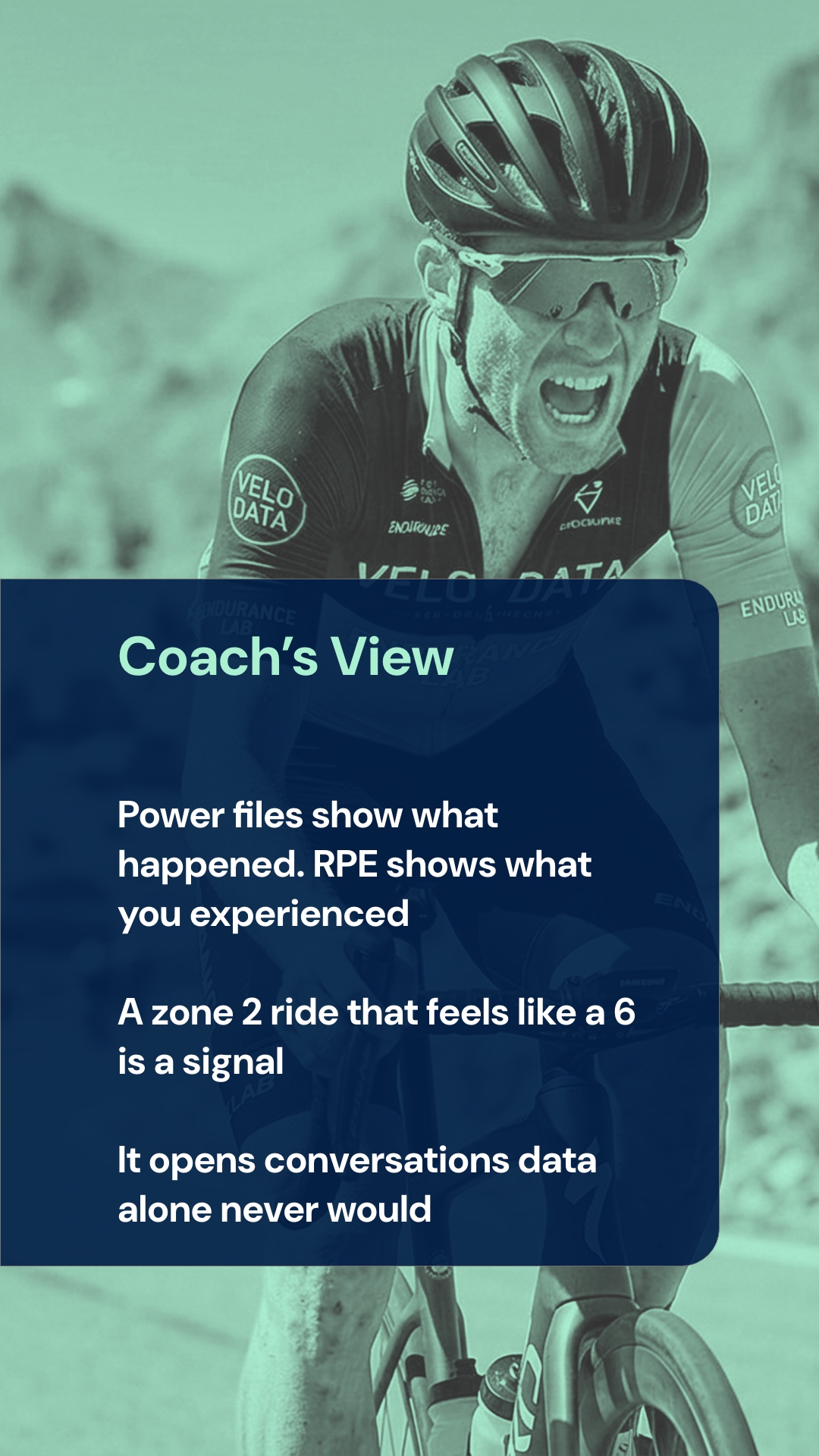
Power files and heart rate data tell a coach what happened during a session. RPE tells them what the athlete experienced. Those two things are often quite different, and the gap between them is where a lot of the most useful coaching information lives.
When an athlete reports that a zone 2 ride felt like a 6, that's a signal. It might mean fatigue from the previous week hasn't cleared. It might mean life stress is bleeding into training. It might mean the zones need revisiting. A number on a screen won't surface any of that. An honest RPE score often will.
The same applies in the other direction. An athlete who records a strong power output but rates the effort at a 9 may be closer to their limit than the data suggests. That's not a rider to push harder the following week. Catching that early can be the difference between a training block that builds fitness and one that tips into overreaching.
RPE is also particularly valuable during fitness testing. When an athlete knows they're riding to a target wattage or heart rate, they unconsciously pace to that number rather than their actual capacity. That ceiling limits the test. RPE-led testing removes it, and often produces truer maximal efforts as a result.
For older athletes, heart rate becomes progressively less reliable as a training guide. Maximum heart rate declines with age, and common medications such as beta blockers directly suppress cardiac response, making HR zones inaccurate or meaningless. RPE sidesteps all of that. It doesn't care what your maximum heart rate is supposed to be. It measures how hard the effort actually feels, which remains a valid and useful signal at any age.
It also builds a common language between coach and athlete. Rather than spending time decoding data, we can have a direct conversation about how training is actually going. Over time, tracking RPE alongside objective metrics gives a much clearer picture of how an athlete responds to load, where they struggle, and when they're ready to be pushed. It's one of the simplest and most revealing questions a coach can ask: how hard did that actually feel?
When to use it
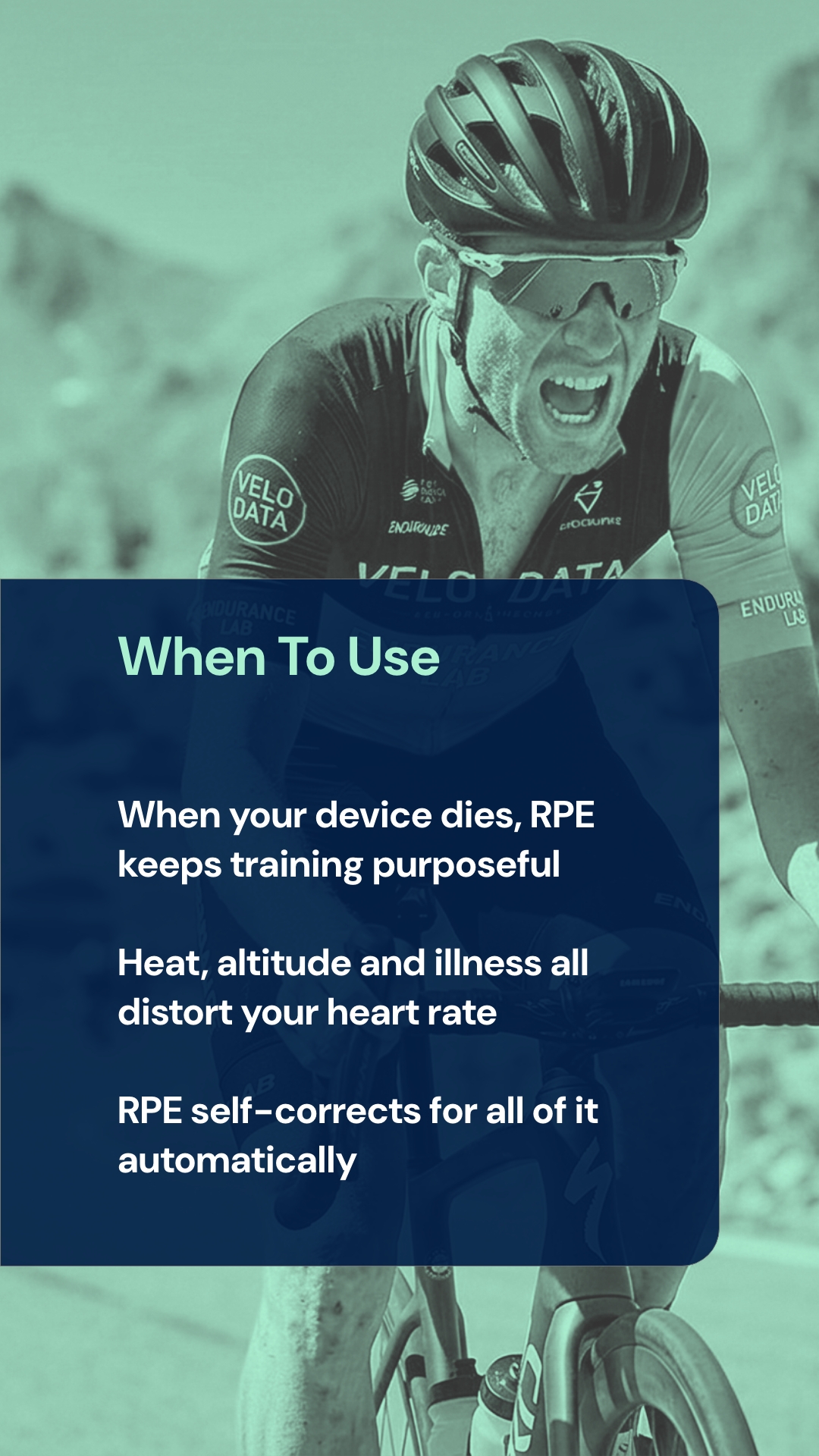
When your data disappears. Your computer dies, your power meter drops signal, or you simply don't have the equipment. RPE means you can still train with intent.
When data is misleading. Heart rate drifts upward in hot or humid conditions independently of actual effort, and responds slowly during short intervals. Using RPE alongside it helps you interpret what you're seeing rather than reacting to a lagging or inflated number. The same applies at altitude, where HR spikes disproportionately in ways that make zone-based training unreliable. RPE self-corrects for all of it automatically.
When you're returning from illness. Prescribed power and heart rate targets predate whatever you've just been through. RPE is a safer guide during the rebuilding phase, letting your body dictate the pace rather than a number set when you were fit and healthy.
When you're calibrating new training zones. An effort at threshold should feel like a 7 to 8: hard, sustainable for around an hour, but not comfortable. If it feels like a 5, your zones may be set too low. RPE is a useful sanity check that most riders skip.
During long events, and especially on hilly courses. One of the most common ways ultra rides unravel is through terrain-driven pacing. A climb appears, the rider responds to it, and without realising they've pushed well above threshold for two or three minutes. Do that repeatedly across a long day and the cumulative cost is significant. RPE helps because it anchors effort to how you feel rather than what the road is doing. The goal is to ride the pace, not the terrain. A climb should feel the same as the flat that preceded it. If it doesn't, you're going too hard.
Getting better at it
RPE is a skill, and most riders aren't naturally good at it. The tendency is to underestimate effort early in a ride and overestimate it when tired. Both improve with deliberate practice.
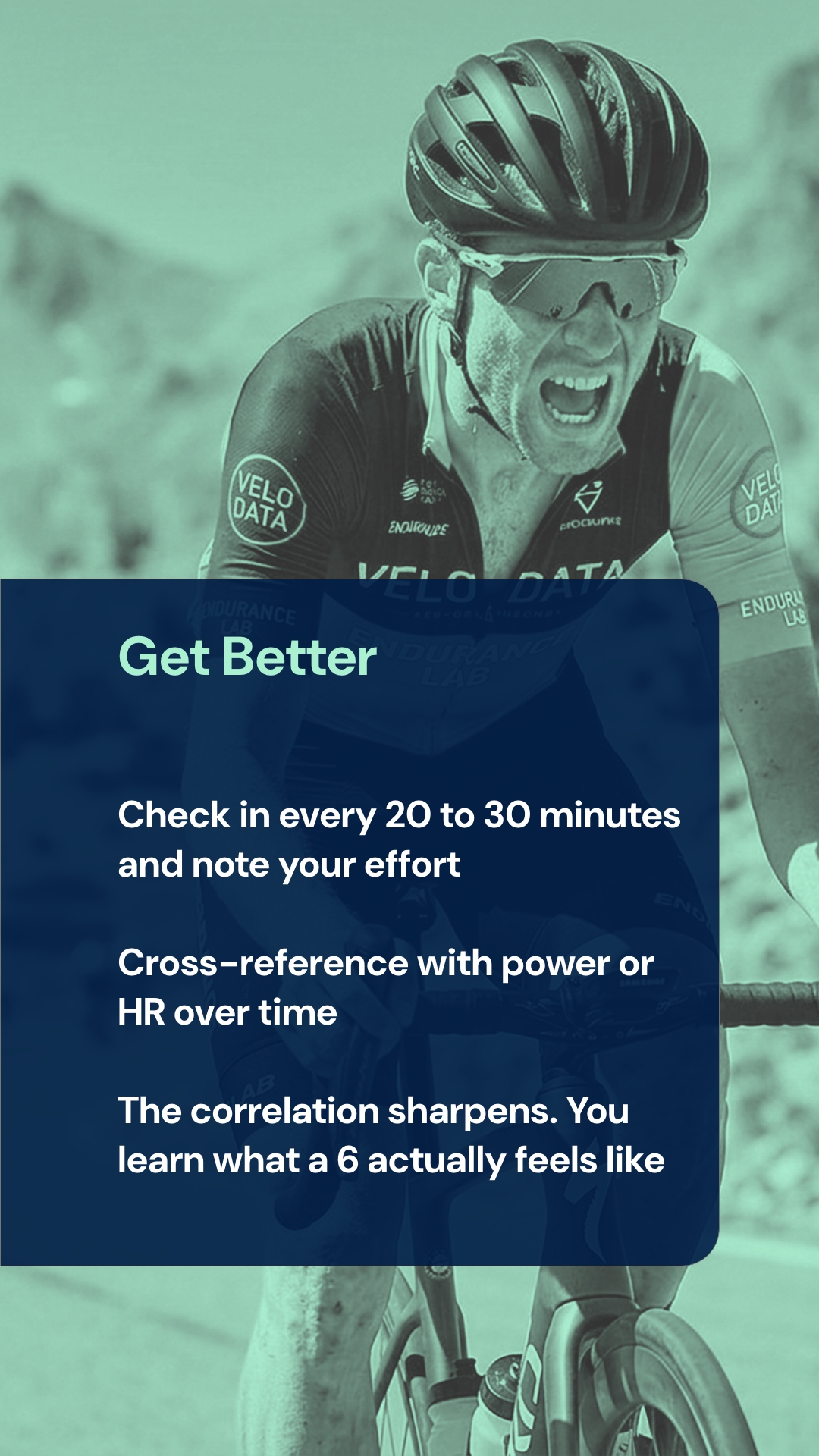
The simplest approach: check in regularly. Every 20 to 30 minutes, note your RPE and cross-reference it with your power or heart rate. Over time the correlation sharpens. You start to recognise what a 6 feels like in your chest, your legs, your breathing. That embodied knowledge carries across different bikes, different conditions, and different points in the season in a way that a number on a screen never quite does.
If you follow structured training plans, RPE descriptors are usually included alongside power and heart rate targets. Don't skip them. An endurance ride at zone 2 should feel easy, almost frustratingly slow. If it feels harder than that, RPE is often the first indicator that something is off, long before your metrics confirm it.
Used alongside your data, RPE makes you a more complete athlete. Used on its own when the data isn't available, it keeps your training purposeful. Either way, it's a tool worth developing. And unlike a power meter, you'll never leave it at home.
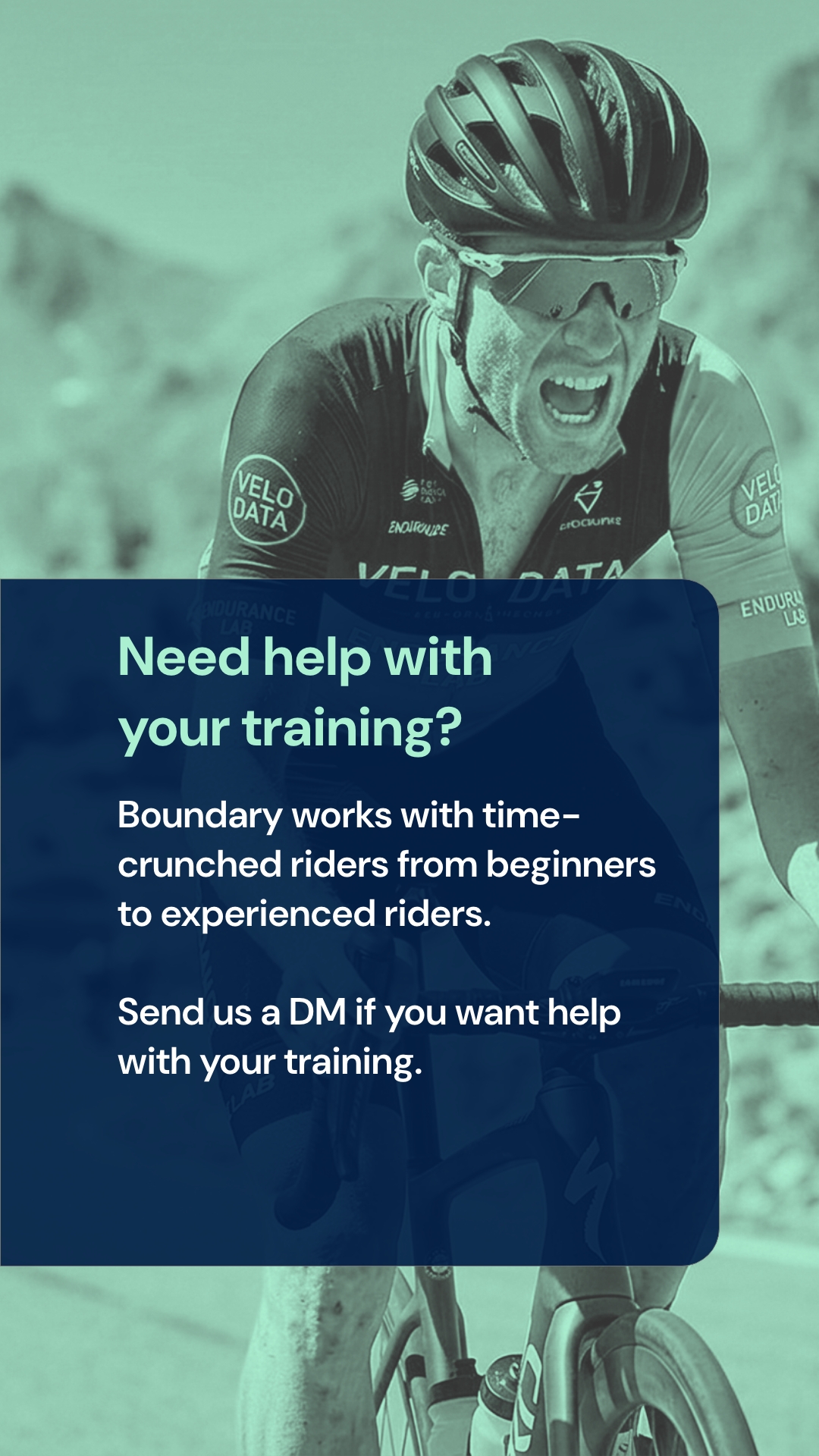
If any of this resonates, and you're wondering whether your training is as well-structured as it could be, it might be worth having a conversation. Understanding RPE is one piece of a much larger picture, and getting that picture right is exactly what coaching is for. Get in touch and we can talk through where you are and what you're trying to achieve.
References
- Borg GA. Psychophysical bases of perceived exertion. Medicine and Science in Sports and Exercise. 1982;14(5):377-381. https://pubmed.ncbi.nlm.nih.gov/7154893/
- Millet GP, Vleck VE, Bentley DJ. Ratings of perceived exertion during cycling exercises at constant power output. European Journal of Applied Physiology. 1998. https://pubmed.ncbi.nlm.nih.gov/9802254/
- Soriano-Maldonado A, Romero L, Femia P, Roero C, Ruiz J, Gutierrez A. A learning protocol improves the validity of the Borg 6-20 RPE scale during indoor cycling. Scandinavian Journal of Medicine and Science in Sports. 2014. https://pubmed.ncbi.nlm.nih.gov/24165960/
- Tucker R. The anticipatory regulation of performance: the physiological basis for pacing strategies and the development of a perception-based model for exercise performance. British Journal of Sports Medicine. 2009;43:392-400. https://pubmed.ncbi.nlm.nih.gov/19224911/