Most riders preparing for a big event spend their final weeks worrying about fitness. Have I done enough long rides? Is my FTP where it needs to be? Those are all reasonable questions, but they're not usually what decides the outcome. By the time you're standing at the start line of an event like Chase the Sun or London to Edinburgh to London, the physical work is largely done. What determines whether you finish, and what kind of day you have, is almost entirely in your head.
I've completed numerous ultra-distance events where I've ridden through nights, navigated in the dark on roads I didn't know, and made decisions about food and sleep at 3am that I'd never make in daylight. I've also coached riders through their first 200-mile day and their first multi-day event and there is a consistent pattern: the riders who struggle most are rarely the least fit. They're the ones who weren't prepared for what the mind does when the body gets tired.
This article goes deeper than the mental training basics I've written about elsewhere. If you're preparing for a serious ultra-distance event, whether that's a one-day 200-miler or something spanning several days and multiple nights, here's what the research actually says and what I've found to be true on the road.
One important caveat before we get into the detail. The strategies in this article are grounded in research and in my own experience of 15+ events, but psychological responses to ultra distance events are highly individual. What settles one rider can unsettle another. A mantra that carries one person through mile 140 will feel hollow or irritating to someone else. Adversity visualisation helps most riders prepare but for some it amplifies anxiety rather than reducing it. The practical implication is that none of this should just be accepted at face value without testing it in training first. Use your long rides in the weeks before your event to find out what works for you, not to confirm what the research says should work.
Ultra distance is a different psychological challenge
There's a temptation to think that ultra-distance cycling is just endurance cycling with more miles. The duration difference is real, but what changes most is what the mind is asked to do. A four-hour ride asks you to endure and keep going. A fourteen-hour day or a four-day event asks you to make decisions, manage sleep, navigate under fatigue, and sustain motivation across a timeframe that no amount of weekend riding truly prepares you for.
Research by Meckfessel and Ross-Stewart at Southern Illinois University Edwardsville compared the psychological characteristics of ultra-endurance athletes with standard endurance athletes and found that the clearest differentiator wasn't self-confidence or mood. It was motivation, specifically drive and persistence. Drive is the internal push that gets you moving toward a difficult goal in the first place. Persistence is what keeps you going when the goal stops feeling worth it. Ultra athletes scored significantly higher on both. What's interesting about that finding from a coaching perspective is that neither is a fixed personality trait. They respond to preparation, to experience, and to the frameworks you put in place before an event starts.
The other thing that changes at ultra distance is the cognitive load. A standard sportive or even a century ride doesn't ask much of your brain beyond turning the pedals, but a 600-kilometre unsupported event asks you to navigate, make sleep and nutrition decisions, manage mechanical problems, and regulate your emotions across multiple days, all while getting progressively more tired. That cognitive demand builds on itself in ways that catch riders off guard. Research by Marcora and colleagues, published in the European Journal of Applied Physiology, demonstrated that mental fatigue induced by prior cognitive work measurably reduced subsequent cycling performance, with no change in physiological markers such as heart rate or oxygen uptake. The only factor linked to the performance decline was a higher rating of perceived effort (RPE). Your brain and your legs are drawing from the same well, which means protecting your mental energy on a long event isn't a soft skill. It's a performance strategy.
Attentional focus: knowing where to put your mind
When sports psychologists talk about where athletes direct their attention during effort, they divide it into two broad strategies.
Associative strategies mean focusing inward on what your body is doing: monitoring your breathing, checking in on your cadence, noticing how your legs feel, making small real-time adjustments to effort or position. It's deliberate, present, and physically connected. If you've ever spent a climb consciously managing your breath and telling yourself to back off slightly because your heart rate is creeping, that's association.
Dissociative strategies mean directing attention away from physical sensation entirely. This could be music, podcasts, conversation, watching the landscape, letting your mind drift to something completely unrelated to the effort. The goal is to reduce the brain's processing of discomfort signals rather than monitor them. If you've ever arrived at the top of a climb and realised you barely noticed it because you were absorbed in a podcast, that's dissociation.
Most riders use both without labelling them, and that instinct is largely correct. The question is whether you're switching between them deliberately or just drifting, and whether you're using the right one at the right moment.
Earlier research suggested that association produced better performance outcomes while dissociation was primarily a coping mechanism for managing perceived effort. More recent thinking, particularly from studies of ultra distance events, challenges that view. Many successful ultra finishers rely predominantly on dissociative strategies not as a fallback when things get hard, but as their primary mode for managing effort across very long durations. Trying to stay fully associated for fourteen hours isn't just unnecessary; for most riders it's cognitively exhausting in a way that compounds the mental fatigue problem discussed in the next section. The honest summary is that neither strategy is universally superior, the research base is stronger for running than for cycling specifically, and individual responses vary considerably. What matters is being able to use both, and knowing which one serves you at a given point in the ride.
In practice, association tends to be more useful when precision matters: on a long climb where you need to manage your effort carefully, in the early miles when pacing discipline is important, or when you need to make a real-time decision about nutrition or position. Dissociation tends to serve better when you simply need to keep moving: flat sections in the middle miles, the grinding hours between feed stops, any point where monitoring your body is telling you things you already know and can't act on usefully.
A useful way to make the switch deliberately is to use a physical anchor: take a drink, adjust your position, roll your shoulders, and use that moment as a conscious cue to redirect your attention. It sounds simple because it is, but having a deliberate trigger makes the switch easier to execute when your thinking isn't at its sharpest.
More recent thinking in sports psychology has moved beyond this two-strategy model towards something closer to mindfulness, which in this context means moment-by-moment awareness of where your attention actually is, rather than where you've decided it should be. On the Trans Atlantic Way I found myself spending an entire hour mentally rehearsing conversations that had nothing to do with the road in front of me, burning cognitive energy on nothing useful, and the moment I noticed that and came back to the ride, my effort settled and my mood lifted almost immediately.
To practise this before your event, pick a thirty-minute block on your next long ride and split it deliberately: fifteen minutes tuned in, fifteen minutes tuned out, with a physical anchor to mark the switch. Do it a few times across your remaining training rides and it becomes second nature. By the time you're deep into your event, switching won't require a conscious decision. It'll just happen.
Self-talk: why it works and how to train it
Every rider has an internal voice. On a good day it's quiet or encouraging. On a bad day at mile 120 it can be relentless, and what it says matters more than most people realise.
Sports science distinguishes between two types of self-talk that are relevant here. Motivational self-talk is the kind that keeps you going when things get hard: reminders of why you signed up, affirmations that you can handle the current difficulty, or simply a short phrase that anchors you to the present. Instructional self-talk is more technical: cues about posture, cadence, breathing, or eating that redirect attention toward process rather than suffering. Both have solid research support, with a systematic review by Hatzigeorgiadis and colleagues identifying self-talk, alongside imagery and goal setting, as among the most effective psychological strategies for improving endurance performance. More recent work has shown that motivational self-talk can specifically mitigate the effects of mental fatigue, prolonging time to exhaustion in endurance tasks.
The important thing to understand is that self-talk is trainable. A mantra that works in an event doesn't come from nowhere; it works because you've used it enough times in training that it's already associated with continuing through discomfort. My own is "keep moving, sure and steady." It took several long training rides before it felt automatic rather than forced, but now when things get difficult it surfaces without any effort, and that's exactly the point. You don't want to be inventing coping strategies at mile 180.
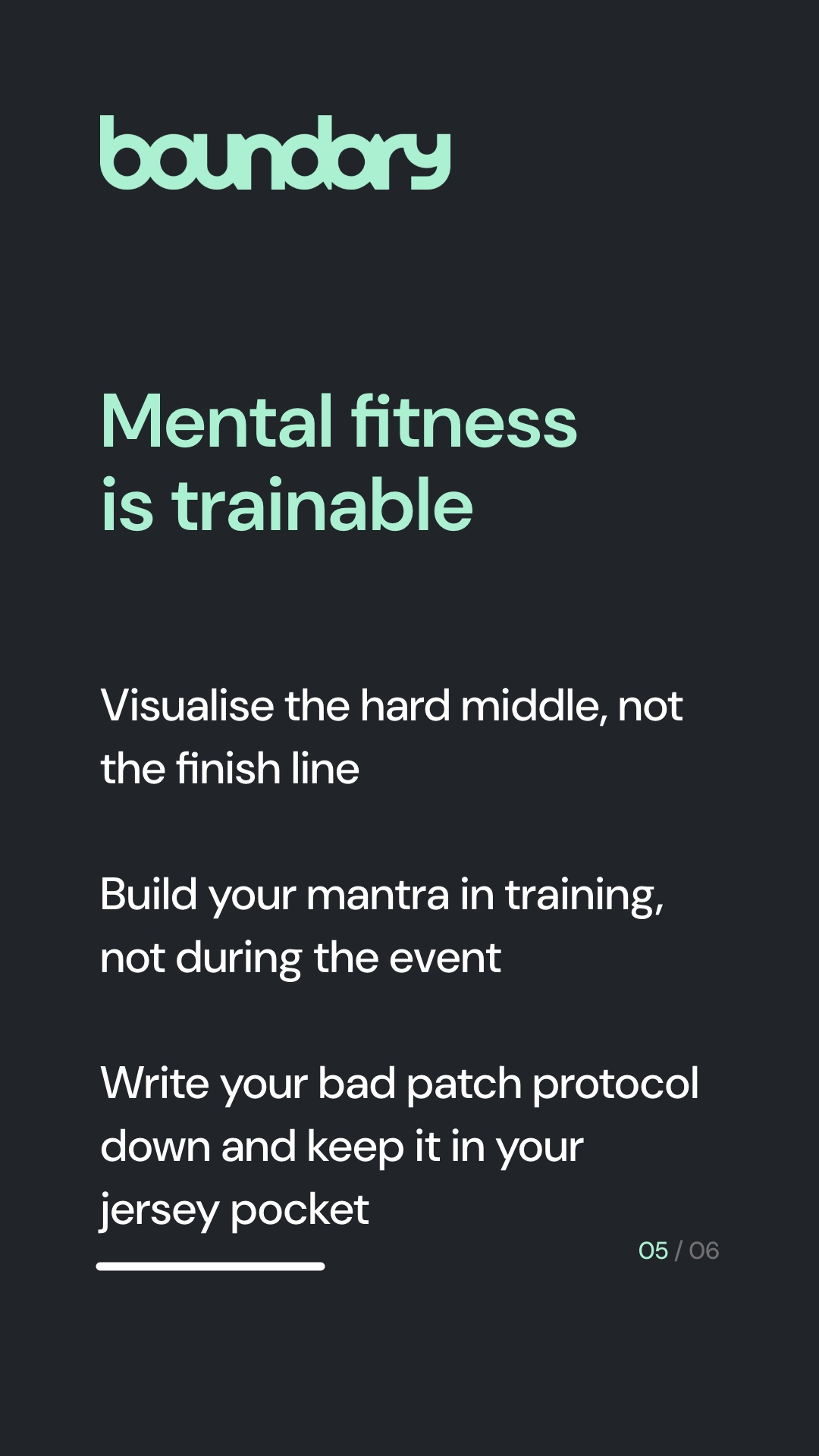
Choose one motivational phrase and one instructional cue before your event. Use them deliberately during the hardest parts of your training rides, not just when things are going well. Treat them like any other piece of kit: tested in training, trusted in the event.
Visualisation done properly
In sports psychology there are two types of imagery that matter most for ultra distance events. Mastery imagery involves picturing yourself in control and coping effectively in difficult situations. Coping imagery goes a step further, rehearsing specific adversity and working through it successfully. Research published in Frontiers in Psychology found that mastery imagery ability was directly associated with better performance under psychological stress and with more positive responses to anxiety, suggesting that the ability to picture yourself handling difficulty, rather than avoiding it, is a genuinely trainable performance skill.
So rather than picturing the finish, picture the hard middle. Picture yourself at mile 130, legs heavy, mood low, starting to wonder whether the whole thing was a good idea. Picture what you do next: you eat something, you drop the pace slightly, you put something on to listen to, you ride to the next village rather than the finish. Picture a mechanical at an inconvenient time. Picture riding into a headwind for three hours. Picture the point, and it will come, when your mind starts searching for an acceptable reason to stop, and picture yourself recognising that for what it is and riding through it anyway.
In the weeks before your event, set aside ten minutes each day for this kind of rehearsal. Find somewhere quiet, close your eyes, and pick one specific scenario you know is likely to be difficult. Run through it slowly and in real time, not as a quick mental skim but as a genuinely immersive experience: what does it feel like physically, what thoughts surface, what do you do next. One scenario done slowly and vividly is worth far more than rushing through three. The goal isn't to frighten yourself; it's to make the hard parts feel familiar rather than catastrophic when they arrive. The brain doesn't distinguish especially well between a vividly imagined experience and a real one, which is exactly why this works.
Mental fatigue is a physical limiter
A lot of riders skip this section but it's probably the one that would make the biggest difference to how they approach a long event.
Sustained cognitive effort, the kind generated by hours of navigation, decision-making, risk assessment, and emotional regulation, measurably reduces physical endurance performance. The Marcora lab's foundational work showed that mentally fatigued cyclists reached exhaustion significantly sooner than rested ones at the same physical starting point, with the mechanism running through perception of effort rather than any change in physiology. When your prefrontal cortex is already taxed, everything feels harder than it actually is, and you slow down or stop sooner as a result.
For ultra-distance riders this has direct consequences that most training programmes never address. Every hour you spend navigating unfamiliar roads, every decision about whether to push on or stop for food, every moment of frustration at a mechanical or a wrong turn, every conversation you force yourself through when you'd rather be quiet, all of it draws from the same cognitive reserve that regulates your physical effort. By hour sixteen it's not just your legs that are tired.
I noticed this acutely on the Trans Pyrenees. There was a section through the mountains where the roads are poorly signed and the GPS track didn't always match the surface I was riding on, and I spent several hours in a state of low-level cognitive stress, constantly checking, second-guessing my route choices, recalculating. By the time the terrain eased I was physically depleted in a way that didn't match my effort level. I hadn't gone harder. I'd just been thinking too hard for too long.
The practical implication is to treat cognitive load as something to manage actively, not just accept. Familiarise yourself with the route in advance so navigation becomes automatic rather than effortful. Keep decision-making simple and pre-made where you can: when you'll eat, how long your stops will be, and the pace you are supposed to ride. Every decision you've already made before the ride is one you don't have to make in the field with a tired brain.
The multi-day event: sleep, cognition and day two
Everything in the previous sections applies to a one-day ultra. On a multi-day event, all of it intensifies, and a new set of challenges arrives that has no equivalent in a single long day.
The most significant of these is sleep deprivation, and it's worth being clear about what actually happens to your brain when you've had insufficient sleep across consecutive days of riding. Research published in PLOS One, using data from the world-record breaking Suffolk Back Yard Ultra, found measurable impairment in both reaction time and executive function following sleep-deprived ultra events, with pre-race sleep quality in the week before the event shown to mitigate these effects. Executive function is the cognitive system responsible for planning, decision-making, and impulse control, and its degradation under sleep deprivation is well established. Research examining Race Across America competitors found that riders managed less than one hour of continuous sleep per sleep episode, with significantly disrupted sleep efficiency. At that level of deprivation, your ability to make rational decisions about your own welfare is genuinely compromised, and you often can't tell that it is.
A pattern I see in multi-day events, and have experienced myself, is what I'd describe as day two dread. You've completed the first day full of energy, enthusiasm and adrenalin, you've slept briefly and poorly, and when you start riding again your body hasn't recovered but your mind now knows exactly how much lies ahead. The combination of residual neuromuscular fatigue, poor sleep, and full awareness of the remaining distance can feel paralysing in a way that day one never does. The important thing to understand is that this is a predictable psychological pattern, not evidence that something has gone wrong or that you've made a mistake entering the event. Almost every rider goes through it, and naming it when it arrives takes away a significant part of its power.
Sleep deprivation also generates something that catches riders off guard on their first multi-day event: irrational thinking that feels entirely rational at the time. You become convinced you've taken a wrong turn when you haven't. You misread distances. You start interpreting neutral events, such as a twinge in a knee or a change in the weather, as evidence that the ride is unravelling. The rule I give all my riders for multi-day events is straightforward: never make a significant decision, and that includes any thought of scratching, before you've eaten a proper meal and had at least a short sleep. A scratch decision made at 3am after twelve hours without food is not a real decision. Eat, sleep, then decide. The number of times a rider wakes up after two or three hours and feels completely able to continue would surprise you.
Pre-event sleep banking is worth doing, though with realistic expectations about what it can and can't deliver. A 2026 narrative review found that preemptive sleep extension does produce measurable benefits in alertness and vigilance during subsequent sleep deprivation, suggesting it's more than just a placebo. The picture is less clear for higher-order cognitive functions like decision-making and executive control, which are arguably the ones that matter most on a multi-day event. The honest position is that banking sleep in the week before your event is low-cost and likely helpful, but it won't protect your judgement at 3am the way a proper sleep stop will. Use it as a supplement to a sensible sleep strategy during the event, not as a substitute for one.
When it's all gone wrong: the in-event crisis toolkit
Every rider hits a point where the wheels come off mentally. It doesn't matter how well prepared you are or how many events you've done. The question isn't whether it will happen; it's whether you have anything in place when it does.
What follows are the mental challenges I encounter most often, both in my own riding and in the riders I coach, along with what actually helps when you're in the middle of them. At the end of this section is a simple bad patch protocol: write it down and keep it in your jersey pocket before you start.
"Why did I sign up to this?"
This one arrives without warning, usually somewhere between a third and halfway through an event, and it tends to feel more rational than it is. Your brain, under sustained physical stress, starts running a cost-benefit analysis that it is entirely unqualified to run at that moment. The thought feels logical, but it's a stress response rather than reasoning.
The antidote is to reconnect with your original motivation before the event, not during it. Write down specifically why you signed up, not "because I wanted a challenge" but the actual reason: the person you're riding for, the version of yourself you're trying to prove something to, the event you've been thinking about for three years. Keep it somewhere accessible. When the question surfaces on the road, you already have the answer.
Planning your scratch
This is a more insidious version of the same problem. Rather than questioning the ride directly, your mind starts identifying acceptable reasons to scratch. You find yourself thinking that if you're still feeling this bad at the next checkpoint, you'll stop. Or that a knee twinge you've ridden through for fifty miles is probably serious enough to justify calling it. The thinking feels responsible, but keeping an exit door open in your mind actually increases suffering, because part of your mental energy is continuously devoted to monitoring the escape route rather than riding the bike. The more useful frame is to take scratching off the table entirely as an option until you've eaten, rested, and given yourself a genuine recovery window. Ride to the next stop, eat a proper meal, sleep if you're on a multi-day event, sleep even on a single day event for 20 minutes and then reassess with a brain that's actually capable of the decision.
Low mood that seems to come from nowhere
This one has a physiological explanation that riders find genuinely useful to know. When your energy availability drops during prolonged exercise, your body triggers a stress hormone response, releasing cortisol and adrenaline, that affects mood, emotional stability, and cognitive clarity in ways that go well beyond simple tiredness. The result is that relatively minor difficulties start to feel disproportionately significant, your mood deteriorates, and the whole enterprise can start to feel pointless in a way that has nothing to do with whether you should actually stop. It's a well-established relationship between fuelling state and emotional experience, and it's worth knowing about because it reframes what's happening.
The mood crash is a nutrition alert, not a psychological failure. When it arrives, the response isn't to push harder or think positively; it's to eat something, wait twenty minutes, and notice how different things look once your body has something to draw on. I've seen this pattern dozens of times in coached riders and experienced it myself more times than I can count. The world genuinely looks different after a proper feed stop.
"I'm going slower and I can't push harder"
After sixteen hours on a bike, your power output will be lower than it was at hour four. That's not a sign that something has gone wrong; it's basic physiology. Neuromuscular fatigue, glycogen depletion, accumulated thermal stress, and cardiovascular drift all reduce what your body can produce at a given level of perceived effort. A rider who doesn't know this will interpret the slowdown as failure and either push harder, which accelerates deterioration, or lose motivation because they feel like they're falling apart.
The solution is to stop measuring output and ride to Rate of Perceived Exertion, or RPE instead. RPE is your friend in the later stages of a long event in a way that power and pace simply aren't. If you're riding at the same perceived effort as you were in the morning, you're executing well, regardless of what the numbers say. Cover the power field on your computer if you have to.
Time stretching in the final miles
Under fatigue, your brain processes more signals from the body, and the result is that each minute feels longer than it should. The final fifty miles of a long event can feel like more riding than the previous hundred, even when they objectively aren't. Knowing this helps, but the more practical response is to stop measuring distance entirely. I never look at the distance covered on my computer during an event. The finish will arrive when it arrives, and looking at numbers in between serves no purpose other than making the road feel longer. Ride to landmarks. Ride to the next village, the next feed stop, the top of the next climb.
Going out too hard
One of the most costly mistakes in ultra distance events happens in the first two hours, not the last two. You have fresh legs, the pace feels easy, there are other riders nearby and you are full of adrenaline. The psychological pull to ride with faster riders, or simply to take advantage of how good you feel, is strong and it feels entirely rational in the moment. It isn't.
The physiological cost of going out too hard in an ultra compounds across hours rather than minutes. A rider who spends thirty percent above their intended effort for the first three hours doesn't just feel it at hour four; they're managing the consequences at hour ten, hour fourteen, and beyond. The mental challenge isn't knowing this intellectually, which most riders do, but overriding the feeling of ease when it conflicts with the plan.
The strategies that help are simple but need to be decided before you start rather than negotiated in the moment. Set your effort ceiling for the first quarter of the ride and treat exceeding it as a mistake regardless of how good you feel. If other riders are pulling away, let them go. In a one-day ultra you'll often see them again later, and in a multi-day event the early pace setters are frequently the ones making difficult decisions about scratching by day two. Ride your event, not theirs.
Riding into a headwind
This is where a lot of riders unravel, not because a headwind is physically insurmountable but because it feels like the event is working against them, and the frustration burns energy that the riding itself doesn't. The principle I use and teach is to ride the effort, not the terrain or the conditions. A headwind doesn't change your target effort level; it changes your speed. Accept that you'll be going slower and keep the effort where it should be. Chasing your normal pace into a headwind means overcooking it, which you'll pay for later in ways that are very difficult to recover from.
Riding in heat
Heat deserves its own section because its psychological effect is different from a headwind and catches riders out in a different way. A headwind slows you down visibly and immediately. Heat works more gradually and more insidiously. Research on cycling performance in hot conditions shows that thermal stress distorts perceived exertion, causing riders to produce meaningfully less power at the same effort level without always being aware that it's happening. The result is that a rider who is working hard in the heat can feel like they're underperforming without understanding why, which generates frustration and self-doubt that compounds the physical difficulty.
The mental adjustment required is the same principle as riding into a headwind: ride the effort, not the output. In heat, your target power or pace is simply lower than it would be in cooler conditions and that's not a failure of fitness or preparation. It's physics and physiology doing exactly what they should. A rider who accepts this in advance, who has mentally agreed with themselves before the start that a hot day means lower numbers at the same effort, handles it significantly better than one who is trying to reconcile the gap between expectation and reality in real time at mile 80.
Practically, heat also accelerates the cognitive fatigue discussed earlier. The additional physiological burden of thermoregulation competes with the cognitive and physical demands of the ride in ways that compound over hours. Keep your stops in the shade where possible, use cool water on your neck and wrists rather than just drinking it, and treat any opportunity to reduce your core temperature as a performance decision rather than a comfort choice. A cooler brain makes better decisions.
The consequences of getting this wrong can be severe, and I know that from direct experience. On day one of the Trans Atlantic Way it was a hot day and I got my pacing wrong early, riding too hard for the conditions across the first 150 miles. By the time I reached a petrol station I was in serious difficulty. I tried to eat and immediately vomited. I was shivering despite the heat. I found the nearest hotel to sleep and lay there thinking seriously about scratching.
What stopped me wasn't resolve or a motivational speech I gave myself. It was simply that I couldn't leave. I had to wait for breakfast to open the next morning, which meant more time to recover than I would have allowed myself if I'd had the option to make a decision and act on it immediately. When I woke up my body had settled enough that I could eat something, not much, but enough. I left on day two at a pace that reflected what my body could actually do that day rather than what I'd planned.
I finished the event in fifth place. Once I found the right pace, I rode three consecutive days of over 200 miles each. The decision I nearly made in that hotel room, on an empty stomach, shivering, at the end of one of the worst days I've had on a bike, would have ended an event I was capable of finishing strongly. That's why I tell every rider I coach: never make a decision about scratching when you can't eat. The body that can't face food at midnight is not the body that will be making the decision at breakfast. Give it the time it needs and then decide.
The pain that finds you
One thing I always tell riders before a major event: the pain will find you. It might take fifty miles or it might take a hundred, but at some point something will hurt, and your relationship with that discomfort will shape the rest of your ride more than almost anything else. This isn't pessimism. It's preparation. Riders who know discomfort is coming, who've accepted it as a normal and expected part of the experience rather than a signal that something is wrong, handle it significantly better than riders who are surprised by it. Expect it. Plan for it. And when it arrives, recognise it as the thing you already knew was coming.
One qualification worth making: dull, generalised discomfort is part of the deal. Sharp, sudden, or localised pain is a different conversation. If something feels wrong rather than just hard, stop to assess it. No finish line is worth an injury that outlasts the event.
Use the people who are with you, even when they aren't
One resource that riders frequently underestimate is the motivational effect of knowing other people are invested in their ride. Dot watching, the practice of followers tracking your progress in real time, has become a significant part of ultra distance culture, and for good reason. Research on social support in endurance sport consistently shows that perceived support from others, even when that support is remote rather than physical, has a measurable effect on persistence and pain tolerance. You don't need someone standing at the roadside to feel its benefit.
Before your event, tell people you're doing it. Not for validation but because creating a network of people who are aware of your progress generates a form of accountability and connection that becomes genuinely useful when things get hard. A message from someone tracking your dot at 2am, or simply knowing your family can see you moving, can shift your mental state in ways that are disproportionate to the effort required to set it up.
On supported events the dynamic is different but the principle is the same. A crew who knows your bad patch protocol (see below) is worth more than almost any other preparation. Brief them before the event: a short-tempered rider at mile 150 doesn't need a pep talk. They need food and fifteen minutes of quiet.
If you're riding unsupported and solo, build your own version of social connection into the event. Check in with someone at agreed points. Know that people are watching. It costs nothing and on a long dark night it can matter more than you'd expect.
The bad patch protocol
When everything has gone wrong at once, you don't want to be making decisions from scratch. Write this down and keep it somewhere accessible during your event.
- Eat something immediately, even if you don't feel like it.
- Reduce your effort slightly and hold that for ten to fifteen minutes.
- Switch your attentional strategy: if you've been tuned in, tune out. Put something on to listen to, let your mind go somewhere else.
- Set a single micro goal, usually the next landmark or feed stop, and ride only to that.
- When you get there, reassess.
In the majority of cases the bad patch will have passed or eased enough to continue. Most bad patches are temporary, and the worst decision you can make is to act on them immediately.
Building mental fitness before the event
Mental preparation isn't something you do the night before. Like physical fitness, it responds to consistent work over time, and the good news is that it doesn't require much additional time in your week. Most of it can be built into training you're already doing.
Before getting into the four-week plan, a note for riders who are closer to their event than that. If you have two weeks, focus on sections three and four of the plan below and spend whatever time you have on visualisation and self-talk practice. If you have one week, skip the structured practice entirely and focus on three things: write down your why, write down your bad patch protocol, and do one long ride without looking at your distance or speed. If you're in the final few days, the preparation window has closed and that's fine. Read the crisis toolkit section, write the protocol on a piece of card and put it in your jersey pocket, and trust the fitness you've built. Mental preparation done late is still better than none, but the single most useful thing you can do the night before an event is get a good night's sleep and arrive at the start line having already decided that whatever happens on the road, you'll eat before you make any decisions.
Here's how I structure the mental preparation block with coached riders in the four weeks before a major event.
Four weeks out: start your visualisation practice
Begin with ten minutes each day of deliberate mental rehearsal. Start with the hard middle, not the finish line. Pick a specific point in your event where you know things are likely to get difficult, and run through it in detail. Sit somewhere quiet, close your eyes, and construct the scenario as vividly as you can. What does it feel like physically? What thoughts are likely to surface? What do you do next? One scenario done slowly and vividly is worth far more than rushing through three. The goal is to make the scenario familiar enough that when it arrives for real it doesn't feel like a crisis. Be specific: "feeling tired at mile 150" is less useful than "riding into a headwind on the second day after a short sleep, legs heavy, mood low, still 80 miles from the finish."
Three weeks out: develop your self-talk toolkit
Choose one motivational phrase and one instructional cue. The motivational phrase is what you'll use when things get hard and you need a reason to keep going. The instructional cue is what you'll use when you need to redirect attention back to process. Write them down and start using them deliberately during the hardest parts of your training rides. The point is to build the association between the phrase and the act of continuing under discomfort, so that by the time the event arrives the connection is already wired in. It will feel slightly forced at first. Keep using it anyway.
Two weeks out: practise attentional switching
On your longer rides in this window, deliberately practise moving between associative and dissociative focus. Spend twenty minutes tuned in: monitoring your breathing, your cadence, the feeling in your legs. Then spend twenty minutes tuned out: music, a podcast, or simply letting your mind go somewhere unrelated to the effort. Practise using a physical anchor, taking a drink or adjusting your position, as the trigger for each switch. The goal isn't to find the one that works better; it's to become comfortable moving between them on demand.
Also in this window, do at least one long training ride without looking at your distance or speed. Cover the fields on your computer or set it to display only time. Practise riding to effort and to landmarks rather than to numbers. This is harder than it sounds if you're used to data, but it's a skill worth having when you're 160 miles in and the numbers aren't telling you anything useful.
One week out: consolidate and simplify
This isn't the time to add new strategies. Your preparation is done. Write down your bad patch protocol and keep it somewhere you can access during the event. If you're doing a multi-day event, extend your sleep this week wherever you can. The research suggests it won't fully offset the deprivation that comes later, but it raises the baseline.
Also worth doing before you start: write down the evidence for why you'll finish. Not optimism, evidence. The long rides you've completed, the difficult weather you've ridden through, the events you've already done, the early starts you've handled, the days when everything went wrong and you kept going anyway. When doubts surface during the event, and they will, you need something more persuasive than positive thinking. You need facts.
On the start line
By the time you're clipping in, the preparation is done and the only thing left is execution. Keep your mental model of the day simple: ride the effort, eat before you're hungry, drink before you're thirsty, stay in the current segment rather than thinking about the finish. The riders I've seen handle long events best are rarely the ones with the most elaborate strategy. They're the ones who stayed calm, kept moving, and didn't treat every difficult hour as evidence that the whole thing was falling apart.
The mind will test you. It tested me on every one of the events I've ridden. Prepare for that, and you'll be ready for it.
Summary: what to take with you
A long article deserves a short summary so here are the things that actually matter.
Before the event
- Write down why you signed up. Be specific. Keep it accessible during the ride.
- Choose one motivational mantra and one instructional cue. Practise them on hard training rides until they're automatic.
- Spend ten minutes a day visualising adversity, not the finish line. One scenario done slowly and vividly beats rushing through three.
- Pre-decide as much as possible: when you'll eat, how long stops will be, what your sleep trigger points are. Every decision made in advance is one fewer to make with a tired brain.
- Bank sleep in the week before the event, particularly if it involves multiple nights.
- Write down the evidence for why you'll finish. Facts, not optimism.
During the event
- In the first quarter of your event, ride below what feels comfortable. The cost of going out too hard compounds across hours, not minutes.
- Ride the effort, not the terrain or the conditions. A headwind or a hot day changes your speed, not your target effort level.
- On a hot day your power will be lower at the same effort. That's not underperformance. Accept it before the day starts, not during it.
- Never look at total distance covered. Ride to the next landmark, feed stop, or summit.
- If your mood crashes, eat something. Wait twenty minutes. It's almost always a fuelling problem, not a psychological one.
- After sixteen hours, your power will be lower. That's physiology, not failure. Switch to RPE and stop watching the numbers.
- Use the people tracking you. Dot watchers, crew, messages from home. Set it up before you start.
- The pain will find you. Expect it. When it arrives, recognise it as the thing you already knew was coming.
- Never make a significant decision, including any thought of scratching, before you've eaten and slept.
The bad patch protocol
- Eat something immediately.
- Reduce effort slightly for ten to fifteen minutes.
- Switch attentional strategy: if you've been tuned in, tune out.
- Set one micro goal: the next landmark or feed stop.
- Ride there. Reassess.
Closing
If this article has been useful and you want that kind of thinking applied to your specific event, your training, and how you're actually built as a rider, that's what working with me looks like. I coach a small number of ultra-distance riders each season with a focus on events that most coaching programmes don't cater for well. If you're interested in working together, or just want to talk through what you're preparing for then get in touch. For riders earlier in their ultra-distance preparation, the mental training basics article covers the foundations.
References
Meckfessel, M. and Ross-Stewart, L. (2019). Investigation into differences in psychological skills in ultra-endurance athletes and endurance athletes. ProQuest Dissertations Publishing, Southern Illinois University Edwardsville. Published summary available via The Sport Journal.
Marcora, S.M., Staiano, W. and Manning, V. (2009). Mental fatigue impairs physical performance in humans. European Journal of Applied Physiology, 106(6), pp.857–864.
Hatzigeorgiadis, A., Zourbanos, N., Galanis, E. and Theodorakis, Y. (2011). Self-talk and sports performance: a meta-analysis. Perspectives on Psychological Science, 6(4), pp.348–356.
Williams, S.E., Quinton, M.L., Veldhuijzen van Zanten, J.J.C.S., Davies, J., Möller, C., Trotman, G.P. and Ginty, A.T. (2021). Mastery imagery ability is associated with positive anxiety and performance during psychological stress. Frontiers in Psychology, 12, 568580.
Benchetrit, S., Badariotti, J.I., Corbett, J. and Costello, J.T. (2024). The effects of sleep deprivation and extreme exertion on cognitive performance at the world-record breaking Suffolk Back Yard Ultra-marathon. PLOS One, 19(3), e0299475.
Hulton, A.T., Lahart, I., Williams, K., Godfrey, R., Pedlar, C., Lane, A.M. and Whyte, G. (2010). The Race Across America: a cycle race or a sleep deprivation challenge? Conference abstract, Research Institute for Sport and Exercise Science, Liverpool John Moores University.
Readers, T., Lastella, M. and Roach, G.D. (2026). The role of sleep banking in reducing cognitive and motor impairments from subsequent sleep restriction: a narrative review. Clocks and Sleep, 8(1), 8.